POTS Diagnostic Criteria and Delays
Doctors often mistake POTS symptoms for anxiety, delaying diagnosis by years.
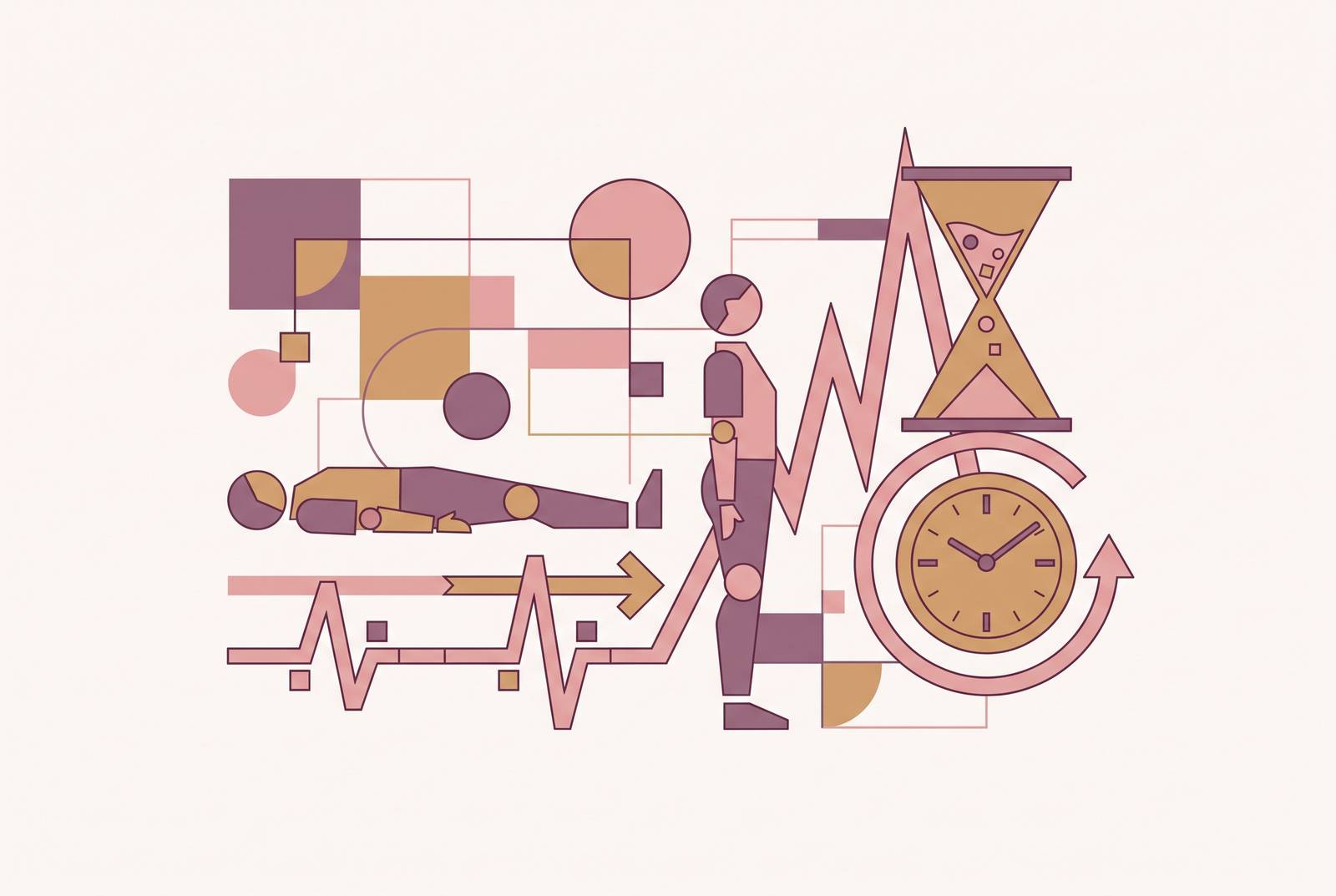
POTS, short for postural orthostatic tachycardia syndrome, is a disorder of the autonomic nervous system that makes the heart race when a person simply stands up. Instead of the heart rate settling into a normal upright rhythm, it spikes, and drags along lightheadedness, heart palpitations, brain fog, fatigue, and nausea. It's the body's standing response gone haywire, not a one-off dizzy spell.
The condition isn't rare, but it isn't exactly common knowledge either. Estimates put it at 0.2% to 1.0% of the US population, which works out to somewhere between 1 and 3 million people https://www.ohsu.edu/sites/default/files/2025-02/PCR25-Mon-4-Le-POTS.pdf. Among teenagers, the number climbs to roughly 1 in 100 https://thedysautonomiaproject.org/pots-and-depression-an-invisible-illness-affects-the-body-and-the-mind/.
Looking at who actually gets diagnosed reveals a pattern fast. So this is, overwhelmingly, a condition of young and youngish women, appearing right around the years when careers, relationships, and independence are supposed to be taking shape.
The measurable criteria that define a POTS diagnosis
POTS isn't some vague, unfalsifiable label doctors reach for when they've run out of ideas. It has a hard number attached to it. The core threshold is a heart rate increase of at least 30 beats per minute within 10 minutes of standing, for adults http://www.dysautonomiainternational.org/page.php?ID=30.
That heart rate spike has to occur without a specific companion: orthostatic hypotension. If blood pressure drops more than 20 mmHg systolic, or 10 mmHg diastolic, upon standing, that's a different diagnosis entirely, not POTS https://www.droracle.ai/articles/299151/. The two conditions can look similar from the patient's chair, dizzy and lightheaded either way, but the physiology diverges, and the distinction changes treatment.
Duration matters too. The symptoms of orthostatic intolerance need to be chronic, generally understood as present for at least 3 months https://www.droracle.ai/articles/299151/. And critically, other explanations have to be ruled out first: dehydration, anemia, an overactive thyroid, certain medications, long stretches of bed rest, anxiety disorders. POTS is, in a real sense, a diagnosis of exclusion layered on top of a diagnosis of inclusion. Both halves have to hold.
Two tests do the actual measuring. Where that equipment isn't available, the Active Stand Test serves as a bedside alternative, with measurements taken lying down, then again at 2, 5, and 10 minutes of standing. It's considered equally reliable, and any clinic with a blood pressure cuff and a stopwatch can run it. Beyond that, doctors typically order an ECG, a Holter monitor, thyroid panels, a full blood count, and a metabolic panel, mainly to rule out the mimics.
None of this is exotic. A standing heart rate measurement and some basic labs. Which makes what comes next harder to reconcile. The tilt table test, considered the gold standard, involves tilting the patient to 60–80 degrees while heart rate and blood pressure are monitored continuously.
The cost of patients' waiting times
Given how measurable POTS is, the waiting times on record are startling. The largest survey conducted so far, covering nearly 5,000 respondents, found a mean diagnostic delay of 4.9 years, with a median of 24 months, and patients saw an average of 7 different physicians before anyone landed on POTS https://www.cognitivefxusa.com/blog/how-is-pots-diagnosed-tests-timelines-and-what-to-expect. Seven doctors. That's seven appointments, seven co-pays, seven times explaining the same symptoms to someone new, before a name finally attached itself to the problem.
An earlier Dysautonomia International survey covering more than 700 patients found an average delay of 5 years and 11 months, with only 25% diagnosed within the first year of symptoms https://www.dysautonomiainternational.org/page.php?ID=184.
The Australian registry found 25.5% of its 500 patients waited more than ten years for a diagnosis https://pmc.ncbi.nlm.nih.gov/articles/PMC12318489/. The Australian POTS Registry shows the diagnostic delay picture is shifting: patients diagnosed between 2019 and 2024 faced a much shorter mean delay, while those diagnosed before 2019 waited an average of 12.9 years https://pmc.ncbi.nlm.nih.gov/articles/PMC12318489/. Awareness is climbing, in other words, even if it's climbing from a low floor.
The UK case series at Queen's Hospital Burton landed on a median time to diagnosis of just one year, though it still recorded outlier delays stretching up to 20 years https://pmc.ncbi.nlm.nih.gov/articles/PMC12726858/. Most of that cohort passed through cardiology first (65% got a cardiology referral), with smaller shares routed to neurology (13%) and internal medicine (10%) https://pubmed.ncbi.nlm.nih.gov/41446482/.
None of this delay is free. In the Australian registry, 22.0% of patients were unemployed, and 26.0% reported going out socially less than once a month https://pmc.ncbi.nlm.nih.gov/articles/PMC12318489/. Years spent undiagnosed are years spent losing jobs, losing plans, losing the ordinary rhythm of a life. They're years spent losing jobs, losing plans, losing the ordinary rhythm of a life.
Why symptoms point away from POTS and toward anxiety
The delay starts to make more sense, even if it doesn't get less frustrating. POTS produces a racing heart, tremor, sweating, dizziness, and chest discomfort, and that's also, almost word for word, the symptom list for a panic attack. The overlap is baked into the biology. It's baked into the biology.
Standing up triggers the sympathetic nervous system, the body's fight-or-flight circuitry, and in POTS that response fires far too hard. The physical sensations that follow are indistinguishable from anxiety, because they run through the same nerves and the same hormones. A patient's heart pounds and their hands shake for the exact reason a panicked person's would, except nothing frightening happened. They just stood up.
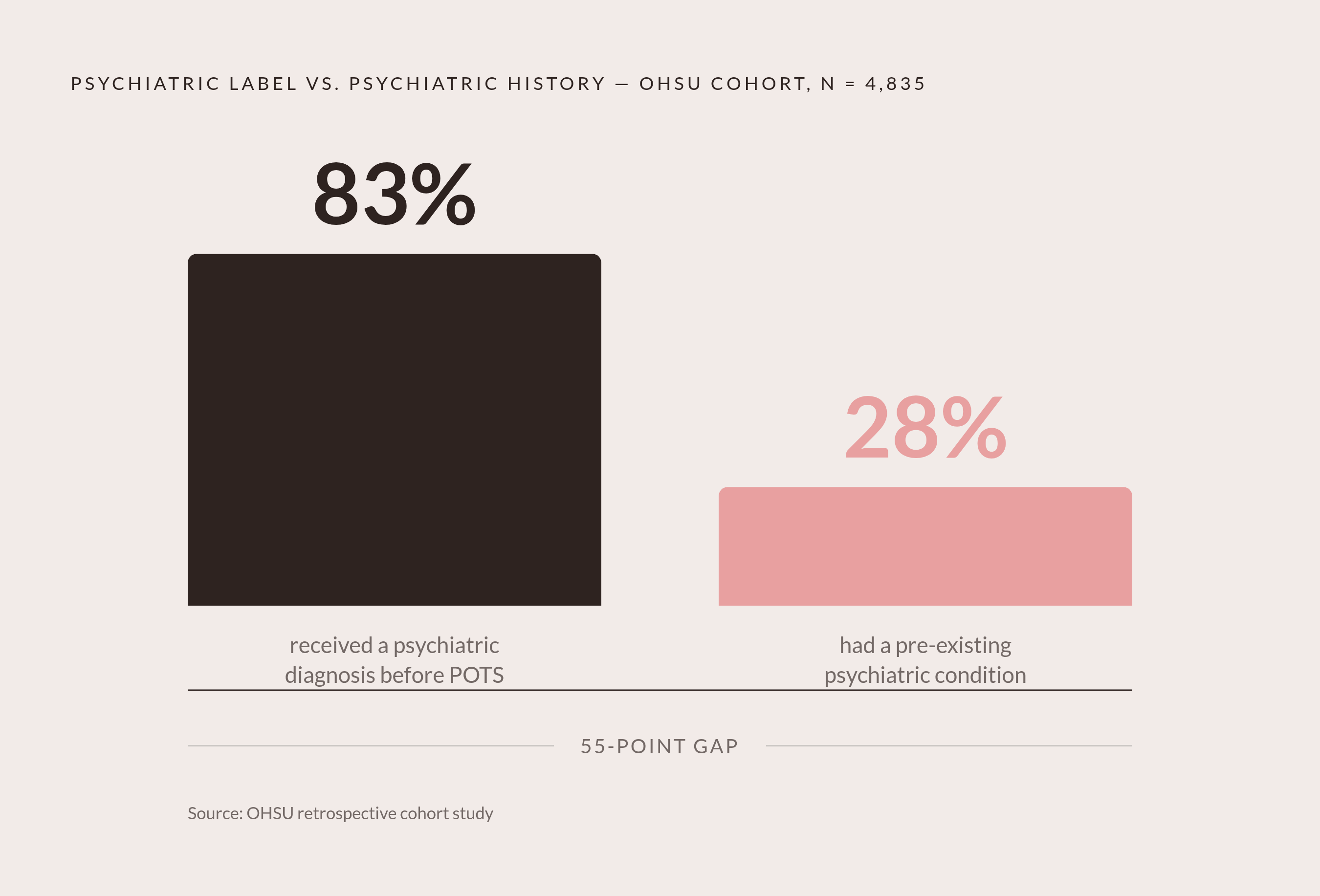
Doctors, working from the symptoms in front of them and not the underlying mechanism, land on the more familiar explanation. Across a large patient survey, 77% of POTS patients said a physician had told them their symptoms were psychological or psychiatric before POTS was ever mentioned https://pmc.ncbi.nlm.nih.gov/articles/PMC12534875/. Yet only 28% of those same patients had any pre-existing psychiatric condition on record at the time https://pmc.ncbi.nlm.nih.gov/articles/PMC12534875/. An OHSU presentation covering a cohort of 4,835 patients put the number even higher: 83% received a psychiatric diagnosis before POTS was identified. So the anxiety label wasn't catching something real in most cases. It was catching the wrong thing that happened to look identical.
The gender gap in diagnostic delay
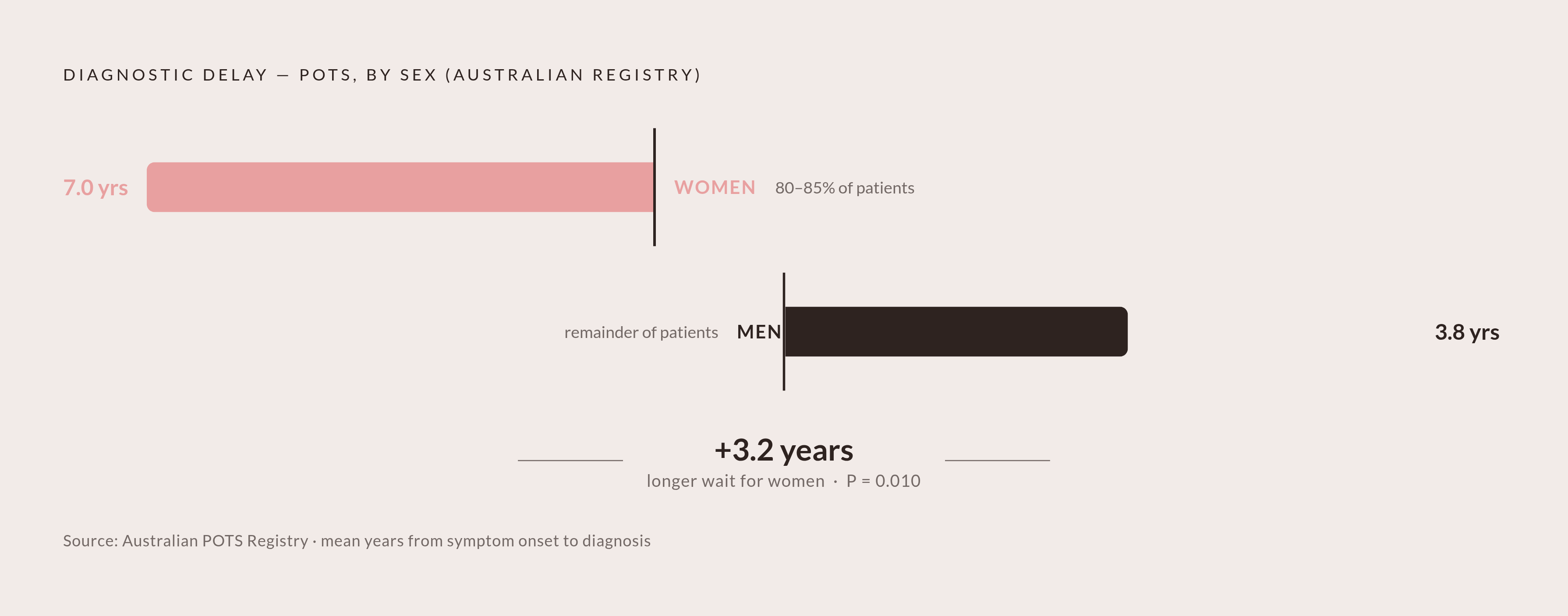
Sex doesn't just shape who gets POTS. It shapes how long they wait to hear the word out loud. Women wait an average of 5.0 years for diagnosis, against 3.0 years for men, and that gap holds up even after researchers control for other variables https://www.cognitivefxusa.com/blog/how-is-pots-diagnosed-tests-timelines-and-what-to-expect.
The Australian registry sharpens the picture further: a mean delay of 7.0 years for women (with a standard deviation of 8.6) compared with 3.8 years for men (standard deviation 5.4), a difference the study reports as statistically significant at P=0.010, wide enough to reorganize a decade https://pmc.ncbi.nlm.nih.gov/articles/PMC12318489/. It's an effect large enough to reorganize a decade, not a small one buried in noise. It's a gap wide enough to reorganize a decade.
Since somewhere between 80% and 85% of POTS patients are women, this is the central experience of the disease. It's the central experience of the disease. And clinicians themselves have acknowledged, openly, that dismissiveness and bias toward female patients contribute to the delay, which moves this out of the territory of inference and into the territory of documented, admitted fact within medicine's own ranks.
How Long COVID has changed the POTS landscape
COVID-19 didn't just add more POTS cases. It rewrote the scale of the problem almost overnight. A large interrupted time-series analysis found POTS incidence jumped from 1.42 cases per million person-years before the pandemic to 20.3 per million after it, with monthly incidence cases climbing from 4.21 to 22.66 https://pubmed.ncbi.nlm.nih.gov/39775762/.
A Swedish prospective study of a severely symptomatic long COVID cohort found 31% ended up diagnosed with POTS, a striking share given how broad and varied long COVID's symptom list otherwise runs. The Australian registry backs this up from a different angle: infection was the single most common trigger behind POTS onset, accounting for 39.4% of the 500-patient cohort, and within that, 32.6% traced specifically to SARS-CoV-2.
The medical field has responded with its own formal marker. The American Autonomic Society's criteria for post-COVID POTS layer the standard diagnostic thresholds on top of one added condition: orthostatic symptoms have to persist at least 12 weeks after the COVID-19 infection. So the old criteria still apply. COVID just gave doctors a specific timestamp to watch for.
Conditions that frequently travel alongside POTS
POTS rarely occurs by itself.
That trifecta framing deserves a dose of caution, though. A Mayo Clinic retrospective review looking at patients labeled with hEDS, POTS, and suspected MCAS found that 95% of the MCAS labels hadn't actually been verified through proper testing. The same review found psychiatric comorbidities, most often anxiety disorder and depression, in 66% of that group. None of that erases the real overlap between these conditions. But it's a signal that the "trifecta" gets applied more loosely in practice than the clean, three-part label suggests, and patients and clinicians alike should treat an MCAS label inside this cluster as a hypothesis worth confirming, not a settled fact.
Beyond that cluster, researchers have flagged small fiber neuropathy, autoimmune conditions like lupus and Sjögren's, and hormonal factors as contributors in some POTS subtypes. The disorder is a shared endpoint that several different underlying processes can arrive at. It's a shared endpoint that several different underlying processes can arrive at.
Steps patients can take toward diagnosis
Knowing the exact test changes the conversation in an appointment room. The core measurement for POTS is a standing heart rate check: a rise of at least 30 bpm within 10 minutes of standing, with no accompanying blood pressure drop.
Tracking symptoms by posture does more work than a general symptom diary ever will. Because the diagnostic criteria hinge entirely on standing versus lying down, a record showing symptoms worsening upright and easing when supine hands a clinician exactly the pattern they need to see. A log that just lists "fatigue" and "dizziness" without context leaves a doctor guessing at the shape of the problem.
Consumer wearables have a role here, but a limited one. Devices like Apple Watch, Garmin, and Oura can't diagnose POTS, and most don't measure blood pressure in the clinical mmHg sense a diagnosis requires, though Apple Watch and the Oura Ring 5 have started rolling out blood pressure signal and trend detection features. What they're genuinely good for is tracking heart rate trends across days and weeks, patterns tied to sleep, activity, and posture that a single in-office reading could never capture. That kind of longitudinal data doesn't replace a tilt table test. It gives a physician something concrete to look at before ordering one.
Finally, log everything, including symptoms beyond the one that feels most dramatic in the moment. Brain fog, nausea, fatigue, and exercise intolerance all belong to the POTS symptom profile, and a consistent record showing these cluster around standing or exertion builds the chronology a clinician actually needs to make the call. A racing heart on its own might get waved off. A racing heart, brain fog, and nausea, all appearing together every time a patient stands for more than a few minutes, is much harder to dismiss. In an Australian POTS registry study of 500 people, 86.8% of participants were women https://pmc.ncbi.nlm.nih.gov/articles/PMC12318489/. In an Australian POTS registry study of 500 people, the mean age of participants was 31.3 years https://pmc.ncbi.nlm.nih.gov/articles/PMC12318489/. In an Australian POTS registry study of 500 people, 15.2% of participants were adolescents https://pmc.ncbi.nlm.nih.gov/articles/PMC12318489/. In a 2025 UK case series at Queen's Hospital Burton, 97% of participants were female https://pmc.ncbi.nlm.nih.gov/articles/PMC12726858/. In a 2025 UK case series at Queen's Hospital Burton, the mean age of participants was 28.2 years, with a range of 18–48 https://pmc.ncbi.nlm.nih.gov/articles/PMC12726858/. For children and adolescents, a diagnosis of POTS requires a heart rate increase threshold of 40 bpm http://www.dysautonomiainternational.org/page.php?ID=30. POTS received a specific ICD diagnostic code, ICD-10 G90.A, from the CDC in October 2022 https://pmc.ncbi.nlm.nih.gov/articles/PMC12460298/. In a Dysautonomia International survey, 50% of POTS patients reported traveling more than 100 miles from home to receive POTS-related medical care https://www.dysautonomiainternational.org/page.php?ID=184.
Sources
- How Is POTS Diagnosed? Tests, Timelines, and What to Expect
- OHSU Presentation Template - White
- dysautonomiainternational.org
- What are the diagnostic criteria and methods for Postural Orthostatic Tachycardia Syndrome (POTS)?
- Dysautonomia International: Diagnostic Delay in POTS
- ncbi.nlm.nih.gov
- pubmed.ncbi.nlm.nih.gov
- ncbi.nlm.nih.gov