Documenting Symptoms Before a POTS Evaluation
Keep a symptom diary documenting positional heart rate changes to help clinicians spot POTS faster.
Documenting Symptoms Before a POTS Evaluation.
Why POTS takes so long to diagnose
POTS symptoms appear when a patient stands, ease off when they lie back down, and are gone by the time they're describing it to a doctor a week later. That timing gap is a large part of why postural orthostatic tachycardia syndrome takes so long to catch, and walking into an evaluation with a real record of what happens between lying down and standing up helps a clinician spot the pattern faster. The condition affects an estimated 300,000 to three million people in the United States, though its aetiology is poorly understood, and it is associated with significant disability assets.cureus.com. Part of the problem is that the symptom list is enormous and none of it screams "autonomic disorder" on its own: dizziness, palpitations, fatigue, brain fog, nausea, near-fainting, disrupted sleep, GI trouble. Any one of those symptoms, in isolation, points somewhere else entirely.
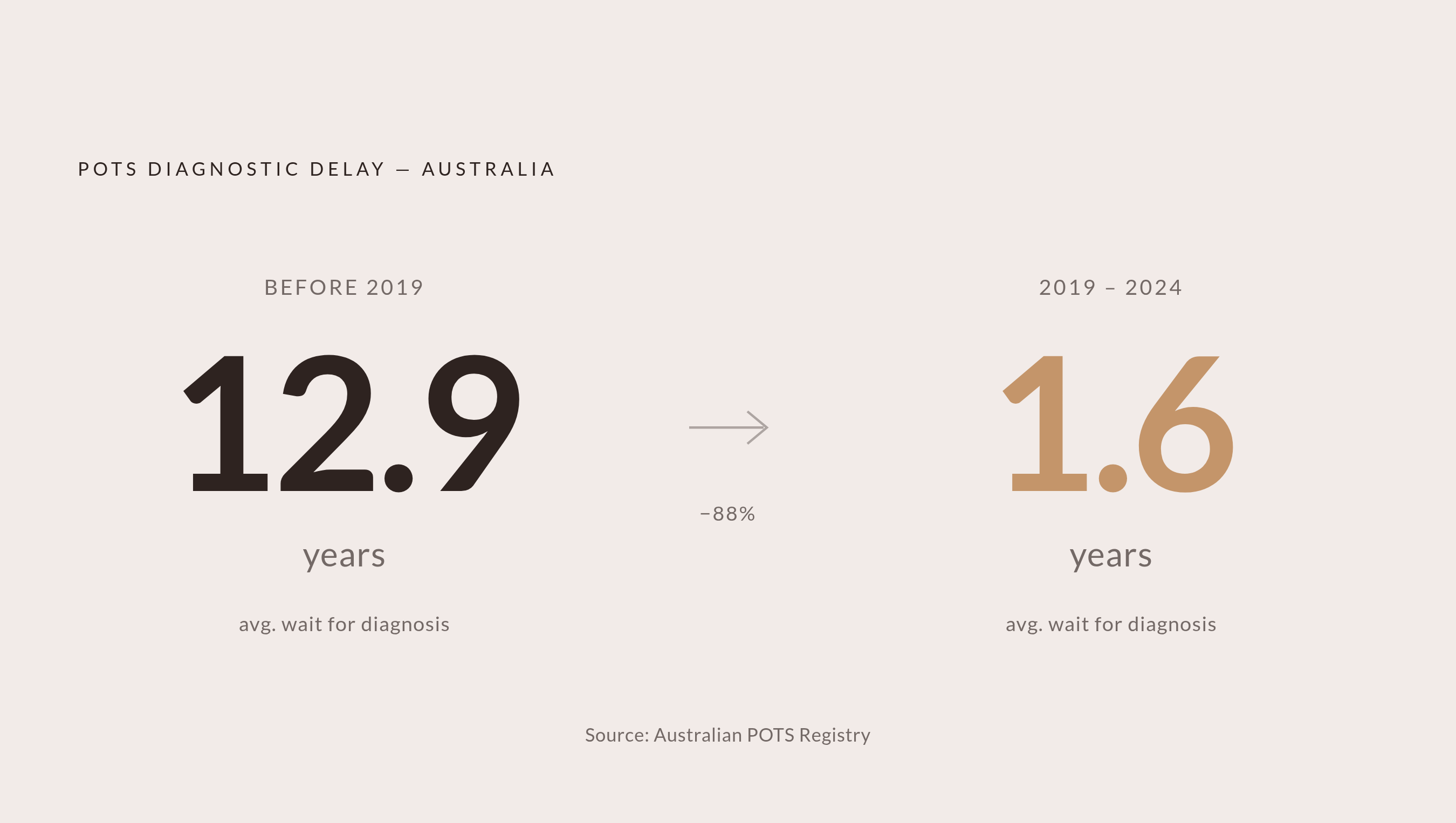
The numbers on how long this actually takes are rough. An Australian registry running from 2021 to 2024, with 500 patients, found that more than a quarter waited over a decade for a diagnosis; the average patient saw 5.2 physicians before getting one, and was consulting 7.5 specialists by the time they enrolled in the registry Australian POTS Registry. There's a real silver lining buried in the data, though. Patients diagnosed between 2019 and 2024 waited an average of 1.6 years, compared to 12.9 years for those diagnosed earlier Australian POTS Registry. Awareness is clearly moving in the right direction. It's just not there yet.
Everything in the sections that follow is built around one idea: a patient can't control how much a given clinician knows about POTS, but they can control what they bring into the room, and that documentation is one of the few levers a patient actually has to pull. According to a Dysautonomia International survey of more than 700 respondents, the diagnostic odyssey in numbers reveals an average delay of 5 years and 11 months, with only 25% diagnosed within the first year and 50% traveling more than 100 miles to receive POTS-related care. The Australian POTS Registry found a gender disparity in mean diagnostic delay of 7.0 years for women versus 3.8 years for men (P=0.010), a finding rendered significant by the fact that 86.8% of that registry cohort were women.
How misdiagnosis happens
The single most common wrong turn is psychiatric. Of those, 45% get an initial diagnosis of anxiety or panic disorder, 11% get depression, and 8% get labeled with conversion disorder or something psychosomatic pcares.org. The Dysautonomia International survey found something even starker: 59% of patients were told, directly, that their symptoms were "all in your head," and 69% picked up an anxiety diagnosis somewhere along the way. That's despite research showing POTS patients are no more prone to anxiety than anyone else Dysautonomia International survey. In the Australian registry, 54.5% had at least one emergency department presentation related to POTS symptoms before diagnosis, and 64.6% had their physical symptoms attributed to anxiety prior to diagnosis.
The distinction that gets missed, over and over, is positional. POTS symptoms appear on standing and ease when the patient lies back down. Anxiety doesn't work that way; it can hit in any position, sitting, lying, standing, doesn't matter. That's the exact pattern a diary can put on paper in a way a clinician can act on. Part of why this gets missed so consistently comes down to training: autonomic disorders, POTS included, aren't covered in any real depth in most medical school or residency curricula. The tests themselves are cheap and simple. The condition just isn't on most clinicians' radar to begin with.
34% of patients end up suggesting their own diagnosis to their doctor. That's not a failure of the patient, it's a symptom of the system. But it does mean that documentation, organized clearly enough that a clinician can act on it fast, makes that act of self-advocacy land instead of getting waved off.
What clinicians are measuring at a POTS evaluation
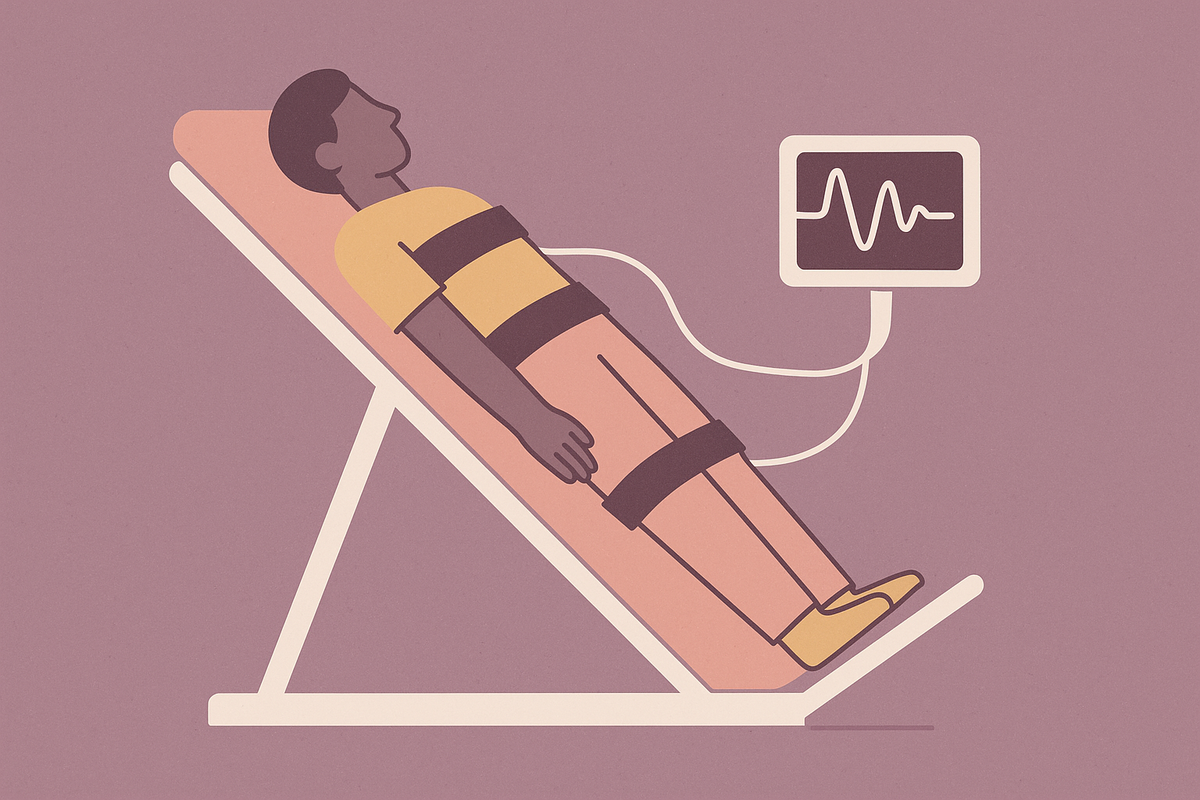
If tilt testing isn't available, the active stand test (bedside heart rate and blood pressure measurements supine and standing at 2, 5, and 10-minute intervals) can diagnose POTS. These two tests don't catch the same patients equally well. A 2025 study of 60 people with POTS who did both tests the same day found 74% met the heart rate criterion on the active stand test, versus 98% on tilt How to test for POTS: tilt table test and stand test. A patient who doesn't clear the bar standing at bedside might still clear it on a tilt table, so it's better to ask about that possibility rather than assuming a negative stand test rules things out How to test for POTS: tilt table test and stand test.
Before any of this gets labeled POTS, clinicians work through a list of other explanations for a racing heart on standing: dehydration, anemia, thyroid disease, medication effects, arrhythmias, structural heart disease. That ruling-out process is why a full medication and health context log matters so much going in. A 2026 state-of-the-art review from an international team of researchers has updated the diagnostic framework further, though the specifics of that update sit outside what's covered here. The upshot for a patient preparing for an evaluation: clinicians aren't hunting for one dramatic reading. They're looking for a pattern that repeats across time, position, and circumstance, which happens to be what a well-kept log already shows them.
The heart rate log: how to record positional readings that mirror the active stand test
Each entry should note the time of day, how long since waking, body position (supine, seated, standing), heart rate, blood pressure if a cuff is on hand, and whatever symptoms are present in that moment.
Timing isn't arbitrary here. Take the lying-down reading after at least five minutes of rest, then check again standing at roughly 2, 5, and 10 minutes, which lines up with the clinical protocol almost exactly. Symptoms and heart rate responses can shift depending on the time of day, so spreading readings across morning, midday, and afternoon over several days shows that variability instead of handing the clinician one snapshot that might not represent much.
Wearables are useful but limited. A device can track standing heart rate over time, but a single number on a watch, especially a resting number, doesn't tell the story on its own. Data from Welltory's own user base backs this up: among users who self-reported POTS, resting heart rate looked almost identical to non-POTS users. The rise on standing means something clinically. Record on both symptomatic and symptom-free days. The contrast between the two is often more convincing than either set of readings alone.
Put together, a log like this does something a verbal description can't. "My heart races when I stand up" becomes a set of time-stamped, reproducible numbers that map directly onto the test the clinician is about to run, which shortens the distance between what the patient says and what the clinician can confirm. Because the diagnostic criterion is a rise from lying to standing over 10 minutes, home measurements taken in the same sequence directly mirror the active stand test and give the clinician recognisable data.
The symptom diary: capturing triggers, timing, position, and relief
POTS isn't diagnosed off a number alone. The Heart Rhythm Society definition requires frequent standing-related symptoms alongside the heart rate criterion, so a diary needs to capture both what the body is doing and what the patient is actually feeling. A useful entry tracks what the patient had eaten or had to drink (hydration and salt intake shift POTS symptoms noticeably) and a rough severity score on a 1-to-10 scale for each symptom.
Of all those fields, whether symptoms resolve on lying down is the one that matters most. It's the anchor that separates a POTS pattern from an anxiety pattern, and a diary that shows repeated improvement in the supine position hands the clinician the exact distinction they need to make. The symptom list itself overlaps heavily with anxiety and half a dozen other conditions, dizziness, palpitations, near-fainting, brain fog, fatigue, nausea, tremors, blurred vision, exercise intolerance, so it's the link to position, not the symptom itself, that does the differentiating work.
Duration counts too. A diary that captures both halves, how it feels and what the numbers show, is doing double duty as diagnostic evidence. The diagnostic threshold requires symptoms lasting at least 3 months, and a diary that spans weeks before the appointment demonstrates duration and consistency by showing chronicity and ruling out a transient cause.
Functional impact: documenting what POTS prevents, not just what it causes
Numbers from the Australian registry make the scale of this concrete: 22.0% of patients were unemployed, and 26.0% had social outings less than once a month. Those aren't background details. They're what undocumented functional loss looks like once someone finally sits down and counts it. Functional documentation means writing down what a patient can't do, or can only do badly, when symptomatic: a shower cut short, a grocery run abandoned halfway through, a work meeting they had to leave, how many minutes they can stand before symptoms start, whether they had to sit or lie down mid-task.
Roughly 30% of severely symptomatic Long COVID patients meet POTS criteria, and in highly selected clinic populations that number climbs as high as 79%. For those patients, linking a pre-infection functional baseline to a post-infection one is part of the documentation, not an afterthought.
What this section really tells a clinician is that POTS isn't an occasional inconvenience. It's a condition that quietly restructures an entire day around how much upright time a person can afford. That burden is real and measurable, and documenting it reflects that reality rather than exaggeration. It's the patient doing the quality-of-life assessment the clinician would otherwise have to reconstruct from scratch, except it's already done, in the patient's own words and own data.
Medication list, comorbidities, and context the clinician needs to rule things out
Before POTS gets confirmed, clinicians work through a list of alternative explanations: dehydration or blood loss, anemia, thyroid disease, medication side effects, arrhythmias, structural heart disease, and other systemic or neurologic causes. Coming prepared for that process means having a few things ready. A current medication list, with doses, timing, and any recent changes, matters because several common medications shift heart rate and blood pressure in ways that can either look like POTS or mask it entirely. Recent blood work, if it exists, helps too. Flagging known thyroid, iron, or CBC results gives the clinician a head start on the exclusion checklist instead of starting from zero.
Known comorbidities belong on the list as well. POTS rarely occurs alone, and noting that reflects its actual scope rather than scope-creep. It's handing the clinician the map they need to make the right referrals instead of missing something adjacent.
That kind of preparation protects the patient too. Arriving with a clear medication and comorbidity list means the evaluation doesn't get sidetracked, or worse, sent down the wrong path entirely, by a treatable secondary cause nobody happened to mention.
How to organize and present documentation at the appointment
Open with the positional pattern first, not a full symptom inventory. From there, structure the rest of the conversation the way a clinician actually thinks: how long the symptoms have lasted, since that demonstrates the three-month threshold, the postural trigger-and-relief pattern that anchors the diagnosis, the home heart rate log with dates and positions attached, a summary of functional impact, medications and comorbidities, and a list of questions written out ahead of time.
Print the questions rather than trying to remember them on the spot. It's a small thing, but it's easy to blank in the moment, and a printed list signals preparation while keeping the conversation on track. Bringing a support person along helps too, someone who can take notes or fill in details if concentrating through the whole appointment turns out to be hard.
It also helps to know what to ask for. That single piece of knowledge, going in already knowing the number a clinician is looking for, might be the most concrete thing a patient can carry into the room. Patients should lead with the positional pattern, not the symptom list, opening the conversation with the most concrete finding ("my heart rate rises from X lying down to Y after 5 minutes standing, and symptoms improve when I lie back down") rather than a comprehensive symptom inventory that risks sounding diffuse. Knowing what to ask for, by familiarizing oneself with the diagnostic criteria of a heart rate increase of ≥30 bpm within 10 minutes of standing, means the patient can specifically ask for an active stand test or tilt table test if neither has been offered.
Sources
- How to test for POTS: tilt table test and stand test
- How Is POTS Diagnosed? Tests, Timelines, and What to Expect
- Symptom burden, quality of life, and diagnostic journey of people with postural orthostatic tachycardia syndrome, Australia, 2021–24: a descriptive patient registry data study
- Dysautonomia International: Diagnostic Delay in POTS
- Key statistics -