POTS in Women and Hormonal Influences
Hormonal cycles amplify POTS symptoms in most women with the condition.
POTS (postural orthostatic tachycardia syndrome) means the heart rate climbs by 30 beats per minute or more on moving from lying down to standing, without a drop in blood pressure. It affects an estimated 3 million people in the US, and somewhere between 78% and 83% of them are women. That imbalance is not a coincidence of who happens to get sick. Research published in Obstetrics and Gynecology International (Boris et al., 2025) shows that most POTS treatment protocols were built on cohorts that skewed male. The majority of patients are managing this condition on evidence that was never built around their bodies.
The mismatch starts below the hormones, in baseline physiology. Women tend to have lower stroke volume and lower blood volume than men, even after accounting for body size, according to research on orthostatic tolerance and POTS in women. Add greater vasodilatory capacity, which lets blood pool more easily in the legs on standing, plus a weaker venous return from less muscle and respiratory pump activity when upright. Higher nitric oxide availability, a blunted renin-angiotensin-aldosterone response, and lower sensitivity to vasopressin strip away most of the natural vasoconstrictor backup a standing body relies on. None of this makes the female cardiovascular system weaker in some general sense. It makes the specific mechanics of standing up harder to compensate for, structurally, before a single hormone enters the picture. Hormones are what turn that fixed vulnerability into something that shifts week to week and decade to decade.
The menstrual cycle's role in driving the POTS symptom rhythm
Most women with POTS already know their symptoms are not flat across the month. The Boris et al. survey found that 72.4% of women with POTS report symptoms fluctuating with their menstrual cycle. That is most patients describing something real that rarely gets validated in a clinical visit.
The pattern has a shape to it. The premenstrual and early follicular phases, when both estrogen and progesterone bottom out, tend to be the worst: blood volume compensation is at its weakest and presyncope risk is highest. The mid-luteal phase, when hormone levels support better fluid retention, tends to bring some relief. But the relationship is not straightforwardly linear. More hormone does not mean better function in any clean, linear way. The relationship has a direction, but it is not a straight line.
Mechanistically, progesterone suppresses norepinephrine and other catecholamines that hold blood pressure up on standing, which is part of why the drop-off phase hits so hard. Pubertal hormones more broadly promote vasodilation and lower blood volume, and that shift is often what first uncovers autonomic vulnerability in a teenager who never had symptoms before. Research in this area ties estrogen and progesterone directly to hypovolemia, poor vasoconstriction, and impaired cerebral autoregulation in POTS patients specifically.
One finding from a cardiovascular research journal stands out: menstrual cycle phase changed hemodynamics in POTS patients, but not in healthy controls. The hormonal swing exists in everyone. A person whose baseline vasoconstriction on standing is already adequate does not develop symptoms from it. In POTS, standing already demands more compensation than the body wants to give, so a hormone-driven dip in vasoconstrictor tone lands harder on a system with no slack left.
There is a histamine angle too. Hormonal shifts can trigger histamine release, and histamine drives vasodilation, vascular permeability, and autonomic symptoms, which matters for the substantial share of POTS patients who also have MCAS (mast cell activation syndrome). The cycle runs through mast cells as a second pathway alongside estrogen and progesterone.
Practically, this explains something that frustrates a lot of patients. Salt loading and compression stockings work, but not the same way every day. If they hold rock-solid in the mid-luteal phase and barely keep the line premenstrually, that is not the treatment failing. That is the hormone curve playing out in real time. The same Boris et al. 2025 data found hormonal contraceptive therapy helped control symptoms in roughly half the women who tried it (52 of 110 subjects), which says something about how directly the cycle itself drives the pattern.
Why some women turn to hormonal contraception to manage POTS
A lot of women with POTS are already using birth control specifically because of it, not just to prevent pregnancy. In the Boris et al. 2025 survey, 81.8% of subjects used hormonal contraceptives to regulate or stop their periods, and 38.2% said they used them specifically to manage POTS symptoms.
The logic holds up. If the premenstrual and early follicular trough, the point where both estrogen and progesterone sit low, is the highest-risk window, flattening the cycle should remove that trough. The survey data backs the idea up to a point: roughly half of the women who tried hormonal contraception for POTS symptoms reported it helped. That is meaningful, but it applies to only about half of women who try it. Half is a long way from a guaranteed fix, and any clinician presenting it as one is overselling what the data supports.
What is missing is precision. Nobody has established whether combined contraceptives outperform progestogen-only options for POTS symptoms, or which route and dose work best. Continuous use versus a cyclical schedule has not been compared head to head either. One useful finding from the Boris et al. data: young women with POTS did not report higher rates of menorrhagia, PCOS, or endometriosis than the general population. That points away from structural gynecologic disease as the driver and toward the autonomic-hormonal interaction as the real mechanism.
For a woman trying to have this conversation with a clinician, the useful move is tracking. Which phase is worst. By how much. How consistent the pattern runs, cycle over cycle. That turns "I feel worse sometimes" into a pattern a clinician can act on, giving a vague complaint the structure of a data set worth treating.
How pregnancy and the postpartum period interact with POTS
Pregnancy takes everything happening across a menstrual cycle and runs it continuously, at a much higher intensity, for nine months straight. Progesterone relaxes smooth muscle in blood vessel walls to keep blood flowing to the fetus, and in a woman with POTS that same mechanism drops blood pressure further and cuts blood flow to the brain. Rising estrogen adds to the load by affecting autonomic neurotransmitter activity in ways that tend to worsen symptoms rather than ease them.
This creates a diagnostic blind spot. Dizziness, a racing heart, fatigue: all of it gets filed under "normal pregnancy" almost by default. POTS during pregnancy is frequently missed, never considered in the first place rather than misdiagnosed.
Then delivery happens, and estrogen and progesterone crash within days. That crash destabilizes autonomic regulation at the exact moment a new mother is expected to function at full capacity with no room for error. According to cognitivefxusa.com, an estimated 30% to 50% of women with pre-existing POTS report their symptoms getting worse after delivery.
Pregnancy does not just aggravate existing POTS. For some previously healthy women, it triggers new-onset POTS altogether, joining other recognized triggers for the condition. A woman who develops new or dramatically worsened heart symptoms after giving birth and gets told it is postpartum anxiety, or plain exhaustion, deserves a second look. That is a documented pattern, and it deserves to be treated as one rather than waved off.
What happens to POTS as women approach perimenopause
POTS is rarely seen in postmenopausal women. That single observation is one of the strongest hints that POTS ties to reproductive-years hormonal activity specifically, though the mechanism behind why it fades after menopause has not been worked out.
The research gap here is stark. HRT and menopause in women with POTS simply have not been studied, despite obvious clinical relevance for the large number of POTS patients moving through this transition every year.
What is known mostly comes from extrapolation. Perimenopause is not a smooth decline, it is an erratic set of estrogen swings, and that instability could plausibly produce a stretch of worsened, unpredictable POTS symptoms before things settle after menopause. Women who have had their POTS under control for years, with a stable routine of salt, fluids, and medication, may find that control slipping during this window for no obvious external reason.
Whether hormone replacement therapy helps remains an open question, and treating it as settled science in either direction misrepresents where the field actually stands. No current evidence shows HRT treats POTS directly, and whether it eases the perimenopausal symptom spike has not been studied either. For women entering this stage of life, that gap reflects a field that has not caught up yet. It reflects a field that has not caught up yet, and the honest response is to push for closer monitoring during perimenopause rather than assume things will sort themselves out.
The diagnostic delay women face, and the gender bias that drives it
A 2019 study of nearly 5,000 POTS patients, run by Dysautonomia International, found the average time from symptom onset to diagnosis was 4.9 years, with patients seeing an average of seven physicians before anyone landed on POTS, the baseline delay for the condition overall. That is the baseline delay for the condition overall.
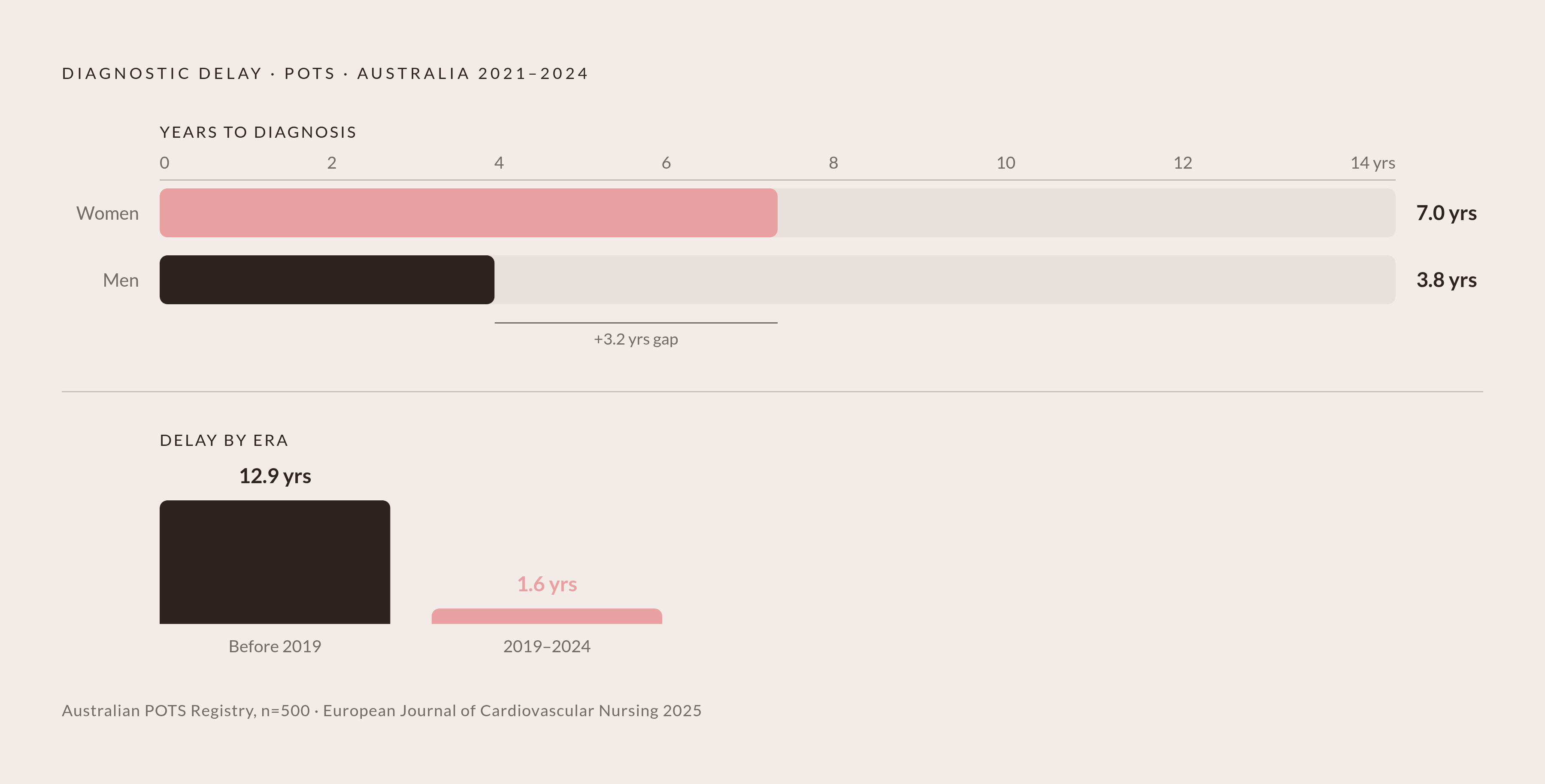
Women wait longer, and the gap is not small. A study of 500 patients in the Australian POTS registry, covering May 2021 through April 2024 and published in the European Journal of Cardiovascular Nursing (2025), found women waited an average of 7 years for diagnosis, compared to 3.8 years for men. That is more than three extra years spent without an explanation, and the cause traces to something specific.
In that same Australian registry, 70% of women had their symptoms initially written off as anxiety or something psychosomatic. Women with POTS were 2.6 times more likely than men to end up on a mental health treatment plan instead of a chronic illness care plan. Across all POTS patients, 69% were diagnosed with an anxiety disorder before anyone identified POTS, and 59% were told, in some form, that their symptoms were in their head. The research is explicit that this gap does not come from women describing symptoms differently or seeking care differently. It comes from clinician-side factors. Over half the Australian cohort, 54.5%, had a POTS-related emergency room visit before diagnosis, and 64.6% had physical symptoms attributed to anxiety before anyone reconsidered.
Real progress is visible in the numbers. Patients diagnosed between 2019 and 2024 waited an average of 1.6 years, compared to 12.9 years for those diagnosed before 2019. Awareness is moving in the right direction, but the gap between men and women has not closed, and a cruel irony sits inside it. Because POTS genuinely fluctuates with the menstrual cycle, a woman who happens to see a doctor during a better week can have her symptoms minimized on the spot. The same hormonal rhythm that shapes her disease becomes, in that moment, a reason not to believe her.
How sex differences affect treatment response for women
Most POTS research ran on male participants, or without breaking results out by sex. That is a structural gap, and it shapes prescribing decisions for a patient population that is overwhelmingly female.
The consequences appear in outcome data. Available data indicate young girls treated with metoprolol, a beta blocker commonly prescribed for POTS, had a markedly increased risk of poor prognosis compared to boys treated with the same drug. A number that large should change how the drug gets prescribed by sex, full stop.
The pattern is not isolated to POTS. The REBOOT clinical trial found women on beta blockers had a 45% higher relative risk of serious outcomes compared to women not on the drug. Men in the same trial showed no such excess risk. The findings point clearly toward sex mattering in how beta blockers are prescribed, which is about as direct a signal as outcome data can produce.
The standard conservative toolkit for POTS, salt loading, compression garments, higher fluid intake, gradual reconditioning, targets blood pooling. None of it was built with the hormonal variability that determines how well it works on any given week factored into the design. A woman doing everything right, same salt intake, same compression, same fluids, who still swings between good weeks and bad ones, is not failing the protocol. She is running into a hormonal overlay the protocol was never built to account for.
Treatment that actually fits needs to flex with cycle phase, with pregnancy and postpartum status, with the perimenopausal transition, and with comorbidities layered on top. Static dosing and static advice miss the entire architecture of how this disease behaves in a female body over time.
The comorbidity picture: EDS, MCAS, Long COVID, and the overlapping complexity women face
POTS rarely travels alone. It occurs alongside connective tissue disorders or hypermobility spectrum disorder (HSD), and mast cell activation syndrome (MCAS) with notable frequency, a pattern patients and clinicians alike have come to recognize. Women with POTS appear to carry a disproportionate share of these overlapping conditions compared to men, concentrated in this cluster of conditions in particular.
Long COVID has become one of the most significant modern drivers of new POTS cases. In the Australian POTS registry, 32.6% of the 500 patients had POTS that developed after a SARS-CoV-2 infection. Research from the University of Toledo estimated that about 30% of people with severe, ongoing Long COVID symptoms go on to develop POTS, which puts the risk close to a coin flip in that population.
The hormonal layer does not stay separate from any of this. It compounds it. In women with MCAS overlap, hormonally triggered histamine release does not just add a second problem alongside POTS, it actively worsens the POTS symptoms already present during that window. In women with EDS, connective tissue hypermobility is understood to compound the blood pooling that characterizes POTS to begin with, so the same hormonal dip that reduces vasoconstrictor tone acts on a vascular system that already has less structural support behind it. Two mechanisms, working on the same vulnerability, at the same time.
For women carrying more than one of these diagnoses, the cycle, the pregnancy, the perimenopausal transition are not background noise sitting off to the side of the real disease. They shape how the disease behaves, month by month and year by year, and treating them as incidental builds in the diagnostic delay from the start.
Sources
- POTS in Women: Why Standard Treatments Often Fall Short
- The Long‐Term Postural Orthostatic Tachycardia Syndrome Outcomes Survey‐Gynecologic Findings: A Cross‐Sectional Survey in Young Women - Boris - 2025 - Obstetrics and Gynecology International - Wiley Online Library
- Women, orthostatic tolerance, and POTS: a narrative review - ScienceDirect
- The Long-Term Postural Orthostatic Tachycardia Syndrome Outcomes Survey-Gynecologic Findings: A Cross-Sectional Survey in Young Women
- ncbi.nlm.nih.gov
- Menstrual Cycle Variability in Symptoms of Postural Orthostatic Tachycardia Syndrome (POTS) - Heart, Lung and Circulation
- medicalxpress.com