MCAS, POTS, and Hypermobility as a Triad
Diagnostic criteria chaos masks the true overlap between these three interconnected conditions.
Start with the number that should stop you: people with hEDS are nearly 30 times more likely to carry a POTS diagnosis than the general population. That's not noise, and it's a signal loud enough to demand a mechanism, which is what the rest of this piece works through.
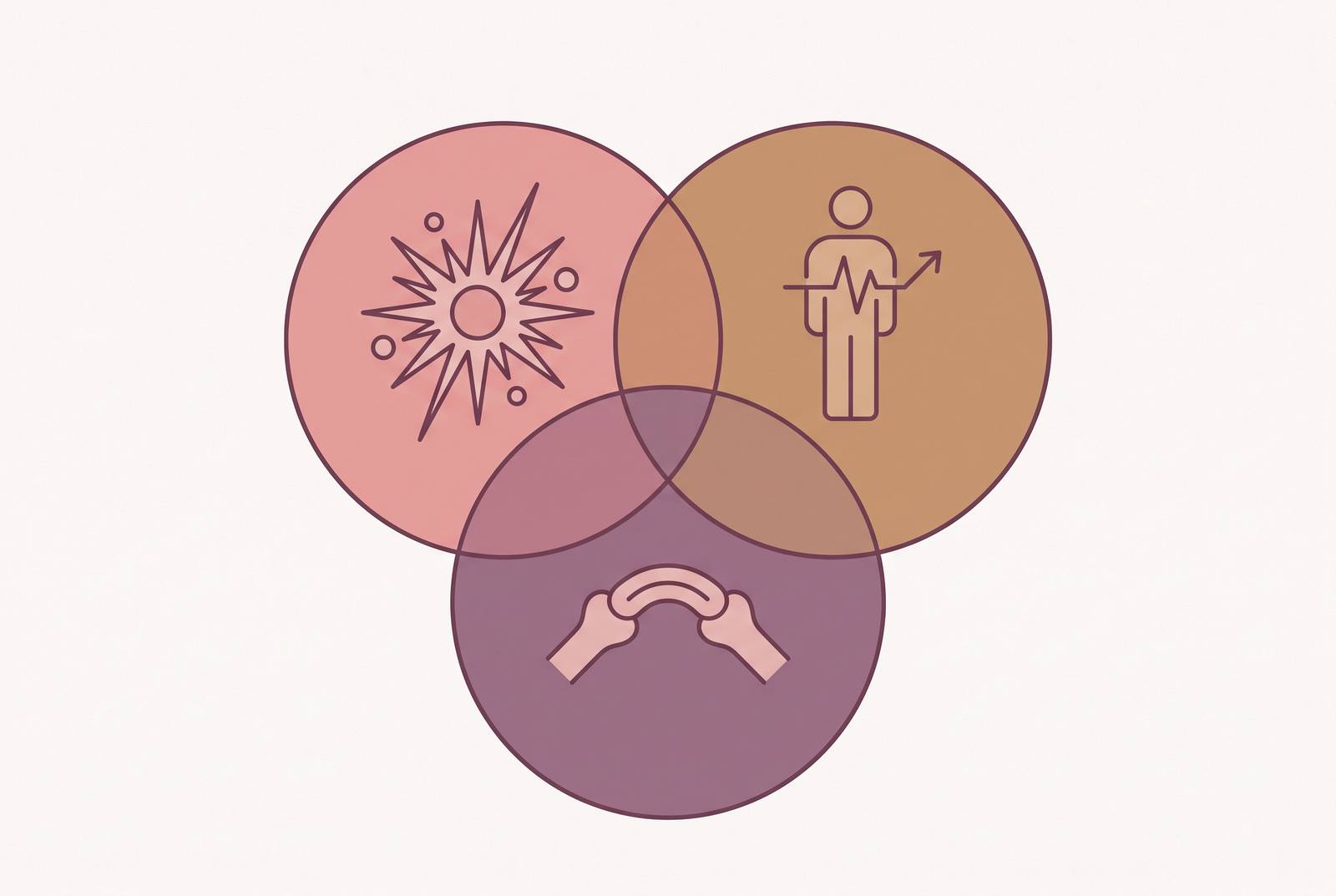
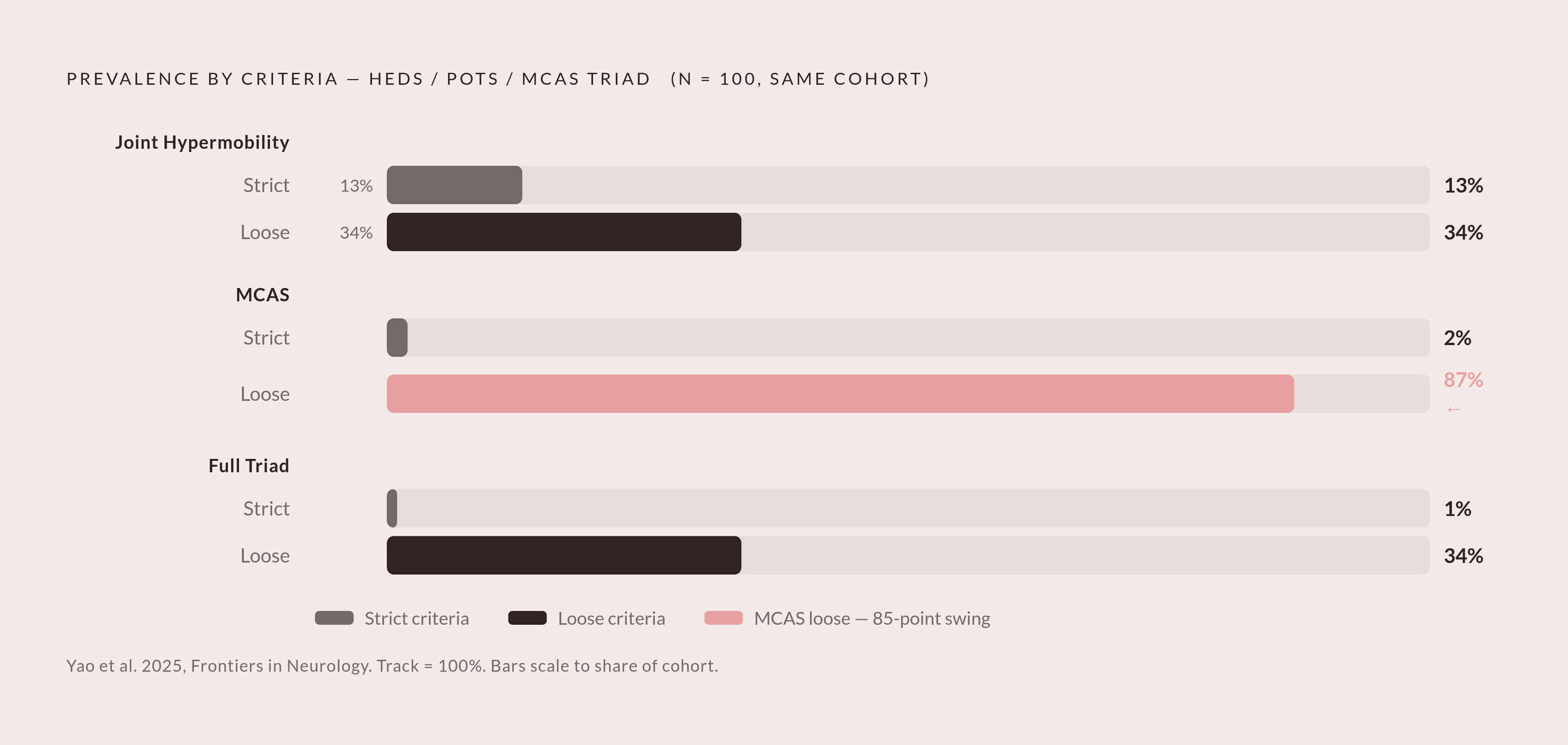
Zoom out to the full triad, though, and the picture gets messy on purpose, almost. A 2025 study in Frontiers in Neurology by Yao and colleagues looked at 100 young POTS patients and found the numbers move entirely depending on which diagnostic criteria get applied. Joint hypermobility showed up in 13% of patients under strict hEDS criteria, but 34% under the looser HSD criteria. MCAS swung even harder: 2% under strict lab-based criteria, 87% under the loosest clinical criteria. The full triad, all three conditions in one patient, appeared in 1 patient under strict criteria and 34 under loose criteria.
Same 100 people, three completely different stories, depending on where you set the goalposts. Most coverage of this topic skips that part entirely: a prevalence number for this triad, cited without naming which criteria produced it, is a placeholder dressed up as data. If a study won't tell you its criteria, don't trust its percentage.
A separate 2025 survey of 84 women with HSD or hEDS backs the pattern up from another angle, and it didn't have to argue about criteria nearly as hard. Among that group, 58.3% had POTS, 32.1% had MCAS, and one in four carried all three diagnoses at once. Ask the question directly, in a population that already has one diagnosis, and the triad stops looking rare. It starts looking like the default.
So the overlap is real, and what causes it is the harder question, the one worth spending real time on.
The biological mechanisms that could explain why one body develops all three
Blood vessels are connective tissue. That single fact does most of the work explaining why hEDS and POTS show up together so often, and it's the mechanism most explanations of this triad skip past too fast.
If the collagen scaffold holding blood vessels together is weaker than it should be, veins stretch more than they're built to. Stand up, and blood pools in the legs instead of returning to the heart at a normal clip. The autonomic nervous system catches that drop in circulating volume and compensates by cranking sympathetic activity: the heart rate spike that defines POTS. Under this model, POTS in an hEDS patient isn't a coincidence sitting next to a joint problem. It's a structural consequence of the same weak scaffold, arriving on the same body for a traceable reason.
Mast cells extend that thread further than most explanations bother to go. They sit embedded in connective tissue throughout the body, not floating free in the bloodstream. Change the collagen architecture around them, and the mechanical and biochemical environment those cells live in changes too, which may be enough on its own to prime them toward misfiring. That gives MCAS a physical address inside the same structural disorder driving the joint and vascular symptoms, instead of leaving it as an unexplained third wheel.
Researchers have identified candidate genetic variants that may express across all three domains at once, which is exactly the kind of mechanism that would produce the clustering they keep running into. No single variant explains every case, but the concept that one genetic factor could drive joint, autonomic, and mast-cell symptoms simultaneously is actively being investigated.
None of this fires in a vacuum. Puberty, pregnancy, physical trauma, infection: all act as triggers that unmask the triad in people who've been carrying the underlying susceptibility quietly, sometimes for years. By the time autonomic and immune symptoms have taken over the clinical picture, the connective tissue signs that might have pointed to the root cause can be harder to detect retroactively.
Long COVID turned into a real-world stress test for this whole model. One dataset found MCAS and POTS jointly diagnosed in 19.09% of hEDS patients who also had Long COVID, against just 5.22% of hEDS patients without it. Infection was the single most common trigger for POTS onset in one study, showing up in 39.4% of patients, with POTS following SARS-CoV-2 specifically accounting for 32.6%. Infection looks less like a cause on its own and more like a switch flipped on a system already primed to fail.
There's no single gene, no single disease process, that accounts for the whole picture, and anyone offering you one is oversimplifying. What actually holds up is that susceptibility appears to express differently depending on which trigger it happens to run into.
What the scientific skeptics are saying (and why the debate matters to patients)
Not everyone buys the triad as a unified biological entity, and the skeptics deserve a real hearing, not a footnote. Critics have flagged that most of the supporting evidence rests on studies using diagnostic criteria that don't match from one paper to the next, making it difficult to establish a clear association between MCAS and either hEDS or POTS.
The Mayo Clinic data adds real weight here, though not in the direction most people expect. A retrospective review looked at adults referred with suspected MCAS alongside hEDS or POTS, and found 95% carried an MCAS label that had never actually been confirmed. The same review found 66% of these patients had documented psychiatric comorbidities: anxiety in 56%, depression in 48%, ADHD in 15%, PTSD in 14%.
Read that correctly. The symptoms aren't imagined, and clinicians are handing out an MCAS label informally, without lab confirmation, because the name fits a confusing symptom picture and nothing else does. That's a failure of diagnostic rigor sitting squarely on the clinician's side of the desk, and it's a separate question entirely from whether what the patient feels is real.
The methodological snag underneath all of it: MCAS and hEDS definitions keep shifting, so a study built on one set of criteria can't be stacked cleanly against a study built on another. Yao's 2025 numbers already showed how far prevalence swings inside a single 100-patient cohort, from 2% to 87% for MCAS alone, depending only on which criteria got applied.
Here's where the position has to be taken plainly: strict criteria protect against overdiagnosis, but they also, provably, leave people undertreated. Yao's own cohort makes the case, since 82% of patients improved on MCAS-directed therapy. Wait for the perfect biomarker before you'll treat, and real symptoms go untouched in the name of rigor. That tradeoff, not a clean resolution, is where the field actually sits.
Clinical co-occurrence of these three conditions is documented and not in dispute, while the unified mechanistic story tying them together is plausible, actively being tested, and not yet experimentally confirmed. Both facts stand at once, and neither one cancels the other out.
Why reaching a diagnosis for any one of these conditions takes so long (and why the triad makes it worse)
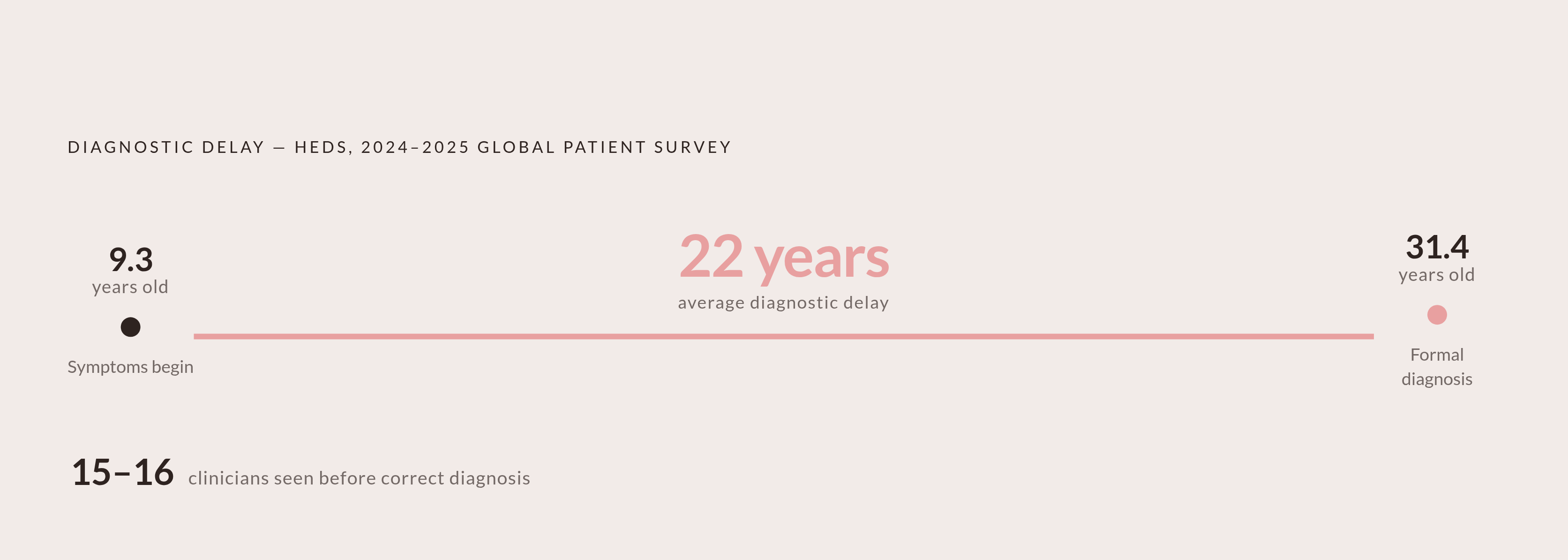
hEDS shows the delay at its worst. A 2024-2025 global survey of thousands of hEDS patients found average symptom onset at age 9.3, with formal diagnosis landing at age 31.4: twenty-two years between the first symptom and the correct name for it. Data from Indiana University found the average hEDS patient sees 15 to 16 different clinicians before getting diagnosed correctly.
POTS carries its own delay, and it splits by gender in a way nobody's managed to explain away. An Australian study covering 2021 to 2024 found a mean diagnostic delay of 7.0 years for women, substantially longer than for men. A quarter of POTS patients waited more than ten years, and among those still undiagnosed or newly diagnosed, 22.0% were unemployed and 26.0% went out socially less than once a month. Awareness is moving, just slowly.
Stack three conditions on top of each other, and the delay compounds rather than simply adding. Symptoms from three different systems, joints, autonomic function, immune response, get funneled to three different specialists who never talk to each other. A gastroenterologist treats the flushing and gut pain, a cardiologist treats the racing heart, and a rheumatologist never hears about either, because nobody in the chain is looking at the whole body. And since hEDS has no biomarker, the connective tissue root underneath everything is usually the last piece named, sometimes decades after the first symptom.
Gender is the part worth naming directly instead of softening into a caveat. The triad skews heavily female, and female patients presenting across multiple systems run into a well-documented pattern of dismissal in clinical settings. The Mayo psychiatric numbers, anxiety, depression, ADHD, PTSD, are real and deserve real treatment. But in practice, they double as a convenient off-ramp: a reason to redirect a patient toward mental health care instead of finishing a physical workup that might actually explain what's happening. That off-ramp gets built on the clinician's side of the exam room, not invented by patients.
Other complicating factors can stack against a fast, accurate diagnosis, adding further layers to an already difficult odyssey.
How the triad produces a symptom picture that looks different every day (and why that makes self-advocacy so difficult)
This symptom picture is multisystemic by nature, which means it refuses to hold still. A POTS flare, an MCAS reaction, and a joint instability episode can all land in the same afternoon, each one set off by something entirely different. A day that felt fine yesterday can turn unmanageable today with no obvious trigger, which is disorienting for the patient and reads as inconsistent to a clinician glancing at a chart for six minutes.
The triggers don't stay in their lanes, and that's the part most self-advocacy guides skip entirely. Heat worsens blood pooling, which aggravates POTS, and heat can trigger mast cell degranulation at the exact same moment. Adrenaline released during an MCAS reaction pushes heart rate up further in a body already primed for POTS tachycardia. Physical activity risks a post-exertional crash and a joint injury in the same movement. These systems feed each other constantly, which is exactly why treating them as three isolated problems falls apart the first time anyone actually tries it.
The emotional weight here is physiological, not just circumstantial, and that distinction deserves to be stated flatly rather than hedged. Anxiety and depression showing up alongside POTS and MCAS are frequently tied to measurable biology: neuroinflammation, an immune system stuck in overdrive, autonomic function running hot. Mood shifts here often reflect a body stuck in constant defense mode, and naming that root changes whether a clinician takes it seriously.
Then there's the energy math. Pacing around one chronic condition is hard enough, and pacing around three systems that can each drain energy on their own timeline needs a different kind of tracking altogether. Spoon theory applies here with extra force: a mast cell reaction at 10 a.m. can wipe out the rest of the day, and a POTS episode on the drive to a doctor's appointment can leave a patient too depleted to explain their own symptoms once they're sitting in the exam room.
What actually helps is tracking symptoms, triggers, timing, and context together, rather than forcing each flare into a single labeled bucket. Clean attribution is usually impossible anyway, and chasing it just burns energy better spent somewhere else.
What knowing about the triad changes for patients in clinical settings
Walking into an appointment able to name the pattern changes the conversation immediately. Saying "I have all three conditions of a recognized triad" turns a long list of complaints into a coherent clinical picture instead of a grab-bag of unrelated symptoms. Referencing the Yao et al. 2025 study in Frontiers in Neurology, tells a clinician the patient has engaged with actual evidence, not a forum thread.
Given how often symptoms cross specialty lines, a clinician who understands the triad specifically is worth more than a bigger name in one narrow field. Short of finding one, a primary care doctor willing to coordinate across specialists matters more than tracking down the single best subspecialist in any one department. Bringing a written summary of how the three conditions interact in that specific patient's body helps a new clinician orient fast, instead of starting from zero at every visit, which is what happens by default.
That summary needs an evidence base, and tracking by condition alone won't produce one. A log built around a single diagnosis misses the cross-condition patterns, which are the entire point. What actually surfaces the interactions is one record: heart rate, mast cell symptoms, joint stability, energy, sleep, triggers, all in the same place, tracked over time. A pattern spotted across weeks is far more persuasive to a clinician than a patient's memory of one bad Tuesday.
Keeping that record by hand is close to impossible, especially on the days a patient is too depleted to write anything down at all. An AI health companion built to track across these domains by text or voice, and turn the record into a doctor-ready summary before each appointment, takes on the paperwork this triad demands, so the patient's limited energy goes toward getting better instead of toward data entry. Juno, a 24/7 symptom-tracking app for people with chronic illness, is one option built around exactly that kind of multi-condition logging.