POTS Flare Triggers in Daily Life
Multiple daily stressors stack together to trigger POTS flares, not one big cause.
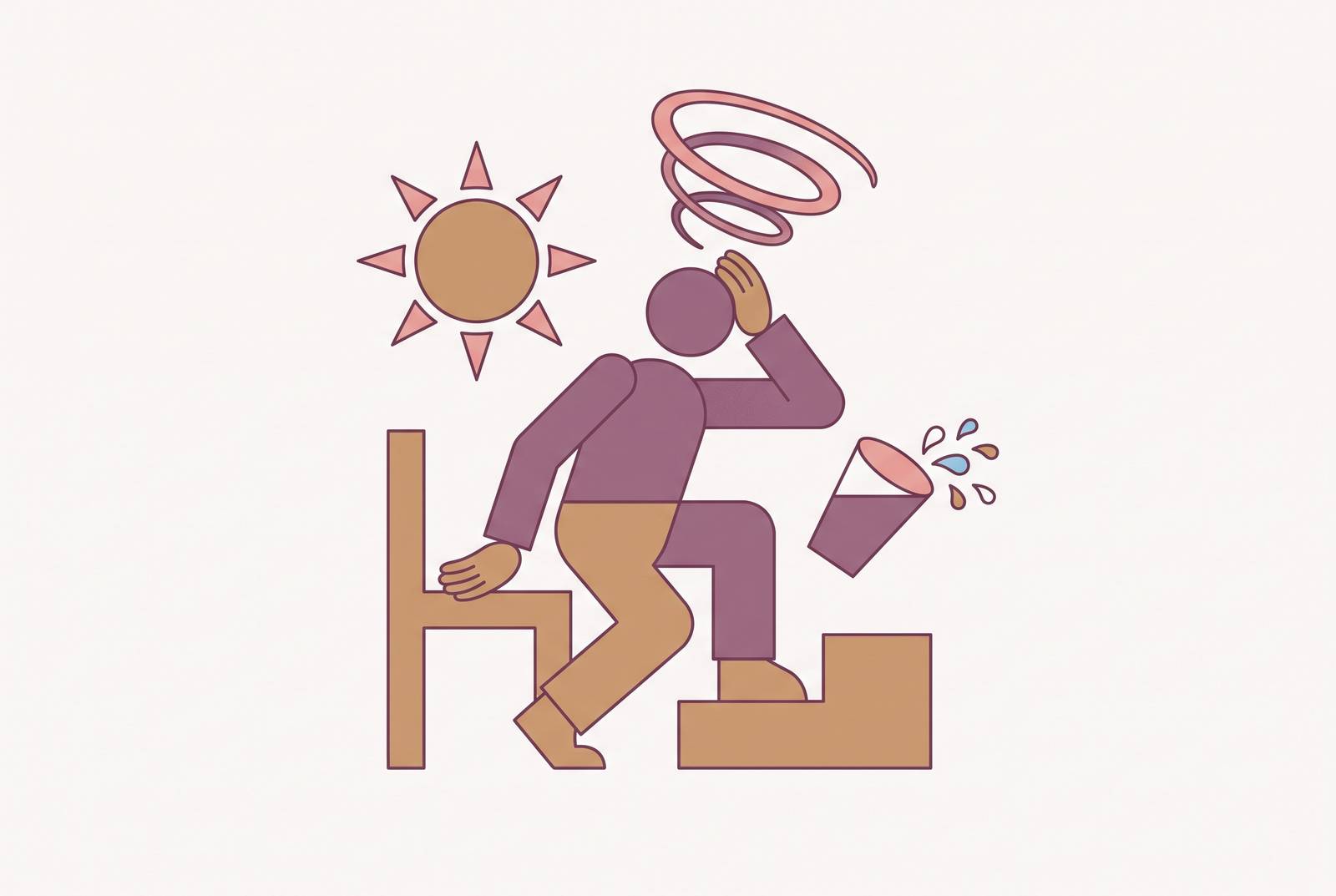
Standing up is a bigger deal than it feels like. Gravity pulls blood down into the legs the second a person gets upright, and in a normally functioning body, the autonomic nervous system responds fast. Heart rate ticks up slightly, blood vessels tighten, and blood gets pushed back toward the heart and brain before anyone notices anything happened.
In POTS, that compensation misfires. Blood stays pooled in the legs, the heart races to cover the shortfall, and the brain ends up running on less flow than it needs. That's the mechanism behind the dizziness, the fog, the sense of not being able to think straight while standing in a checkout line.
Here's the part that matters for everything else in this piece: the autonomic nervous system has a tolerance window, not a switch. Every stressor narrows that window a little. A trigger that causes barely-there symptoms on its own, a slightly warm room, say, can push someone into a full flare once it lands on top of a second or third stressor the same day. That's why "I didn't do anything different" is so often technically true and still wrong. No single big thing accounted for the difference. It was three medium things arriving together, and most people spend years hunting for the one big thing instead.
Symptom surveys back this up with striking consistency. Lightheadedness shows up in 99% of POTS patients, tachycardia in 97%, presyncope in 94%, shortness of breath in 88%, palpitations in 87%. No trigger on this list acts alone, so how they stack matters more than which one gets blamed.
Heat and hot showers: the fastest way to exhaust the system's blood-volume reserve
Heat makes blood vessels near the skin dilate so the body can cool itself. For most people, that's a minor adjustment. For someone with POTS, it's a second draw on blood that's already pooling in the legs, and circulation can't cover both demands at once.
Hot showers are a special case in their own right. They combine heat-driven vasodilation with prolonged standing, the exact two-part combination the system handles worst. Summer functions as its own flare season: ambient heat sits in the background all day, quietly lowering the threshold for every other trigger that comes along.
Lukewarm showers beat hot ones, full stop. A shower chair should be the default, not the last resort someone reaches for after fainting once, because it removes the standing component entirely. A cold towel to the neck before stepping into a hot environment helps, and so does running cold water over the hands and forearms during an active flare, which triggers fast vasoconstriction. Air conditioning and a portable fan on hot or humid days aren't luxuries here. They're symptom management, the same category as sodium or compression gear, not a comfort upgrade to feel guilty about.
Heat pulls blood volume reserve from the outside, draining it through the skin. The next trigger drains the same reserve from the inside.
Dehydration and low sodium: starting the day already in deficit
Most people with POTS start each day with lower circulating blood volume than average. Dehydration doesn't add a minor discomfort on top of that. It compresses a reserve that was already thin to begin with.
Plain water alone doesn't fix this, a mistake that trips up almost every newly diagnosed patient. Low sodium reduces the osmotic pressure that keeps fluid inside blood vessels, so water shifts out into surrounding tissue instead of staying in circulation. Total fluid intake can look perfectly fine on paper while intravascular volume, the actual blood volume doing the work, stays low. Chugging water without salt does close to nothing for this specific problem, which is exactly backwards from what most people assume when they feel dehydrated.
The deficit is invisible until it isn't. Mild dehydration, the kind that wouldn't register as a problem for most people, can amplify POTS symptoms substantially because the margin is so thin. Sodium targets should be worked out with a provider, especially for anyone also managing blood pressure. Fluid targets land around 2 to 3 liters daily, more during heat or exercise. Electrolyte drinks outperform plain water for this reason. Salting food at every meal works as a steady baseline instead of a reaction after symptoms already show up.
This is often the hidden variable behind a flare that gets logged as "heat" or "exertion." Dehydration is frequently sitting underneath both, unlogged and unblamed, doing more damage than the trigger that gets the credit.
Food, meals, and the postprandial window
Eating a large meal pulls blood into the gut for digestion, usually within 30 to 60 minutes of the first bite. That's another draw on a circulating volume that's already stretched thin, and it's called postprandial pooling for exactly that reason.
Alcohol compounds the problem through two separate channels. It dilates peripheral blood vessels, and it acts as a diuretic, so it worsens blood pooling while also pulling fluid out of circulation at the same time. Two mechanisms working against the same reserve at once is why alcohol tends to hit POTS patients harder and faster than it hits everyone else at the table.
For patients who also have mast cell activation syndrome, part of what's increasingly described as a symptom cluster with connective tissue and autonomic conditions, high-histamine foods add a third mechanism. They trigger mast cells to release vasodilatory compounds that worsen the same pooling problem directly.
Meal timing is one of the few triggers on this list fully within a person's control, which is exactly why it's worth taking seriously instead of shrugging off as unavoidable. Eating several small meals instead of large ones reduces the size of each postprandial draw. Sitting or reclining for about 30 minutes after eating gives the system time to redistribute blood without the added stress of standing. Anyone who suspects an MCAS overlap should trial a low-histamine approach for four to six weeks and watch what actually changes, not what they expect to change.
The 30 to 60 minute lag between eating and symptom onset is consistent enough that it shows up fast in a log. Meal size and composition next to symptom timing is one of the clearest patterns available to track, and it doesn't take months to see it.
Hormonal fluctuations across the menstrual cycle
Up to 90% of POTS patients are women of reproductive age, so hormonal timing is central here. It's central to the whole picture, and treating it as background noise is a mistake worth correcting early, because it's often the single biggest lever nobody's pulling.
Estrogen and progesterone both affect blood vessel tone and fluid retention, and both drop in the days before a period starts. That drop drains the blood-volume buffer that normally keeps symptoms in check, so the same triggers that were manageable the week before, a warm day, a bigger lunch, suddenly aren't.
Pregnancy and menopause work through similar mechanisms and mark their own inflection points worth watching closely. Symptoms that look like random monthly bad luck usually have a cycle-linked explanation, one that only becomes visible once someone charts symptom severity against cycle phase over a few months.
That kind of log changes what a clinical appointment sounds like, too. "I have bad weeks sometimes" becomes a chart a clinician can actually respond to.
Sleep deprivation and the morning transition as a flare window
Sleep is the main window the autonomic nervous system has to recalibrate. Disrupted sleep keeps sympathetic tone elevated, raises cortisol, and blocks the parasympathetic recovery that's supposed to happen overnight. The system starts the next day already running hot, before anything else even happens to it.
Morning itself is mechanically the roughest part of the day. Hours of lying flat followed by standing up fast is the most abrupt shift in blood distribution the body goes through all day, and POTS patients feel that shift harder than most people ever will.
Sitting upright for two to three minutes before standing fully gives the autonomic nervous system a head start on compensating, and it costs nothing to try. Raising the head of the bed by roughly 6 to 8 inches cuts down on overnight fluid redistribution, which blunts the morning spike before it starts. Consistent sleep timing matters too. Irregular schedules remove a stabilizing rhythm the system depends on more than most people realize.
Tracking sleep quality next to next-day symptom severity turns up a clear pattern: a bad night doesn't just mean feeling tired. It means a lower threshold for every other trigger on this list, all day long.
Illness, infection, and the body's immune-autonomic crossfire
A minor cold or stomach bug hits the same volume deficit as dehydration, just faster. Fever, reduced appetite, and GI fluid loss all pull blood volume down at once, and the immune system adds a second problem on top of that: cytokines released during infection disrupt autonomic signaling directly, independent of any fluid loss.
For patients whose POTS started after a COVID-19 infection, even a mild reinfection can restimulate the neuroinflammatory process that caused the condition in the first place. That's a different category of risk than an ordinary cold, and it deserves to be treated that way instead of shrugged off. The scale of this shift shows up in clinic data: one US clinic, at the University of Toledo, averaged 4.21 new POTS cases a month before the pandemic. After COVID emerged, that rose to 22.66 a month, more than five times higher. In the Australian registry, 32.6% of the 500 patients tracked had POTS secondary to a SARS-CoV-2 infection.
A sick-day plan worked out in advance with a provider beats improvising mid-flare, every time. That plan should include oral rehydration solutions instead of plain water for faster volume expansion, resting heart rate tracked as an objective gauge of severity, and sodium intake raised temporarily while illness is active. Recovery also runs slower for POTS patients than for people without the condition, so planning around that, rather than assuming a quick bounce-back, prevents the second flare that comes from jumping back into normal activity too soon.
Exertion: the trigger that becomes the long-term treatment
Exercise sends blood to the muscles, raises core temperature, and demands more cardiac output, all from a system that's already underperfused before the workout even starts. Palpitations, presyncope, or a multi-hour crash afterward are the short-term cost.
And yet structured, recumbent exercise is one of the most effective long-term treatments known for POTS. Dose and timing entering the picture resolves the apparent contradiction. How much, how upright, and how fast, that's what separates a session that builds tolerance from one that triggers a three-day crash.
Overdoing it on a good day borrows against tomorrow's tolerance, the boom-bust cycle that spoon theory describes so well. Rowing, swimming, and recumbent cycling avoid the upright, orthostatic component that makes standing exercise so destabilizing early in rehab. Keeping heart rate at a conservative target during early training cuts the odds of a crash afterward. Loading up on sodium before a workout, one of the simplest habits on this whole list, raises blood volume ahead of the exercise draw instead of after it.
The best clinical approach to post-exertional malaise is still actively debated, and that should be stated instead of papering over with false confidence.
Stress, emotional load, and the ANS as a threat-detection system
The autonomic nervous system doesn't tell the difference between a physical threat and a psychological one. A stressful phone call activates the same sympathetic pathways as a hard run, raising heart rate and vascular resistance through the identical mechanism.
For a system already running with less tolerance than most, emotional stress lowers the threshold for everything else on this list. A warm day, plus a stressful meeting, plus a big lunch, adds up to something entirely different than any one of those alone would produce. Major stressors, trauma, surgery, a significant life disruption, show up in the literature as triggers not just for flares but for POTS onset itself.
The diagnostic process adds its own layer of stress on top of all this. Patients in the Australian registry saw an average of 5.2 physicians before getting a diagnosis, and 64.6% had their symptoms written off as anxiety before POTS was identified. Being disbelieved repeatedly becomes a chronic stressor in its own right, feeding right back into the cycle it's supposed to explain. That loop deserves to be named for what it is instead of treated as an unfortunate side detail.
Pacing applies to emotional energy the same way it applies to physical energy. Rest between demanding social or cognitive tasks is a physiological necessity, not a preference, and it belongs in the same category as sodium loading or compression socks. Therapy, framed correctly, is a legitimate first response in its own right. It's a tool for managing a physiological condition, one that builds pacing skills, communication tools, and space to grieve what chronic illness actually takes away.
How triggers stack: why the worst days are almost never caused by one thing
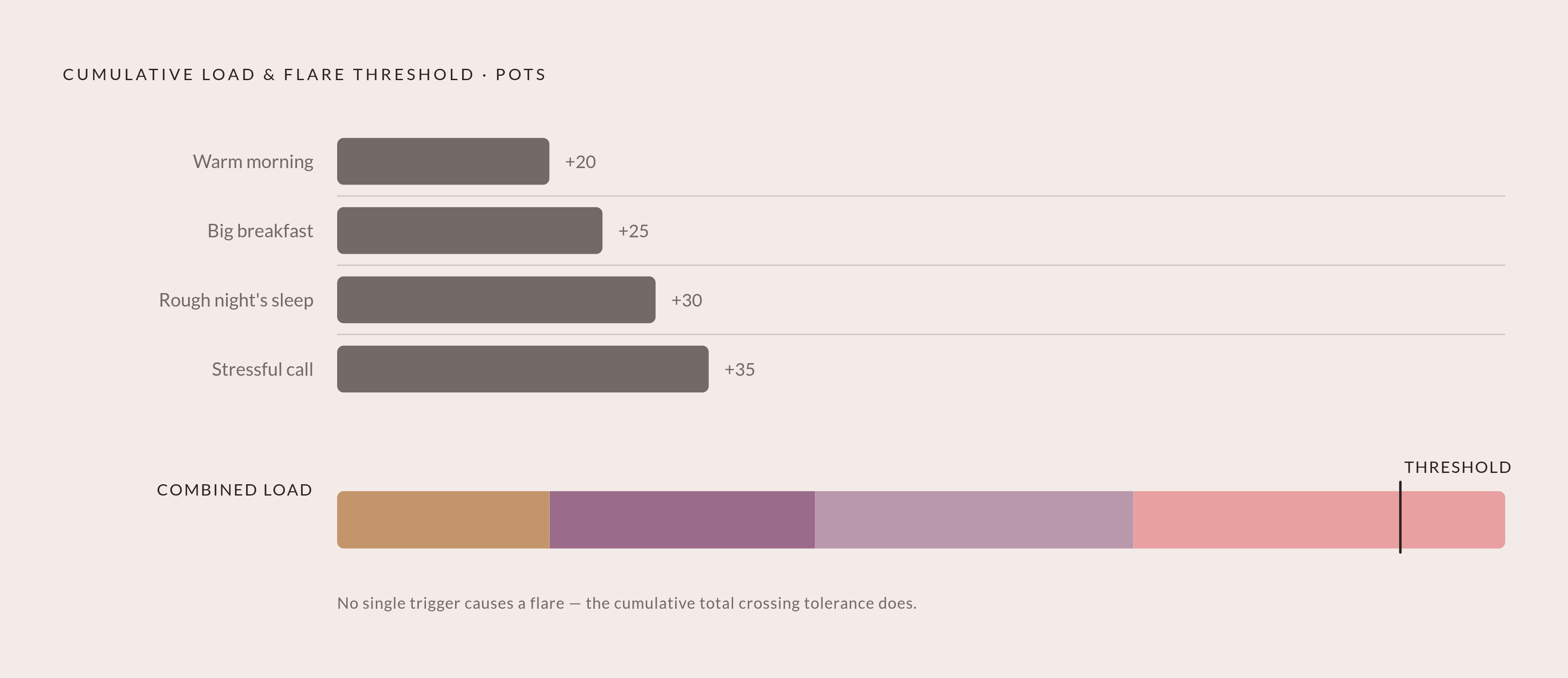
Back to the threshold. Any one trigger from this list, on its own, might stay comfortably inside what the system can absorb. Two or three of them together, on the same day, tip it over.
Picture a morning that's a little warm, a big breakfast, a rough night of sleep, and a stressful call, all landing within a few hours of each other. None of those four things looks unusual by itself. Together, they're a flare. The perimenstrual week works as a standing example of a lowered baseline: every trigger on this list hits harder during that window, which is exactly why the same routine produces wildly different outcomes depending on where someone sits in their cycle. Illness works the same way, crushing tolerance so hard that ordinarily manageable triggers suddenly aren't, which is why a minor cold can feel catastrophic to someone with POTS in a way it wouldn't to anyone else.
Eliminating every trigger isn't realistic, and chasing that goal wastes energy better spent elsewhere. Only data answers which combinations cross a given person's threshold. Guessing after the fact doesn't work, not reliably, not for long. Seeing the stack requires logging enough variables, at the same time, over enough days, for the pattern to actually show up.
What structured symptom tracking actually reveals that a general diary does not
A written diary captures how a day felt. Structured tracking captures why, because it logs the same variables (sleep, sodium, meal timing, cycle phase, exertion, stress) side by side with symptom severity, day after day, until the combinations that matter start repeating.
That repetition is the whole point. A single bad day proves nothing. Ten bad days that all share a poor night's sleep and a skipped-salt breakfast prove something a person can actually act on. Free-text diaries tend to describe symptoms in isolation ("felt dizzy, tired, foggy") without the structure to line those symptoms up against the five or six variables that might be driving them. Structured tracking is the only format that closes the gap, since that comparison requires it.
Over weeks, that comparison turns a condition that feels chaotic into one with visible edges. It shows which trigger combinations are load-bearing and which are noise. It gives a provider something concrete to respond to instead of a vague account of a bad month, and it hands the person living with POTS the one thing an unpredictable illness usually withholds: a reason to believe tomorrow is at least partly plannable.
Sources
- What Triggers POTS Flare-Ups — and What to Do About Them
- Symptom burden, quality of life, and diagnostic journey of people with postural orthostatic tachycardia syndrome, Australia, 2021–24: a descriptive patient registry data study
- Frontiers | The body and the brain keep the score: a data-driven conceptual model linking trauma and postural tachycardia syndrome
- What Is POTS? Postural Orthostatic Tachycardia Syndrome Explained Simply
- Did You Know? The Untold Truth About POTS, Autonomic Dysfunction & MCAS - POTS.NET
- incitefulmed.com
- eds.clinic
- health.clevelandclinic.org