POTS Symptoms Beyond Dizziness and Fainting
Brain fog, fatigue, and gut trouble often signal POTS, not separate conditions.
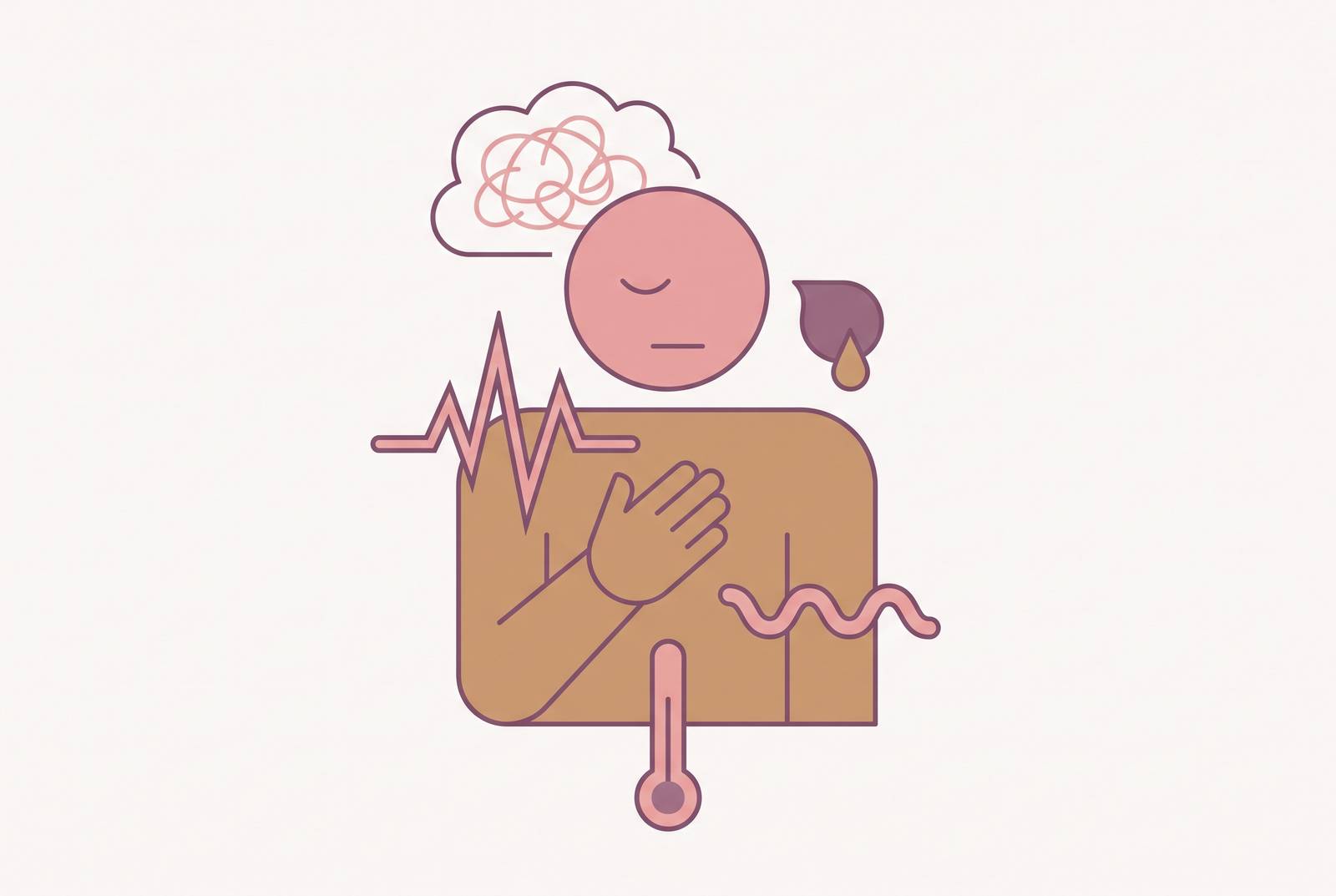
POTS, postural orthostatic tachycardia syndrome, is a form of dysautonomia: the autonomic nervous system stops managing heart rate, blood pressure, sweating, and body temperature the way it's supposed to. Most people know it by the headline symptom, dizziness or fainting on standing, but that's a sliver of the picture. Brain fog, gut trouble, temperature swings, crushing fatigue, and wrecked sleep run daily life for most patients, and doctors routinely treat them as separate problems instead of one condition. That habit, treating each symptom in isolation, is the single biggest reason diagnosis takes so long, and it's the wrong way to look at this disease.
Beyond dizziness and fainting, POTS patients commonly experience brain fog (reported by over 95% of patients), crushing fatigue that rest does not fix, nausea, constipation, bloating, temperature dysregulation, abnormal sweating, headaches tied to being upright, visual disturbances, chest pain, sleep disruption, and urinary urgency. All of these trace back to the same root cause: the autonomic nervous system failing to manage blood flow, vessel tone, heart rate, and organ function the way it should. Doctors mismanage them because each symptom, in isolation, looks like a different condition, fatigue reads as depression, nausea earns an IBS label, bladder trouble goes to a urologist, and nobody steps back to ask whether one underlying disorder explains the full picture. That habit of siloing symptoms is the reason the average patient waits 4 to 7 years for a correct diagnosis and sees roughly 7 different doctors before anyone connects the pieces.
The diagnostic marker is specific: a heart rate increase of 30 beats per minute or more in adults (40 or more in adolescents) within 10 minutes of standing, without a drop in blood pressure. Johns Hopkins Medicine lays this out plainly. What happens underneath is physics gone wrong: gravity pulls blood toward the legs when you stand. A healthy body tightens blood vessels and nudges heart rate up to compensate. In POTS, that vessel response is slow or missing, blood pools low, and the brain runs short on the flow it needs.
Three subtypes shape which symptoms hit hardest, and they don't sort into tidy boxes. Neuropathic POTS involves nerve damage that causes vessels in the arms and legs to fail to tighten, so blood pools there; it accounts for roughly half of POTS cases in adults, making it the most common subtype. Hyperadrenergic POTS comes from an overactive sympathetic nervous system, the fight-or-flight circuit, flooding the body with norepinephrine and causing surges and shakiness. Hypovolemic POTS involves insufficient circulating blood volume, compounding the pooling problem from the outset. Most patients show features of two subtypes, sometimes all three, at once, which is exactly why treating POTS as one uniform diagnosis misses the point.
POTS affects an estimated an estimated one to several million Americans, hits women at roughly five times the rate of men, and shows up most often in young adults. Because the autonomic nervous system touches nearly every organ, the symptom list stretches across the heart, the brain, the gut, the skin, and the bladder. Connecting those dots, the ones doctors rarely put together, is the point of everything below.
Why do doctors keep mismanaging POTS by treating each symptom separately?
The test itself isn't complicated. A 10-minute standing test, or a head-up tilt table test, tracks heart rate and blood pressure over time. Diagnosis needs the bpm threshold plus symptoms of orthostatic intolerance, with low blood pressure ruled out as the cause. None of it requires exotic equipment or a specialist most hospitals lack.
Yet the average time from first symptom to correct diagnosis runs 4 to 7 years, and patients see an average of 7 different doctors before someone connects the pieces. That delay isn't a mystery once you look at the overlap: fatigue, cognitive trouble, heart palpitations, and nausea read a lot like anxiety on paper, so patients get sent to psychiatry instead of cardiology or neurology. Apps like Juno, a symptom-tracking companion for chronic illness, exist partly because spotting those cross-symptom patterns over time is exactly what a single clinic visit cannot do. Treating anxiety in someone whose real problem is autonomic dysfunction doesn't just waste time, it leaves the actual condition to keep doing damage while nobody's watching it.
More than two-thirds of healthcare providers have never heard of POTS, according to Cognitive FX. That single number explains most of the "it's all in your head" conversations patients describe having for years running, and the misdiagnosis isn't a harmless detour. Research documents real iatrogenic harm, meaning harm caused by the treatment itself, when psychiatric interventions get aimed at what's actually an unrecognized autonomic disorder.
The diagnostic gap is widest exactly where this piece is headed next: symptoms nobody thinks to trace back to standing up, or to posture at all.
Brain fog: the symptom most patients report and most clinicians underestimate
Cognitive dysfunction shows up in over 95% of POTS patients, according to Cognitive FX. That's not a side effect some people get. It's close to universal, and it's the symptom clinicians most often wave off as stress or a mood problem, which is exactly backwards.
Patients describe trouble concentrating, losing words mid-sentence, slow processing speed, weak short-term memory, and struggling to hold several steps of a task in mind at once. The mechanism traces straight back to the same pooling that drives the heart-rate spike: when blood sits low in the body, the brain runs short on flow, and thinking suffers as a direct, physical result.
Recent research backs up what patients have said for years. A 2025 brain SPECT imaging study found 61% of participants had reduced blood flow in key brain regions even while lying down, which matters because it means the problem isn't purely about standing up. Standardized neuropsychological testing has documented mild to moderate cognitive impairment using objective measures, not self-report. Separate research has found working memory deficits that worsen when upright compared to healthy controls. Recent research points to multiple mechanisms working together, including cerebral hypoperfusion and autonomic dysregulation with sympathetic overactivation.
Brain fog persisting while lying flat is the detail clinicians miss most, and it's the one that should end the anxiety diagnosis on the spot: if resting doesn't clear it, it isn't a mood problem wearing a disguise. Cognitive dysfunction is often the first thing patients notice about POTS and the last thing anyone takes seriously.
The fatigue that doesn't improve with rest
POTS fatigue isn't ordinary tiredness, and rest doesn't fix it. Patients describe feeling wiped out after activities most people never think twice about: a shower, a walk to the mailbox and back.
A 2024 Cleveland Clinic sample of post-COVID POTS patients found fatigue reported by 62.5% of respondents, making it one of the most disabling symptoms in the condition. Many patients also get post-exertional malaise, or PEM: every symptom gets worse in the hours and days following activity, so a crash can trace back to exertion from well before it hits.
A vicious cycle builds from there. Fatigue cuts activity, less activity weakens cardiovascular fitness, weaker fitness worsens POTS symptoms, and worse symptoms feed the fatigue right back up. Breaking that loop takes careful, structured reconditioning. Pushing through it makes things worse. So does resting more; either extreme backfires. Exercise intolerance shows up as its own cluster on top of this: heart rate spikes with minimal effort, activity can't be sustained, and recovery drags on, especially after anything upright like walking or a standing workout.
None of this is laziness. It's physiological resource depletion, which is why pacing and energy budgeting count as medical strategy here, not lifestyle advice tacked on the side.
Gastrointestinal symptoms most POTS patients are told are something else
GI trouble runs through POTS at rates too high to write off as coincidence. A Boston Medical Center POTS survey, cited by Cognitive FX, found 86% of patients report nausea, 70% report constipation, and 59% report bloating. Pooled data from 352 patients out of Vanderbilt University Medical Center found nausea, vomiting, and abdominal pain ranging from 21% to 80% prevalence, with four studies on gastric motility finding 43% showing rapid gastric emptying and 20% showing delayed gastric emptying.
The mechanism isn't mysterious once you know where to look. Autonomic nerves control gut motility, blood flow to the digestive tract, and how fast the stomach empties, and POTS disrupts all three at once. That's a wiring problem with a measurable cause, not a functional or psychological complaint, and treating it as the latter is the mistake that costs patients years.
Eating makes things worse because digestion pulls blood toward the gut, deepening the pooling problem POTS patients already carry, which can trigger palpitations, weakness, and fatigue right after a meal. Large meals and high-carb meals hit hardest. Plenty of patients get an IBS diagnosis instead, and it sticks for years in some cases, but anyone with GI symptoms who also gets dizzy or feels their heart race on standing should push for a POTS evaluation specifically rather than settle for the IBS label. In the 2024 Cleveland Clinic post-COVID sample, IBS tied with Raynaud's as the second most common comorbidity, each showing up in 18.75% of patients.
Temperature dysregulation, sweat abnormalities, and blood pooling in the limbs
Heat is a universal trigger, full stop. Warm rooms, hot showers, humid days: all of it widens blood vessels, which deepens pooling and drops blood pressure further, amplifying nearly every other symptom on this list at once.
Sweating goes haywire in a way that looks contradictory but isn't. Some patients sweat heavily (hyperhidrosis) in certain regions while other areas, especially the extremities in neuropathic POTS where nerve damage runs deepest, produce no sweat at all (anhidrosis). Sweating can also hit with no connection to heat or exertion whatsoever. Research using the COMPASS-31 autonomic testing tool, published in Autonomic Neuroscience, documents significant secretomotor dysfunction (the nerves controlling sweat glands) across POTS patients broadly.
Many patients develop acrocyanosis, a purple-blue discoloration in the hands and feet from blood pooling when upright. It looks alarming the first time someone sees it, but on its own, it isn't dangerous. In hyperadrenergic POTS specifically, sudden flushing and sweating can strike with no warning. Research has found facial flushing in a large majority of POTS patients. Cold intolerance shows up too, since autonomic dysfunction breaks temperature regulation in both directions, not just toward heat.
None of this is cosmetic. Skin color changes and erratic sweating are visible signs of the exact nerve dysfunction driving everything else on this list.
Headaches, visual disturbances, and chest pain caused by reduced blood flow, not structural problems
About 30% of POTS patients get headaches tied specifically to being upright, driven by reduced blood flow to the brain, and many also deal with separate migraine-type headaches layered on top.
There's a symptom called coat hanger pain: an ache across the neck, shoulders, and upper back from reduced blood flow to the muscles holding posture upright. It's rarely named out loud, so patients chase it as a musculoskeletal issue, seeing physical therapists and chiropractors before anyone connects it to autonomic dysfunction. That detour alone can burn months, and it's a detour that a single tilt table test would have skipped entirely.
Vision takes a hit too. Blurred vision on standing, trouble focusing, light sensitivity, tunnel vision, and spots or floaters all trace back to reduced blood flow reaching the eyes and the brain's visual processing regions. Autonomic testing tools have documented measurable dysfunction consistent with these visual symptoms, giving them an objective basis instead of a subjective one.
Chest pain sends plenty of people to the ER convinced they're having a heart attack. It usually comes from the heart's abnormal rate changes, not a blocked artery, and it tends to worsen when upright. Shortness of breath follows the same pattern: breathlessness on standing or with minor exertion that sends patients to pulmonology or cardiology long before anyone says the word dysautonomia. Every symptom in this section gets worse with posture. That's the thread, and it's the clue nobody follows far enough.
Sleep disruption and bladder symptoms: how autonomic dysfunction reaches into night and rest
Sleep doesn't switch the autonomic problems off. Patients report trouble falling asleep, frequent waking, and waking up unrefreshed no matter how many hours they logged, stacking non-restorative sleep on top of daytime fatigue that's already severe.
In hyperadrenergic POTS especially, adrenaline surges can jolt someone awake in the middle of the night. Heart-rate variability during sleep runs abnormal in POTS patients generally, evidence that the nervous system stays dysregulated even at rest. A feedback loop sets in from there: bad sleep worsens brain fog, fatigue, and pain sensitivity the next day, and those worse symptoms make the following night even harder to get through.
Bladder symptoms follow the same autonomic thread, though doctors usually treat them as a separate issue entirely, which is another version of the same mistake running through this whole condition. Urinary urgency, a sudden and hard-to-delay need to go, creates real anxiety about being too far from a bathroom. Incomplete bladder emptying leaves patients feeling like they need to go again right away, raising the risk of urinary tract infections. Frequent urination shows up as its own recognized domain on the COMPASS-31 autonomic questionnaire, confirming it as a genuine autonomic symptom rather than a coincidence. Urologists and sleep specialists tend to treat these in isolation, and rarely does anyone step back and ask whether one underlying condition explains all of it at once.
When and why symptoms get worse: the triggers that define daily life with POTS
Symptoms don't hit at random. They cluster around a short list of predictable triggers, and once a patient sees the pattern, that's often what finally gets a doctor to take the condition seriously.
Mornings tend to be worst. Overnight fluid shifts leave circulating blood volume low on waking, which intensifies orthostatic stress right out of the gate. Eating triggers a second wave, since digestion pulls blood away from the rest of the body and worsens pooling, with large or high-carb meals doing the most damage. Heat compounds everything through vasodilation, whether it's a hot shower, a warm room, or a summer afternoon. Physical activity, especially anything upright, spikes heart rate and drains reserves fast, and PEM can delay the worst of the crash by 12 to 48 hours, so a patient often doesn't connect Tuesday's crash to Sunday's hike.
Menstruation adds another layer: hormonal shifts affect blood vessel tone and fluid balance, and many patients report worse symptoms around their period, though how much worse varies a good deal person to person. Dehydration and illness round out the list, both cutting circulating blood volume that's usually too low already, which is exactly why a mild cold or a skipped glass of water can knock a POTS patient flat for days.