POTS Prevalence and Who It Affects
A 14-fold surge in diagnoses reveals how COVID-19 transformed a hidden condition.
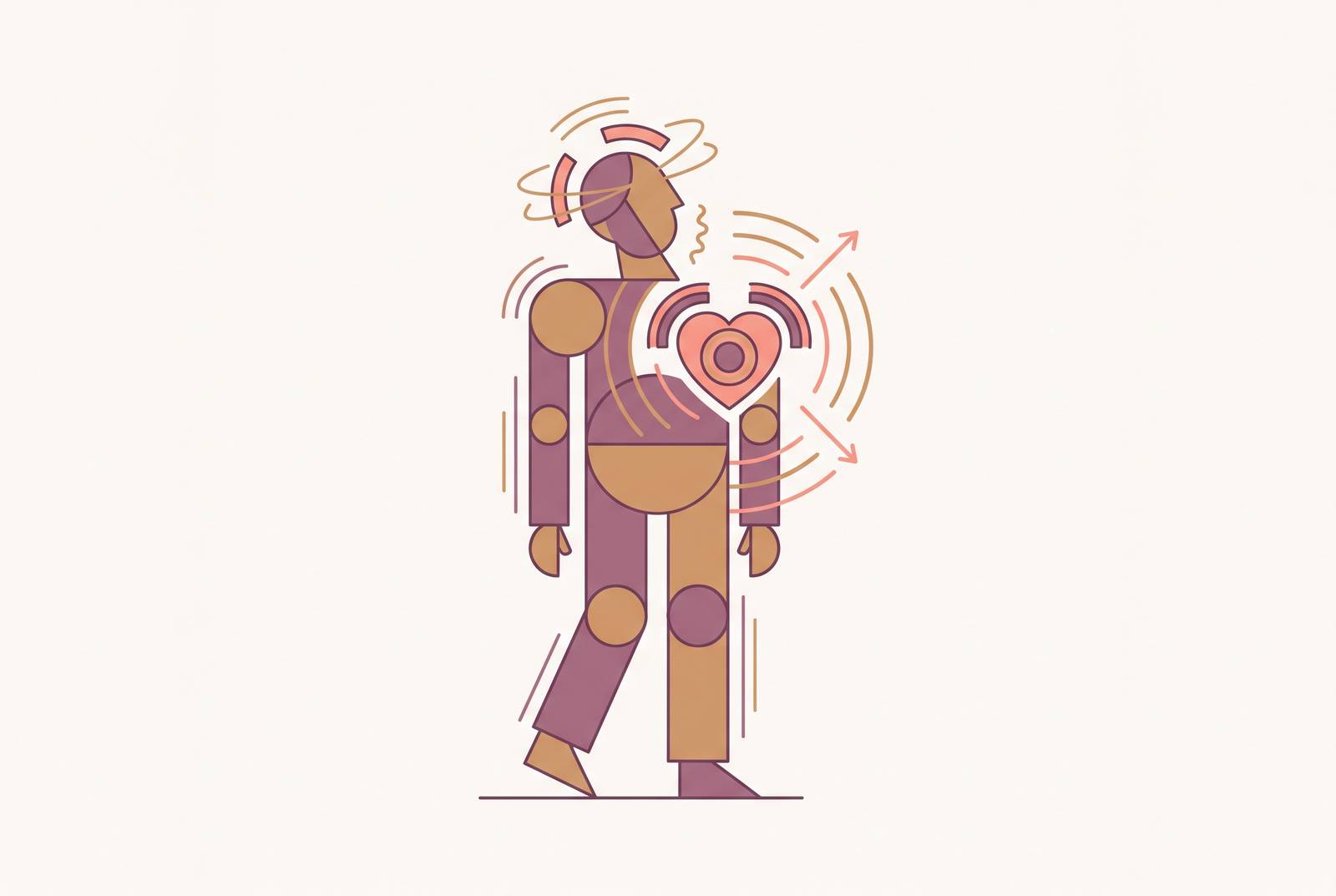
Postural orthostatic tachycardia syndrome, or POTS, is a chronic dysautonomia. The body fails to compensate when a person stands up. Blood pools in the legs instead of circulating back toward the brain and heart, the brain loses part of its oxygen supply, and the heart rate spikes as it tries to make up the difference.
In adults, the clinical threshold is a heart rate rise of at least 30 beats per minute within 10 minutes of standing, without a drop in blood pressure (orthostatic hypotension), along with symptoms. Kids get measured differently: a higher heart rate rise threshold, again within that same 10-minute standing window. The symptoms that come with it read like a list nobody wants: dizziness, fatigue, heart palpitations, fainting, exercise intolerance, brain fog, blurred vision, headaches. That overlap matters. A lot of these symptoms mimic other conditions, which becomes a real problem later on when doctors try to figure out what's actually going on with a patient.
This isn't some rare curiosity confined to a few odd case reports. POTS causes measurable, day-to-day functional loss for the people who have it, and the numbers involved are bigger than most people assume, especially now.
POTS prevalence before COVID
Even before COVID, nobody could pin down exactly how many people had POTS. Estimates put the general population rate around 0.2%. In one country's data, conservative counts landed somewhere between 500,000 and one million people, while clinical sources cited figures as high as 1 to 3 million.
A range that wide, from half a million to three million, tells its own story. Prevalence was contested territory long before the pandemic, and undercounting was baked into the system from the start, partly because getting diagnosed took so long (more on that shortly).
None of this was new territory, either. Doctors already knew that a viral illness could trigger POTS: somewhere between 30% and 40% of patients reported sudden onset following something that looked like a virus. COVID didn't invent this pathway, it just ran a huge number of people down it at once. There's a historical echo here too. After the 1918 flu pandemic, a well-known physician described a cluster of symptoms in British soldiers that Dr. Blair Grubb of University of Toledo Health now recognizes as POTS. The condition, in other words, predates its own name by about a century.
How COVID-19 changed the scale of POTS in five years
A 2025 study led by Dulal, Maraey, and colleagues and published in the European Heart Journal, Quality of Care and Clinical Outcomes, pulled electronic medical records from more than 65 million adult patients across 64 healthcare organizations in a single country. adult patients across 64 healthcare organizations, covering January 2018 through June 2024. The researchers split the data at March 1, 2020, marking the pandemic's arrival.
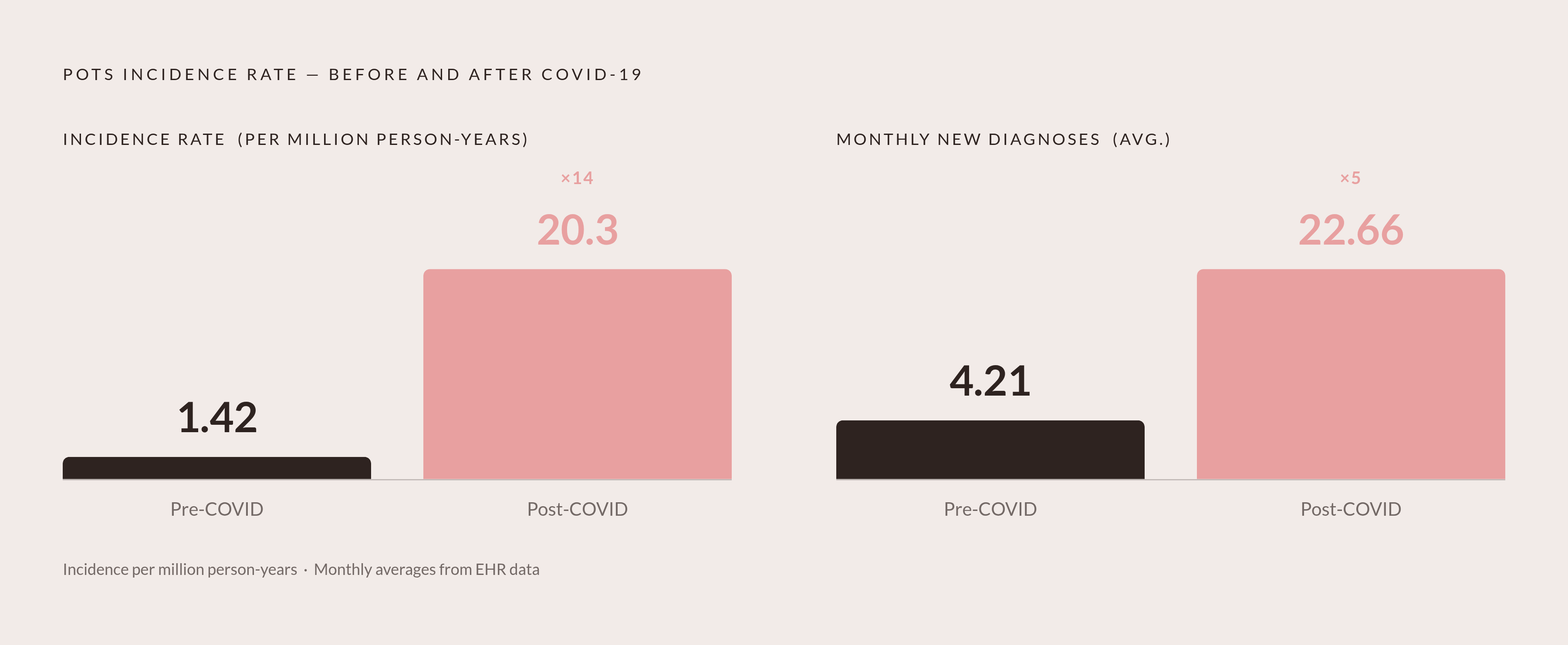
Before COVID, the incidence rate sat at 1.42 cases per million person-years. After COVID, it jumped to 20.3 per million person-years. That's a 14-fold increase in a condition that was already hard to count accurately. Monthly new diagnoses tell the same story from a different angle: 4.21 new cases per month before the pandemic, climbing to 22.66 per month after, more than a five-fold rise.
Case numbers actually dipped right after COVID hit, before climbing sharply starting in January 2023. That delay matters. It suggests doctors weren't immediately connecting POTS symptoms to post-COVID patients, and it took time (years, really) for recognition to catch up with what was actually happening in exam rooms. Dr. Grubb said in a University of Toledo news release: "My waiting list is longer than it has ever been."
Long COVID is a broad umbrella term covering a lot of different symptom clusters, the researchers behind the study noted. POTS is one specific, diagnosable, and treatable condition that long COVID, as a broad umbrella term, includes. Not everyone with long COVID has POTS. But a meaningful chunk of them do, which the next set of numbers makes clear.
How common POTS is specifically within long COVID populations
A separate study, published in Circulation: Arrhythmia and Electrophysiology, followed 467 long COVID patients who were highly symptomatic, not hospitalized, and on sick leave at least half the time. Researchers examined them at a median of 12 months after infection.
The breakdown: 31% met full criteria for a POTS diagnosis. Another 27% showed some symptoms but didn't meet the full clinical threshold. The remaining 42% had no clinical signs of POTS.
The functional difference between these groups appears clearly on a 6-minute walk test. Patients with POTS walked an average of 448 meters. Those with partial symptoms walked 472 meters. Patients with no POTS signs walked 509 meters (P≤0.001). The gap is stark: 448 meters versus 472 meters versus 509 meters (P≤0.001). It's the physical cost of the condition, measured in meters walked, and it's a concrete illustration of what "lower physical capacity" actually looks like day to day.
The overlap in reported complaints across groups underscores a core clinical challenge: symptoms alone don't reliably tell doctors who has POTS and who doesn't. Only systematic screening (the standing test, the heart rate measurement) can sort that out. And that 31% figure, arrived at only through testing rather than symptom checklists, is the real payoff here. It also lines up with a demographic pattern that long predates COVID.
Who has always been most likely to develop POTS
POTS has always disproportionately affected young women. Somewhere between 75% and 80% of patients are female, and most are diagnosed between ages 15 and 25.
The post-pandemic numbers from the TriNetX database, in that same 2025 Dulal et al. study, echo this almost exactly. The pre-pandemic cohort was 86% women with a mean age of 36. The post-pandemic cohort was 87% women with a mean age of 35. COVID expanded the total number of people with POTS considerably, but it didn't shift who gets it. Within the long COVID POTS subgroup specifically, the number climbs even higher: 91% female, somewhat older than the classic pre-pandemic presentation.
Kids show the same skew. Girls are diagnosed at 3 to 5 times the rate of boys, and POTS is increasingly recognized as a real driver of functional disability among children and teenagers, not just something they'll grow out of. An Australian patient registry covering 2021 through 2024, with 500 participants, found a mean age of 31.3 years, with 86.8% women and 15.2% adolescents.
Hormones play a real, documented role here, not a minor one. In one survey, 72.4% of respondents said their POTS symptoms got worse right before or during their period. Among those who tried hormonal contraceptives to manage symptoms, half said it helped. That's a clinically significant pattern sitting inside a population that's already overwhelmingly female.
Public figures like a well-known competitive swimmer and a singer named Halsey have both spoken about living with POTS, which has helped put a face on a condition most people had never heard of. But the registry data has a real blind spot: the Australian registry was 96.6% white, and racial and ethnic diversity is badly underrepresented across POTS research generally. The picture of who actually develops POTS may be more incomplete than the existing numbers suggest.
That demographic concentration in young women hasn't been incidental to how POTS gets treated by the medical system. It's shaped, and in a lot of ways distorted, how seriously doctors have taken the condition, which leads directly into the next problem: how long it takes to get diagnosed.
Why getting a POTS diagnosis takes longer for women
The Australian registry found patients saw an average of 5.2 different physicians before landing on a POTS diagnosis, and were currently consulting with an average of 7.5 specialists to manage it afterward. Worse, 13% of patients had seen more than ten doctors before anyone identified what was going on.
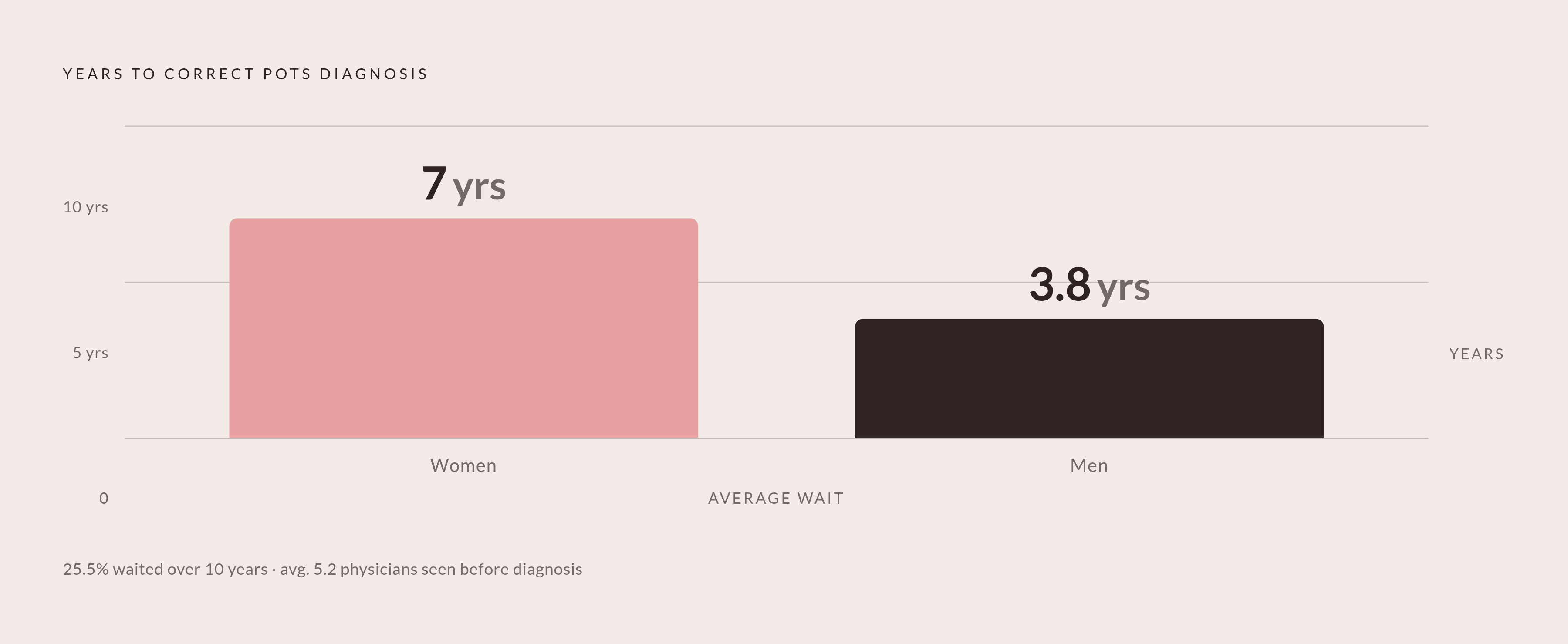
The gender gap in diagnostic delay is stark. Women waited an average of 7 years for a diagnosis. Men waited 3.8 years, less than half as long. Research into why points to a pattern that isn't flattering to the medical system: the delay appears to sit on the doctor's side of the exam table, not the patient's.
More than a quarter of Australian registry patients, 25.5%, waited over ten years for a diagnosis. There's a genuine bright spot buried in the numbers, though: patients diagnosed between 2019 and 2024 waited an average of 1.6 years, compared to 12.9 years for those diagnosed before 2019. Awareness is clearly improving. That doesn't erase the toll on everyone who spent a decade or more searching for an answer.
Misdiagnosis compounds the delay. In the Australian registry, 64.6% of patients had their symptoms chalked up to anxiety before anyone found POTS. Research has found that roughly 77% of POTS patients were initially diagnosed with a different condition. Further research broke down exactly what patients were told instead: 45% were first diagnosed with anxiety or panic disorder, 11% with depression, and 8% were told they had a conversion disorder or something psychosomatic.
The broader pattern is consistent: even when delays are shorter, some patients still wait many years before receiving a correct diagnosis. The downstream cost of all this delay is visible in emergency rooms: 54.5% of Australian registry patients had visited the ED before getting diagnosed, with a median of three visits each.
None of this traces back to patients failing to describe their symptoms well. It traces back to a systemic clinical failure, one with a documented, measurable body count in wasted years and unnecessary ER visits.
The disability POTS causes while patients wait
While all that diagnostic delay plays out, patients are living with a condition that genuinely disables them. In the Australian registry, 22% were unemployed. Just over a quarter, 26%, reported socializing less than once a month. Patients are living with a condition that genuinely disables them. It's isolation and lost income, stacking up year after year while people wait for someone to name what's wrong with them.
The disability burden POTS imposes is substantial, reflected in high rates of unemployment and social isolation among patients. Some patients end up needing wheelchairs or become bedbound. Registry data shows roughly one in five patients are unemployed while symptoms go unmanaged.
There's real reason for hope once a diagnosis actually happens, though. Evidence indicates that patients can see genuine symptomatic improvement with proper management. The outcomes aren't uniformly bleak. But every bit of that improvement depends on getting a diagnosis first, which is exactly the bottleneck the last section laid out.
The gap between what a person can physically do and how much energy a task demands is measurable in POTS, and it doesn't fluctuate randomly, it follows patterns tied to posture, sleep, hormones, and activity. That's why pacing and symptom tracking matter so much for this population.
POTS alongside EDS, MCAS, and hypermobility, the overlapping conditions that complicate the picture
In 2025, the American Gastroenterological Association issued clinical practice guidance addressing a pattern doctors kept seeing more of: patients showing up with some combination of hypermobile Ehlers-Danlos syndrome (hEDS), gastrointestinal symptoms, POTS, and mast cell activation syndrome (MCAS) all at once.
The overlap is substantial. In a pediatric registry, 62% of POTS patients also met criteria for hEDS or a hypermobility spectrum disorder. Flip it around, and among EDS patients under 25, 72% met criteria for POTS. A separate analysis covering more than 37,000 patients found that nearly 1 in 3 people diagnosed with MCAS also carried a comorbid hEDS diagnosis, and 38% of EDS patients met criteria for POTS as well.
What stands out about the AGA's guidance is the admission built into it: clinicians themselves often feel underequipped to manage patients presenting with this cluster of overlapping conditions. That's not a complaint coming from patients online, it's an acknowledgment from the medical establishment itself.
This cluster of EDS, MCAS, and POTS concentrates in exactly the population that already carries the heaviest POTS burden: younger women, particularly those with underlying connective tissue differences. Counting POTS diagnoses alone misses the real scope of the problem. For a lot of patients, POTS is just one layer sitting on top of several others, and each additional layer multiplies the mental and logistical work of managing a chronic illness, coordinating specialists, tracking symptoms, and figuring out which condition is driving which flare.
The impact of the expanding POTS population on day-to-day patient management
POTS symptoms shift with posture, the menstrual cycle, activity level, sleep quality, and medication timing. A single appointment, one snapshot in time, misses almost all of that movement. Patients who track what actually triggers their worst days walk into appointments with something concrete to hand a doctor, rather than a vague list of complaints assembled from memory.
That matters even more given how often POTS gets waved off as anxiety. When 45% of patients are first told they have a panic disorder and nearly two-thirds are told their symptoms are psychological, a timestamped, structured record of symptoms becomes a tool for pushing back, not just a nice-to-have.
Pacing isn't a lifestyle suggestion for people with POTS, it's a medical necessity, and the 6-minute walk test data (448 meters versus 509 meters) puts a number on something patients already knew from lived experience: their capacity is genuinely lower, not imagined, not exaggerated. Wearable devices and health data, heart rate response on standing, daily activity, sleep quality, all capture exactly the kind of signal that can reveal these patterns over time instead of relying on memory alone.
POTS went from a diagnosis most doctors barely mentioned to one that potentially affects millions of people, in the span of about five years. The systems built to manage it, clinical and technological alike, haven't caught up to that shift. Until they do, the work of tracking, pacing, and making the invisible pattern of this illness visible falls on the patients living it.
Sources
- COVID-19 Brought About a Large Rise in POTS Cases | UToledo News
- Rate of postural orthostatic tachycardia syndrome increased after COVID-19 pandemic
- Prevalence and Clinical Impact of Postural Orthostatic Tachycardia Syndrome in Highly Symptomatic Long COVID | Circulation: Arrhythmia and Electrophysiology
- Prevalence and Clinical Impact of Postural Orthostatic Tachycardia Syndrome in Highly Symptomatic Long COVID - PubMed
- ncbi.nlm.nih.gov
- pmc.ncbi.nlm.nih.gov
- academic.oup.com