Which Specialists Diagnose POTS
Multiple specialists are needed because POTS spans the heart and nervous system.
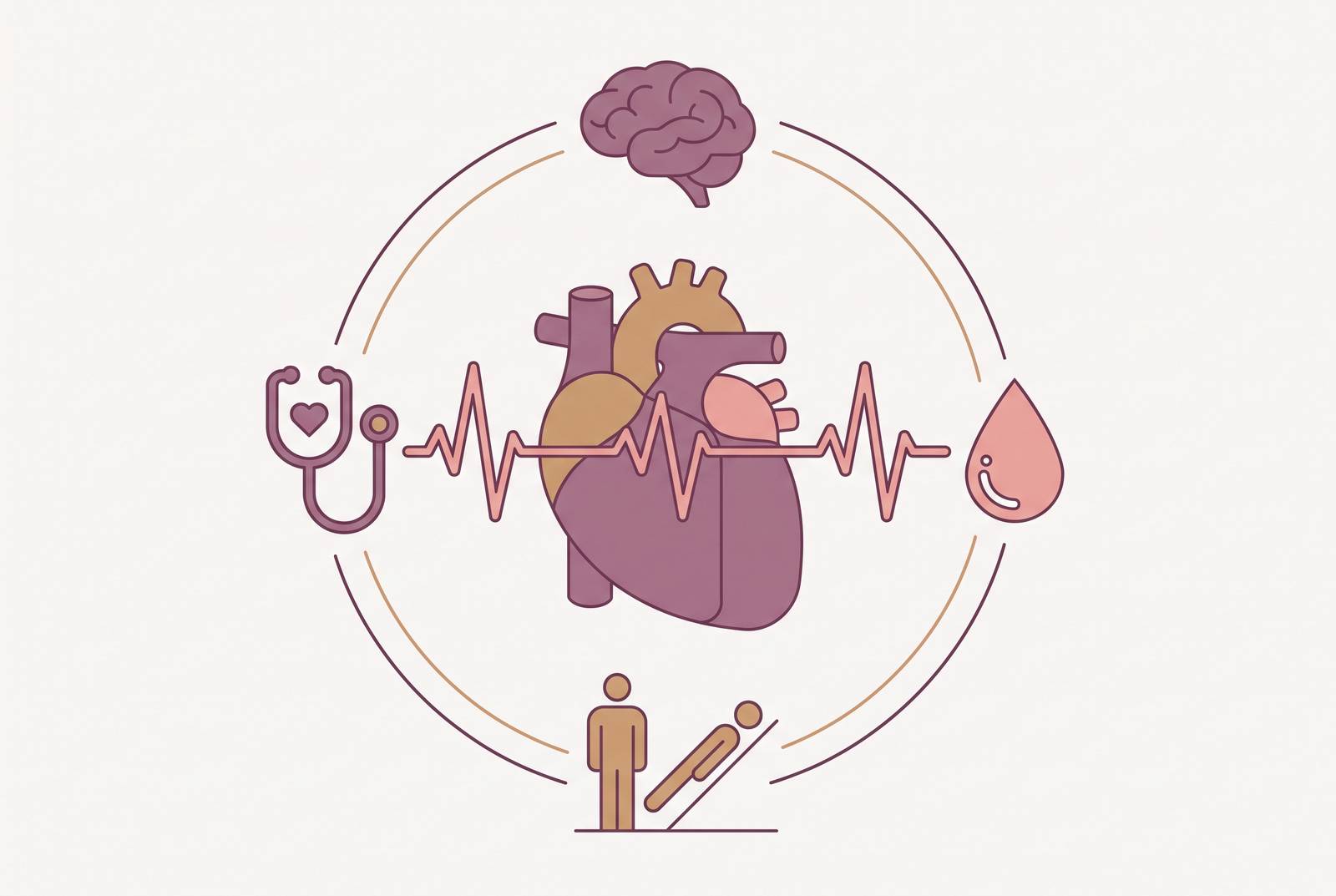
POTS (postural orthostatic tachycardia syndrome) is a disorder of the autonomic nervous system, not the heart, even though the heart makes the loudest noise. Stand up, and the heart rate climbs 30 beats per minute or more within ten minutes of standing in adults (40 or more in teenagers). The heart is following orders. The nervous system gave the bad instruction, and that mismatch is why POTS falls into the gap between specialties instead of landing cleanly in one. An estimated 3 million American adults and teens live with it, and it may affect as many as 1 in 100 teenagers.
Why cardiologists are usually the first door patients reach
Palpitations. Lightheadedness on standing. Near-fainting spells. Describe that combination to a primary care doctor, and the first word out of their mouth is almost always "cardiac." On paper, that's a fair guess.
History plays a part too. The tilt table test became the standard tool for diagnosing POTS, and its close association with cardiac workups gave cardiology an early claim on the condition. That claim has outlasted the reasoning behind it.
A cardiologist does real work here:
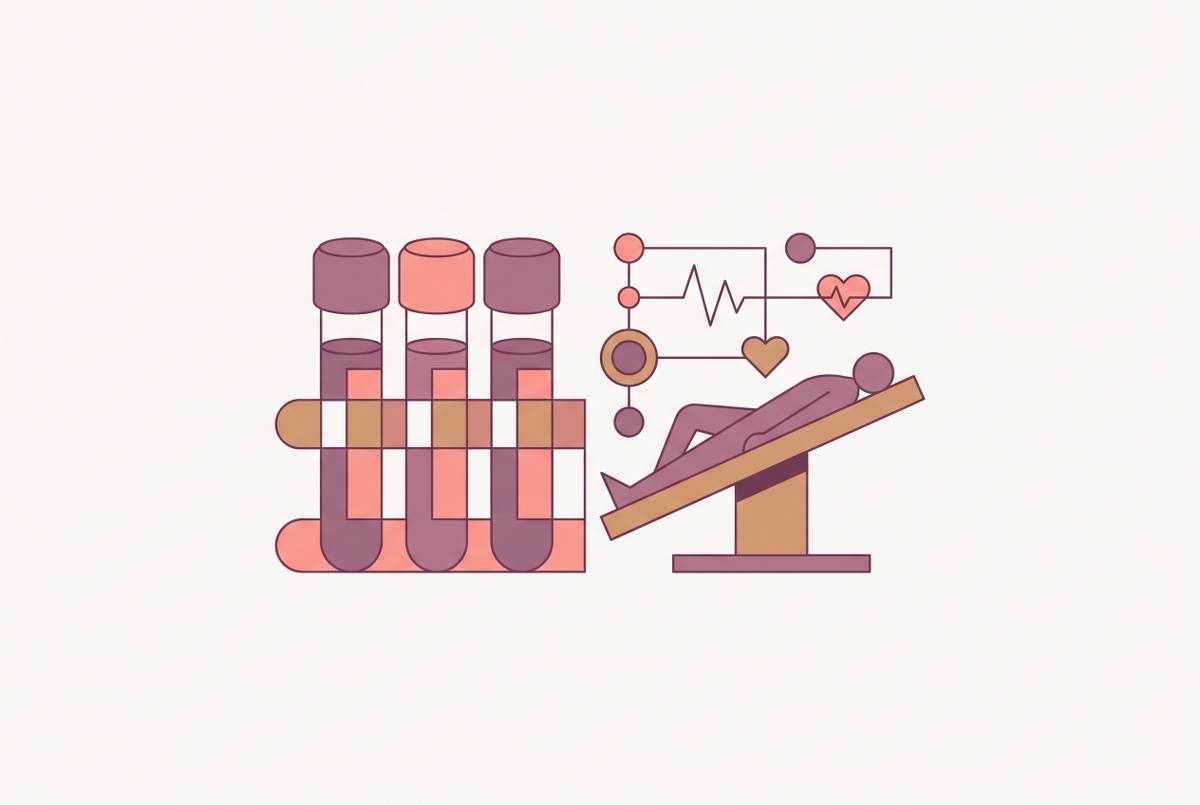
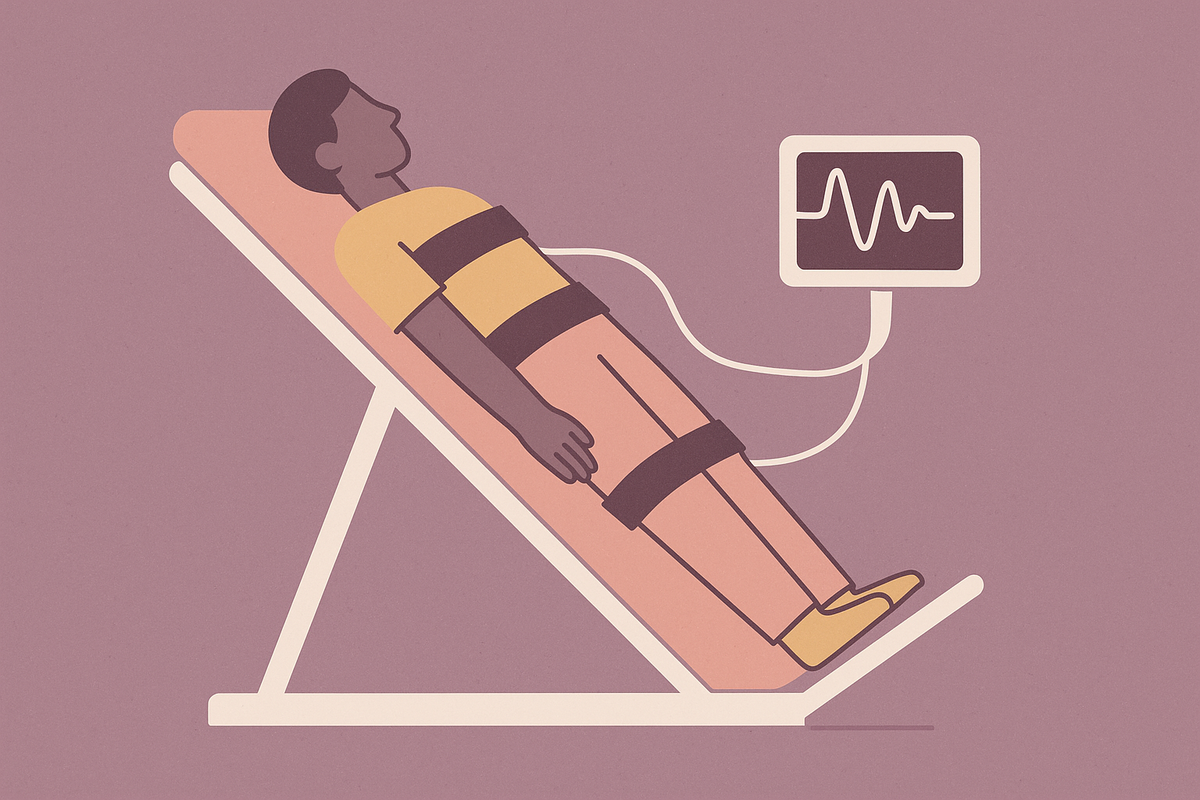
- Confirms the diagnosis with a tilt table test or standing heart rate monitoring
- Rules out structural heart problems that mimic POTS or make it worse
- Rules out orthostatic hypotension, a separate condition with its own treatment path
- Prescribes heart medications like beta-blockers, fludrocortisone, or midodrine
Cardiologists and autonomic specialists also tend to use different tilt table protocols, varying in duration and interpretation.
None of that reaches the nervous system actually sending the signal. A cardiologist can manage a patient's heart rate for years without ever identifying which subtype of POTS they have. That's the limit of the specialty, and it's the reason cardiology alone rarely closes the case.
What neurologists and autonomic specialists bring that cardiologists cannot
Neurologists chase the nerve-level cause. That's the whole difference, and it's the reason so many patients need a second specialist after cardiology has already run its tests.
Autonomic testing looks nothing like a cardiac workup:
Deep breathing exercises measure heart rate response, the Valsalva maneuver is used, and sweat gland function tests check whether the small nerve fibers controlling sweat glands still work.
Autonomic specialists also tend to use a different tilt table protocol from the one cardiology typically employs.
POTS presents differently across patients. Neuropathic POTS involves damage to small nerve fibers. Another form involves an overactive sympathetic nervous system. A third involves low blood volume. Treatment differs across these presentations, and a cardiologist working from a tilt table result alone has no way to tell them apart. That's a neurologist's job, and when small fiber neuropathy turns up on a biopsy, a neuromuscular specialist gets pulled in as well.
Other specialists who play a role
Primary care doesn't get enough credit here. A good GP rules out dehydration, medication side effects, and other conditions that mimic POTS before anyone gets referred anywhere. A squat-to-stand test or a cold pressor test done at the bedside can build enough evidence for a specialist referral without waiting on a tilt table slot, which in some regions means months.
Concrete cases with symptoms that include hypermobility require a rheumatologist referral once a connective tissue disorder becomes relevant. POTS occurs alongside connective tissue disorders often enough that a rheumatologist becomes relevant the moment hypermobility enters the picture. Dr. Brittany Goss, DO, a board-certified rheumatologist at The EDS Clinic in California, has spent over 16 years treating EDS and the conditions that travel with it.
Mast cell symptoms alongside POTS point toward allergy and immunology. Dr. Jim Harris, MD, Medical Director of The EDS Clinic and board-certified in Pediatrics and Allergy & Immunology, has treated EDS, MCAS, and POTS across multiple states.
Post-COVID cases add another layer. A Cleveland Clinic chart review of post-COVID POTS patients found chronic migraines as the most frequent comorbidity at 37.5%, with irritable bowel syndrome appearing in 18.75%. That pattern alone justifies a look from neurology and gastroenterology, depending on what the rest of the symptom picture shows.
How long patients wait for diagnosis, and why
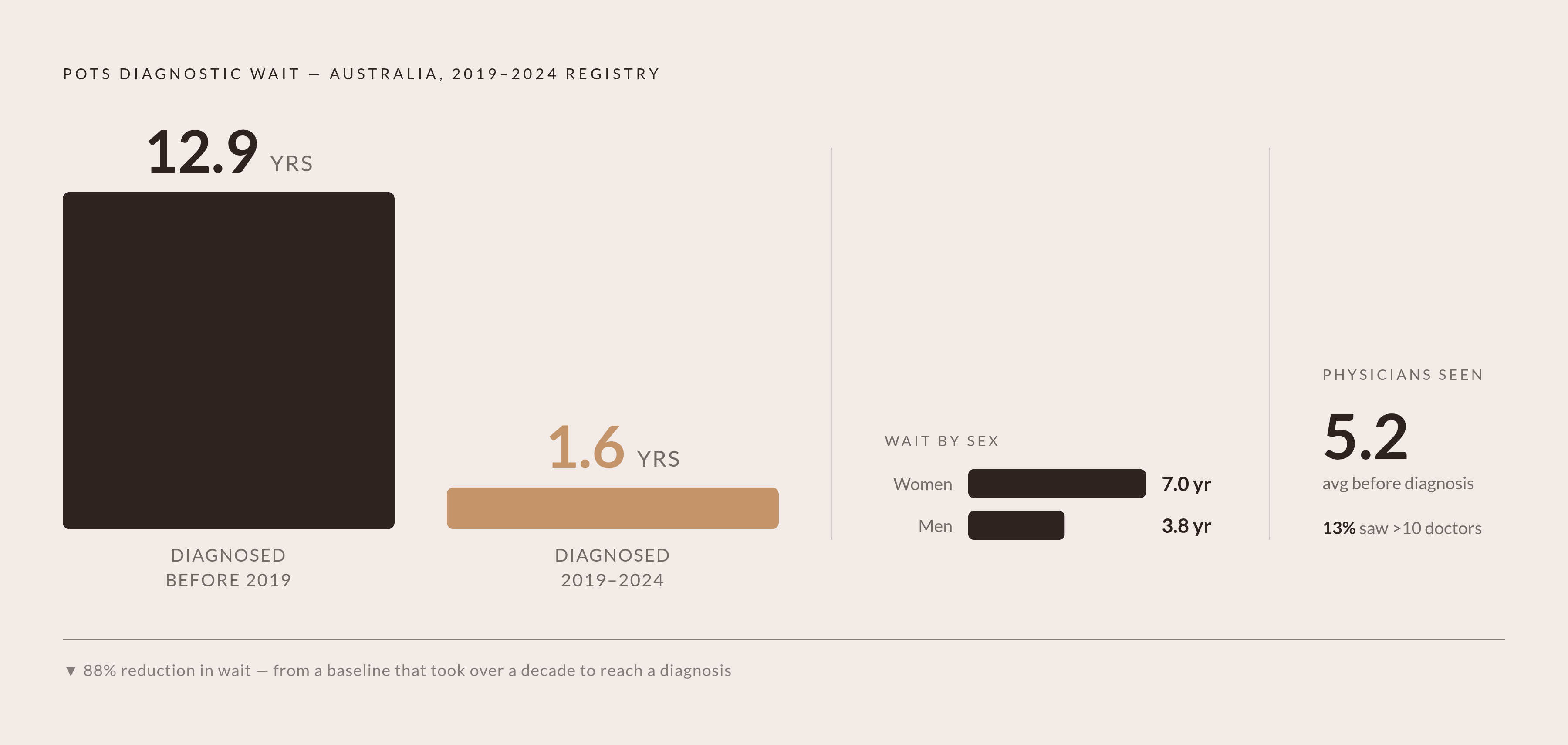
The Australian POTS Patient Registry found patients saw a mean of 5.2 physicians before diagnosis, and were juggling a mean of 7.5 specialists by the time they got one. Thirteen percent had seen more than ten doctors first.
An older survey of over 700 patients by Dysautonomia International found an average diagnostic delay of 5 years and 11 months. Only 25% got diagnosed within the first year. Half traveled more than 100 miles for care. The same Australian registry found women wait longer than men, a mean of 7.0 years against 3.8 (p = 0.010), and 25.5% of patients waited more than a decade. That gap between men and women is a sign that something in how symptoms get read by sex is broken. It's a sign that something in how symptoms get read by sex is broken, and it's been broken for a long time.
There's a genuine improvement buried in the same registry, though. Patients diagnosed between 2019 and 2024 waited a mean of 1.6 years, down from 12.9 years for those diagnosed earlier. Awareness is moving. It's moving slowly, and unevenly, but it's moving.
Roughly 77% of POTS patients get misdiagnosed with something else first. Anxiety or panic disorder tops the list at 45%. Depression follows at 11%. Another 8% get told they have a conversion disorder, a doctor's way of saying the symptoms are made up by the mind.
Why patients are so often told it is anxiety
The anxiety label isn't pulled out of nowhere. POTS runs through the same autonomic nervous system that governs the body's stress response, so anxiety-like symptoms can appear as a direct neurological feature of POTS itself, distinct from any anxiety a patient develops from living inside a confusing illness for years.
The numbers show where the real problem sits. A survey found more than 77% of POTS patients had been told by a doctor that their symptoms were psychological. Only 28% reported a comorbid psychiatric condition. That's a 50-point gap between what doctors said and what patients' histories actually showed, and that gap is where the misdiagnosis lives. It reads less like a nuanced clinical judgment and more like doctors reaching for the label that takes five minutes instead of the one that takes a tilt table.
Whatever psychiatric burden POTS patients carry tends to develop during the diagnostic odyssey, not before it. Untreated autonomic dysfunction wears a person down on its own. Being told repeatedly that nothing is physically wrong wears them down further.
That label carries a real cost, and it isn't just emotional. Once a patient gets filed under anxiety, the referral pathway closes behind them. Nobody sends an anxiety diagnosis to cardiology or neurology. They send it to therapy, or to an SSRI prescription, while the actual autonomic dysfunction keeps running untreated.
Navigating toward the right specialist without waiting years to get there
Start with primary care, but ask for something specific: an active standing test. Lie down for 10 minutes, stand, and have heart rate checked at 1, 5, and 10 minutes. It costs nothing, takes fifteen minutes in-office, and a positive result is often enough to justify a specialist referral without waiting on a tilt table slot.
From there, the right next stop depends on which symptom is loudest:
- Palpitations and near-fainting as the main complaint point toward cardiology or cardiac electrophysiology
- Brain fog, small fiber neuropathy, or autonomic problems spread across multiple systems point toward autonomic neurology, and it's worth going there directly instead of waiting for a referral chain
- Suspected EDS or joint hypermobility points toward a rheumatologist familiar with POTS, often the faster route than starting in cardiology
- A clear post-COVID trigger points toward a long COVID clinic, since a 2025 study in Circulation: Arrhythmia and Electrophysiology looked at 467 nonhospitalized long COVID patients and found 31% met POTS criteria at a median of 12 months after infection, and these clinics have developed familiarity with the overlap
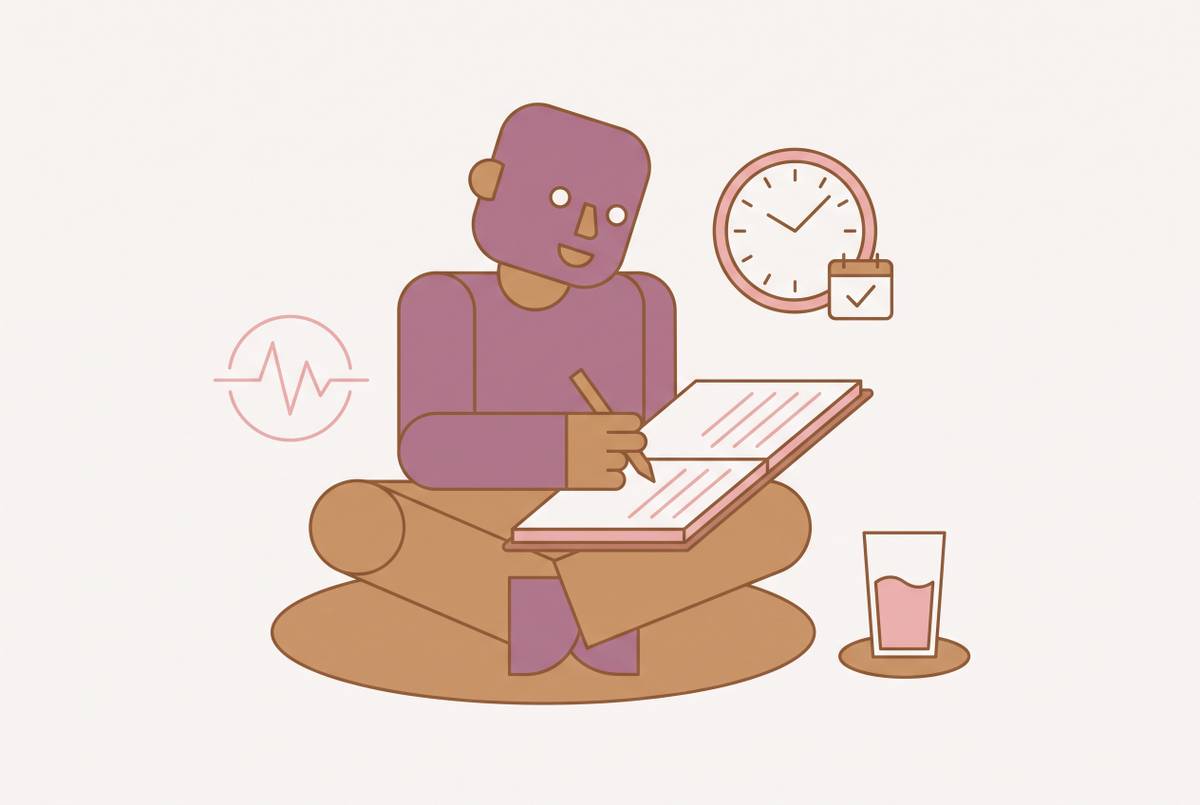
Prep work matters as much as the referral itself. Document symptoms by position (lying, sitting, standing) and by time of day: the pattern across posture is what separates POTS from other causes of a fast heart rate. Track triggers too, heat, meals, the menstrual cycle, activity level, and walk into the first appointment with a written timeline of when symptoms started, what made them worse, and what's already been ruled out.
Once in the room, a handful of questions cut through a lot of wasted time. Will a tilt table test or active standing test get ordered? Can the subtype get identified? Is there experience treating POTS alongside EDS, MCAS, or long COVID? Who else needs to be on the care team?
What structured symptom tracking gives you beyond memory alone
POTS symptoms move constantly. Palpitations, fatigue, brain fog, dizziness, all of it shifts with position, time of day, activity, temperature, and hormonal cycle. Heat makes it worse. So does standing too long. So can a heavy meal.
Memory can't hold that much moving data. Nobody remembers, six weeks later, that symptoms spiked on the three days it hit 90 degrees, or that they reliably worsen an hour after lunch. A written or app-based log does the one thing memory can't: it lines symptoms up against posture, time, and trigger, so a pattern that would otherwise dissolve becomes something a doctor can actually read and act on.
Walk into an appointment saying "I've been feeling bad." The likely outcome is a shrug and a follow-up booked for six months out. Walking in with a log showing when, how bad, and what came right before it tends to make the same appointment end in a referral instead.