Tilt Table Test What to Expect
Doctors use this test to catch autonomic nervous system failures that cause fainting.
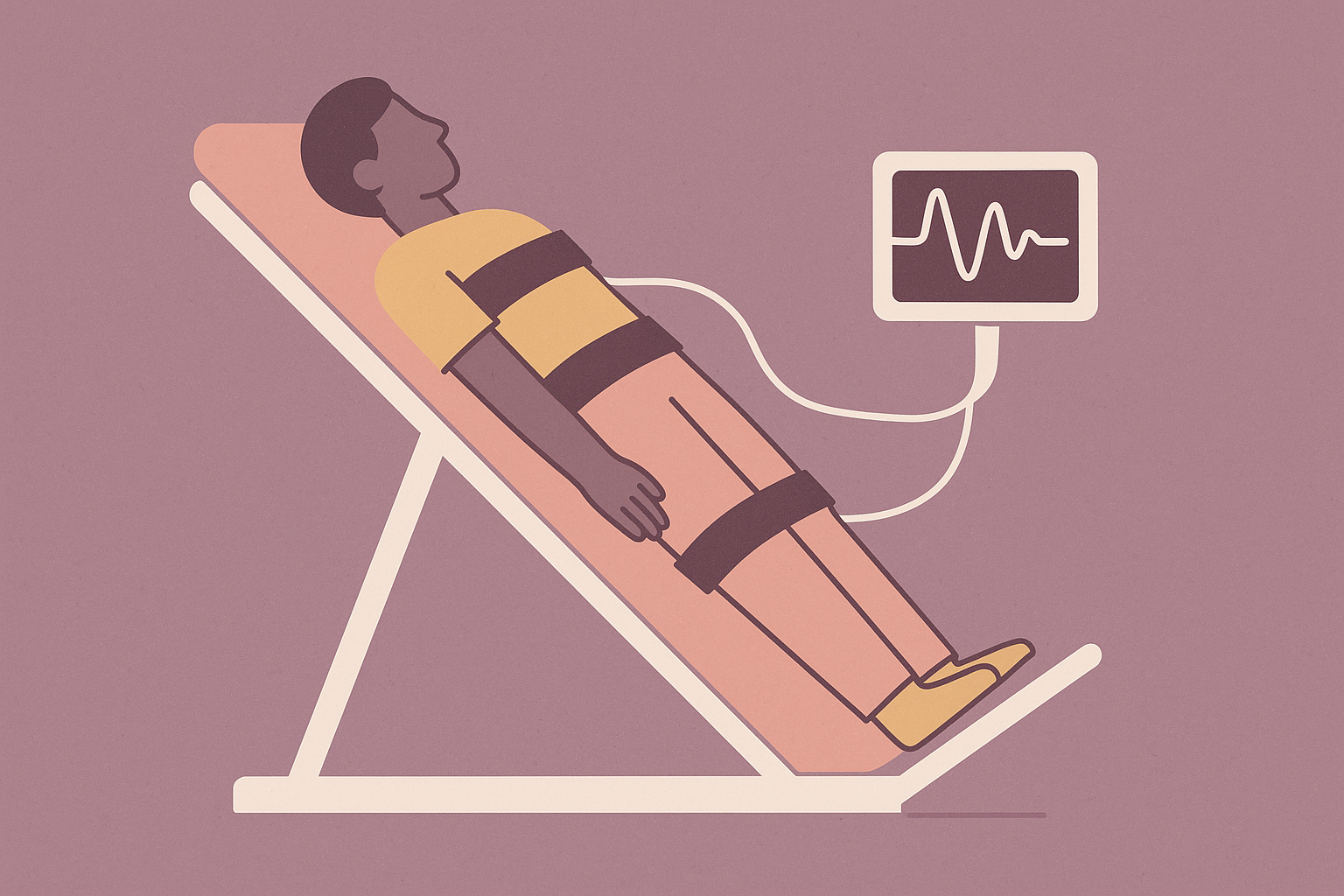
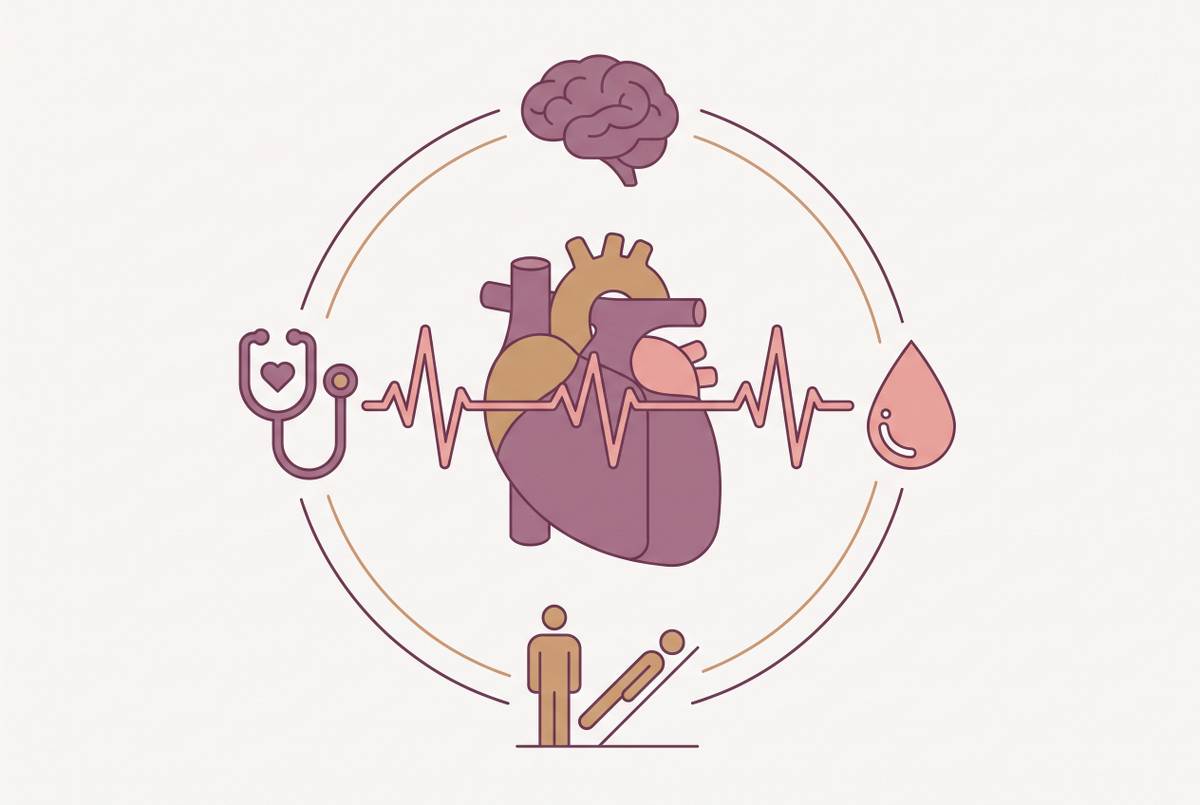
A tilt table test moves a patient from lying flat to nearly upright on a motorized table, while doctors watch how heart rate and blood pressure respond to that shift. Standing up looks simple, but the autonomic nervous system does real work every time it happens, tightening blood vessels and speeding the heart so blood doesn't pool in the legs and starve the brain. In POTS and vasovagal syncope, that adjustment process breaks down, and the tilt table test catches it happening in real time. It won't treat anything. What it produces is objective, reproducible data that turns "something's wrong" into an actual diagnosis, which is a different thing entirely and often the harder thing to get.
Doctors order this test after other explanations for fainting, dizziness, or unexplained falls have already been ruled out, often as part of a wider autonomic testing panel. It works up recurrent syncope, near-fainting spells, falls with no clear cause, and suspected POTS or orthostatic hypotension. It also separates convulsive syncope from epilepsy and can catch psychogenic pseudosyncope, where a patient loses consciousness, or appears to, without any drop in blood pressure. Cardiogenic causes like arrhythmias or structural heart disease get ruled out first, since those need a different workup.
Who this test may not be right for
Tilt table testing isn't for everyone, and the people who assume it's a routine, low-stakes procedure for anyone with fainting spells are wrong about that. Certain conditions make it unsafe or pointless, and providers screen for these before scheduling anyone.
Standard contraindications include significant carotid or coronary artery stenosis, hypertrophic cardiomyopathy with outflow tract narrowing, and severe anemia. If the cause of a syncopal event is already established through other means, tilting someone just to confirm it again serves no purpose. A patient with no history of syncope, pre-syncope, or falls generally isn't a candidate, either. Anyone medically unstable gets excluded too. Pregnancy adds another layer of caution, and providers review medical history closely before deciding whether the test makes sense.
For people with severe or bed-bound presentations, the exertion involved doesn't have to look like exercise to trigger a crash. A 2026 cardiometabolic review indexed in a biomedical research database found that challenges far milder than conventional exertional testing can worsen symptoms in this population, and it raises the possibility that post-exertional malaise in severely affected patients is a distinct physiological state, a difference in kind from what milder patients feel. Healthy controls in that data showed no meaningful change at any point, which is exactly the contrast that matters here.
Juul Tromp, whose account appears in reporting on this issue, could walk down stairs and manage light tasks before a tilt table test. Afterward, she became effectively bedbound. That's a reason for a subset of patients to sit down with a specialist first and ask direct questions: what protocol will be used, whether a shorter tilt angle or duration is an option, and what the rec... It's a reason for a subset of patients to sit down with a specialist first and ask direct questions: what protocol will be used, whether a shorter tilt angle or duration is an option, and what the recovery plan looks like if symptoms spike mid-test. For most people reading this, none of it applies. For a smaller group, this is the paragraph that matters most in the whole piece.
Preparing in the days and hours before the test
Preparation is one of the only things a patient actually controls here, so treat it as more than a formality.
Arrange a ride home ahead of time. Driving yourself is unsafe if fainting or severe symptoms hit during the test, and most facilities won't discharge someone who plans to drive, regardless of how the test went.
Fasting matters too. Expect instructions to skip food and drink, sometimes from midnight the night before, with water occasionally allowed. Cut caffeine entirely on test day; some providers push that back to 24 hours for both caffeine and alcohol, since both dehydrate the body and raise the odds of fainting. Nicotine is off the table in any form.
Medications need careful handling, and this is not a decision to make solo. Certain drugs affect heart rate and blood pressure directly, and a doctor may want them paused before testing, but that call belongs to the care team. Stopping a medication without guidance can be dangerous. Bring a full list: prescriptions, over-the-counter drugs, vitamins, supplements, all of it, and flag anything for blood pressure, heart rhythm, or erectile dysfunction specifically, since those interact most directly with how the test plays out. Pacemakers and implanted cardioverter defibrillators need disclosing too.
On the day itself, wear something easy to move in, ideally a two-piece outfit, since the top half usually comes off for a gown. Read the consent form fully and ask questions before signing, not after. Empty the bladder right before the procedure starts. Fainting can occasionally cause urinary incontinence, and providers should mention that risk ahead of time, so packing a change of clothes is just practical.
What happens in the room: setup, monitors, and the resting phase
The room tends to be quiet and dimly lit, often inside a cardiac electrophysiology or autonomic function lab. Nothing about the environment is built to stimulate the senses, and that's deliberate.
The table is padded and motorized, fitted with a footboard to stand against and straps across the chest and legs. Those straps aren't for comfort. The straps keep the patient from falling if fainting occurs. Leg muscles never have to work to hold the body upright. Muscle contraction in the legs normally helps push blood back to the heart when a person stands, and taking that mechanism away is part of what makes the test sensitive enough to catch subtle autonomic failures that a normal stand-up wouldn't reveal. Taking that mechanism away is part of what makes the test sensitive enough to catch subtle autonomic failures that a normal stand-up wouldn't reveal.
Setup includes an IV line in the hand or arm, in case medication or fluids become necessary later. ECG electrodes go on the chest, wired to a monitor tracking heart rhythm continuously. A blood pressure cuff wraps around the arm, and some facilities add a second cuff on a finger for continuous, beat-to-beat readings instead of periodic checks.
Then comes the resting phase. Patients lie flat for at least 10 to 15 minutes while staff record baseline heart rate and blood pressure. Skipping this step removes any way to tell whether what happens during the tilt is genuinely abnormal or just ordinary variation. The room can feel sterile and a little disorienting at this point, lying still under monitors with nothing to do but wait. That's a normal reaction, not a problem, and staff stay present the entire time, watching vitals without a break.
The tilt sequence: angles, timing, and bodily sensations
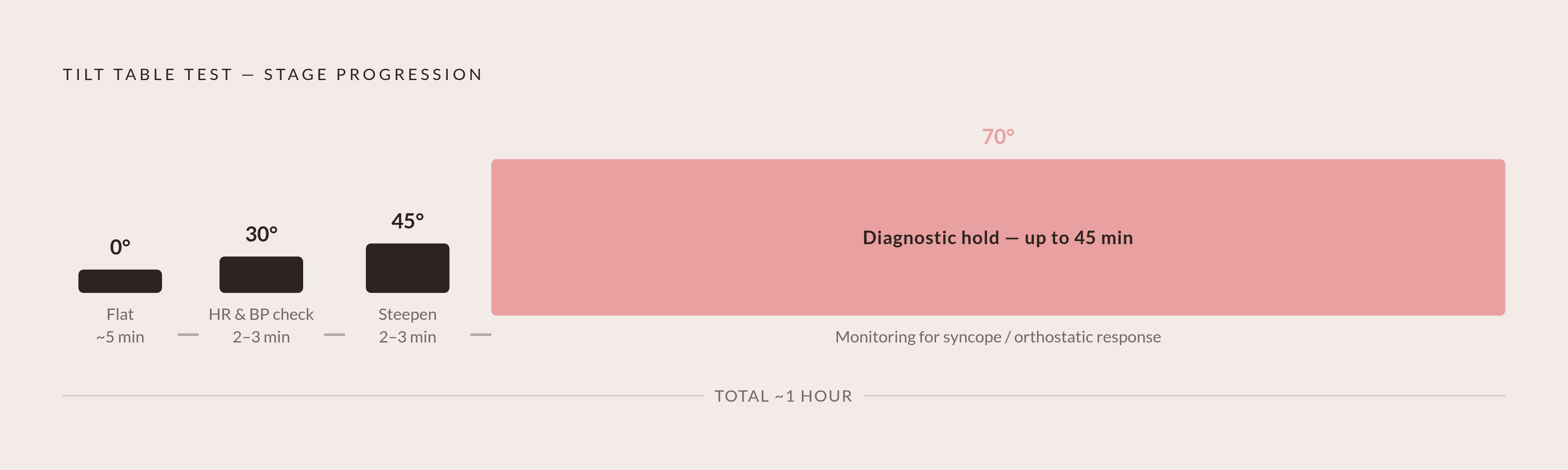
The actual tilt happens fast: flat to nearly upright in about 10 seconds. The table lifts the head to 30 degrees first, where blood pressure and heart rate get checked. After 2 to 3 minutes, it moves to 45 degrees. After another 2 to 3 minutes, it reaches 70 degrees, and most protocols hold there for the bulk of the test, sometimes up to 45 minutes. Different sources put the target upright angle anywhere from 60 to 80 degrees, but 70 is the standard most protocols cite.
During that upright phase, the job is simple: stay still, stay quiet, and say something the moment anything feels off. Dizziness, nausea, a faint feeling, shortness of breath, none of that counts as failure. It's the exact data the test exists to collect, and staff are watching continuously, ready to bring the table back to flat the second symptoms escalate.
Common sensations include lightheadedness, heart palpitations, nausea, changes in vision, and a heavy, weak feeling in the legs. If fainting actually occurs, the table drops back to horizontal right away, and recovery tends to happen fast once gravity alone restores blood flow to the brain. Total time upright runs up to 45 minutes, and the whole test, start to finish, usually takes around an hour.
Why the pharmacological challenge phase may be added
Sometimes the tilt alone doesn't produce a clear answer, so a medication challenge gets layered on top to push things further.
Two drugs come up most often. Isoproterenol, a beta-agonist given through the IV, raises heart rate and makes vasovagal syncope more likely to show up in people prone to it. It gets used when that diagnosis is already suspected going in. Nitroglycerin works from the other direction, lowering blood pressure to provoke orthostatic symptoms that the passive tilt alone might have missed.
The sequence for this phase usually brings the patient back to flat first, gives the medication, then tilts the table upright again while symptoms get watched closely. Headache is a common side effect and generally passes on its own, and knowing that ahead of time keeps it from feeling alarming mid-test.
Older protocols treated the two-part structure, passive tilt followed by medication, as the default. The passive tilt alone is often enough, and the pharmacological add-on gets used more selectively depending on the clinical picture. Ask the referring clinician directly whether a medication phase is planned, and if so, why. The answer should speak to the specific case.
Reading your results: what normal, positive, and specific patterns mean
A normal result looks almost boring on paper: blood pressure stays steady as the table rises, heart rate climbs moderately, and systolic pressure holds steady for the full duration without symptoms.
POTS has a specific, numeric threshold, which makes it one of the more clear-cut findings this test can produce. Heart rate needs to climb by at least 30 beats per minute within 10 minutes of tilting (40 bpm in adolescents), without a matching drop in blood pressure. The tilt table test is the gold standard for documenting that rise, though a full POTS diagnosis needs more than one test result on its own. Clinicians also look for symptoms lasting at least three months, a pattern that worsens upright and improves lying down, and the absence of some other condition that would explain the heart rate increase by itself.
Other patterns point toward other diagnoses. Vasovagal, or neurocardiogenic, syncope is marked by a drop in blood pressure, sometimes with a drop in heart rate, sometimes without. Orthostatic hypotension is a plain blood pressure drop on standing. Delayed orthostatic hypotension is the same drop arriving later in the tilt instead of right away, and initial orthostatic hypotension is a distinct pattern occurring at the start of the tilt. Psychogenic pseudosyncope looks like fainting from the outside, but blood pressure never actually drops, telling clinicians the cause is somewhere outside the cardiovascular system.
A positive result gives the treating clinician something concrete to build a plan around, often the answer a patient has been chasing for months. A negative result doesn't mean nothing's wrong: it can mean symptoms are intermittent and simply didn't show that day, or that a different test is needed next. Either way, the tilt table result gets read alongside symptom history and whatever other autonomic testing is already on file. It's one piece of a larger picture, not the whole picture.
Recovery after the test at home
Right after the table returns to flat, feeling lightheaded or worn out is common, and resting in that position until things settle is standard practice. Hydration and food help the recovery along, and anyone who fainted or had severe symptoms during the test shouldn't drive for the rest of that day. For most patients, the dizziness, low blood pressure, and nausea clear up fast once they're lying flat again.
The 278-patient study mentioned earlier tracked post-tilt outcomes across multiple follow-up points. Healthy controls showed no meaningful change across those checkpoints, which is the whole point of comparing them against patients who did.
Arrange help getting home. Clear the following day or two for rest instead of jumping back into normal activity, and have an explicit plan with the care team for what to do if symptoms worsen days later. Post-exertional malaise doesn't always appear right away. Sometimes it takes 24 or 48 hours to land, which is exactly the window most people assume they're already in the clear.
Sources
- What Is Tilt Table Testing?
- Tilt table test - Mayo Clinic
- Tilt Table Testing | Johns Hopkins Medicine
- Tilt Table
- Tilt-Table Test | American Heart Association
- Tilt Table Testing - Cardiology - Merck Manual Professional Edition
- Recommendations for tilt table testing and other provocative cardiovascular autonomic tests in conditions that may cause transient loss of consciousness: Consensus statement of the European Federation of Autonomic Societies (EFAS) endorsed by the American Autonomic Society (AAS) and the European Academy of Neurology (EAN)
- “It’s like torture”: The tilt table test could be risky for many people with Long COVID - The Sick Times