Dysautonomia Types and How They Differ
Distinguishing dysautonomia types prevents years of misdiagnosis.
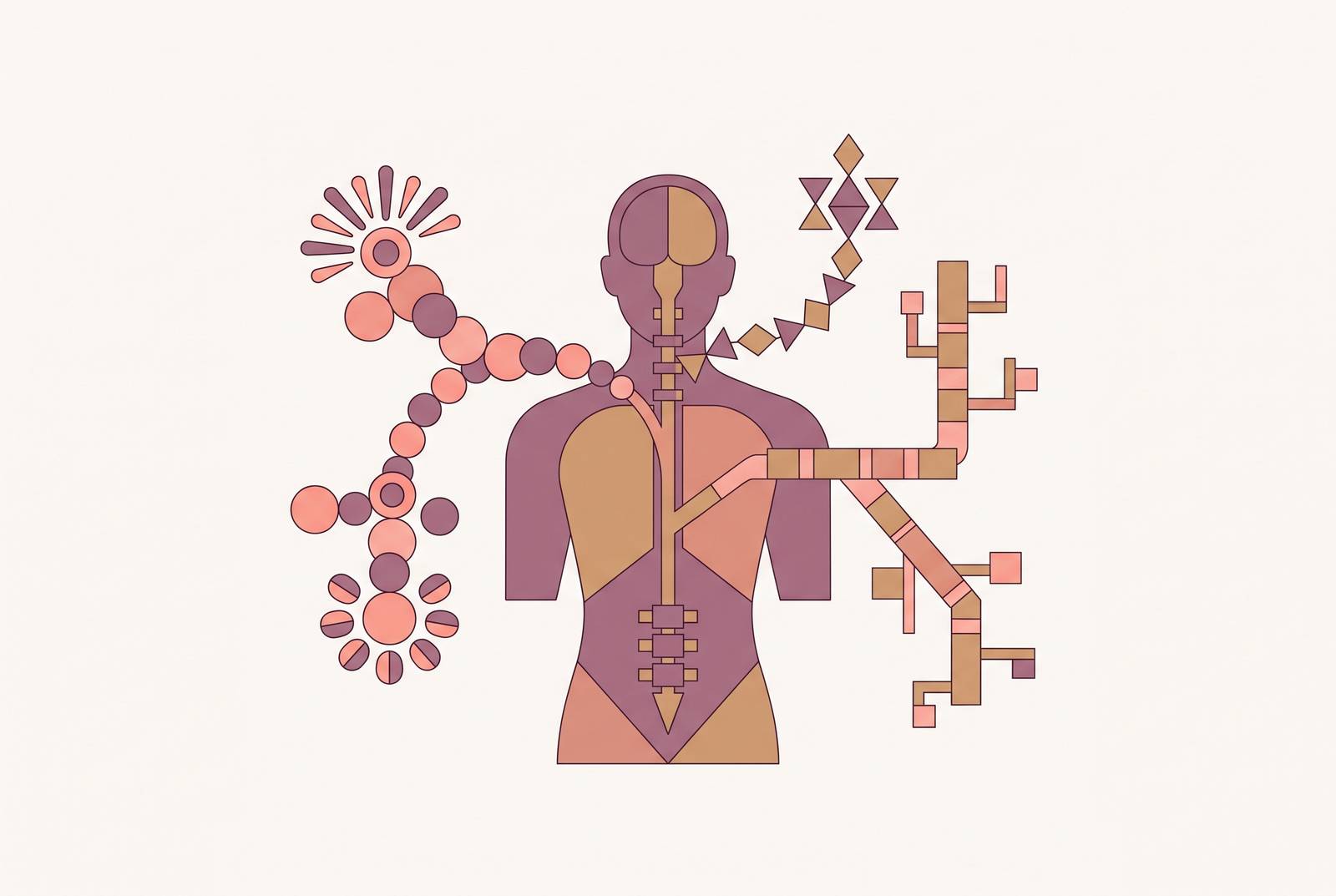
Dysautonomia is not one disease. It's an umbrella term for any breakdown in the autonomic nervous system, the network running heart rate, blood pressure, digestion, temperature, pupil size, and kidney function without anyone ever having to think about it. Under that umbrella sit more than a dozen distinct disorders, each with its own failure pattern, its own triggers, its own daily grind. Mixing them up is exactly why so many patients spend years being told it's "just anxiety," and that mislabeling is the actual problem worth fixing.
Dysautonomia International puts the global figure at over 70 million people living with some form of this. POTS gets most of the attention these days, a focus worth pushing back on. RTHM's 2026 analysis puts the figure for one country at 6 million, a number pushed up hard by post-COVID illness. Zoom out globally, though, and POTS accounts for roughly 11 million of that 70 million total, according to an October 2025 epidemiological analysis. Do the subtraction: something like 59 million people are living with a non-POTS form of dysautonomia, forms that get a fraction of the research funding and public awareness POTS now enjoys. The condition getting the headlines is a minority of the actual patient population. That's backwards, and it matters, because it means the other 59 million are working from a research base and a public vocabulary that wasn't built with them in mind.
The recognition gap is the real story here. Somewhere around 90 people get told they have "dizziness" or "unexplained fainting" for every 1 person whose symptoms actually get traced back to an autonomic root cause. That's an enormous pool of people walking around with a vague symptom label instead of an actual diagnosis. At least 15 subtypes have been formally recognized. The rest of this piece covers the ones that matter most clinically, and shows how they differ not just in symptoms but in mechanism. A fainting spell and a racing heart come from completely different places in the body. Treat the wrong one and nothing improves, no matter how well-intentioned the treatment plan.
The autonomic nervous system runs on autopilot. Stand up too fast and it should tighten blood vessels and nudge the heart rate so blood keeps reaching the brain. Eat a meal and it redirects blood flow to the gut. Get too warm and it triggers sweating. Dysautonomia means one or more of these automatic corrections is broken, sometimes because the nervous system tissue itself is degenerating (the way it does in Parkinson's disease), sometimes as a downstream effect of something else entirely, like an infection, an autoimmune disease, or a spinal injury. Onset can happen at birth or arrive decades later; average onset lands somewhere between 50 and 60, though plenty of the conditions below hit teenagers and young adults hardest. Because the symptoms, dizziness, fainting, a racing heart, exhaustion, are so generic, a 2025 review by Blitshteyn in Immunologic Research noted that dysautonomia may go undiagnosed or be mislabeled as a psychiatric disorder instead of what it actually is: a physical malfunction with a traceable mechanism.
Neurocardiogenic syncope: the most common form most people have never heard of
Neurocardiogenic syncope, also called vasovagal syncope, is the most common dysautonomia on the planet, affecting tens of millions of people worldwide. Most have never heard the term even after living through it repeatedly.
The mechanism is a reflex gone wrong. Gravity constantly pulls blood down toward the legs. A working autonomic system corrects for this instantly, tightening blood vessels and adjusting heart rate so the brain stays perfused. In NCS, that correction misfires: heart rate and blood pressure drop suddenly instead of adjusting, blood flow to the brain briefly fails, and the person faints. Standing up is the classic trigger, but dehydration, heat, alcohol, and emotional stress all set it off too.
Severity varies enormously. Some people faint once a year. Others faint multiple times a day, which brings real risk of head injury from falls. Most episodes come with a warning period first: nausea, sweating, pale skin, tunnel vision. That warning is what separates NCS from a sudden cardiac event with no prodrome at all. Management usually starts simple: avoid known triggers, use physical counter-maneuvers like crossing the legs and tensing muscles, and in some cases try beta-blockers, though the evidence there is mixed. A small number of severe, refractory cases get a pacemaker.
NCS is not low blood pressure in general, and it's not free-floating anxiety either. It's a specific reflex failure, and confusing it with other types sends the treatment plan in the wrong direction from day one.
POTS: why a racing heart upon standing is its own distinct problem
POTS, postural orthostatic tachycardia syndrome, gets defined by one number: a heart rate increase of at least 30 beats per minute in adults (40 in adolescents) within 10 minutes of standing, without a major drop in blood pressure. That last part matters. Blood pressure holds roughly steady. The heart just races to compensate for something else going wrong in circulation.
This is the key difference from NCS. POTS patients don't need to faint to be miserable. Many never faint at all, yet still deal with lightheadedness, chest pain, shortness of breath, exhaustion after minimal activity, gut trouble, brain fog, and trouble regulating temperature.
POTS affects an estimated 1 to 3 million people in one country, and about 80% of them are female. Onset frequently follows some identifiable trigger, like an infection, a pregnancy, or a surgery. It also clusters with other conditions worth naming, because recognizing the cluster helps patients make sense of their own case: autoimmune markers show up often in POTS patients, alongside higher rates of Sjögren's disease and lupus. Ehlers-Danlos syndrome shows up too, where lax and overly stretchy vessel walls make blood pooling in the legs worse. Post-infectious cases, following mono, Lyme disease, hepatitis C, and now a widespread viral illness, are largely why POTS numbers have climbed so fast in the last few years.
Some clinicians talk about POTS subtypes, neuropathic, hyperadrenergic, hypovolemic, based on which physiologic pattern dominates. Useful shorthand, but these categories are not rigid boxes. A patient may show features of more than one pattern at once. First-line treatment is unglamorous, involving more fluids, more salt, a structured exercise program, and lifestyle changes before anyone reaches for medication. Beta-blockers or other medications come in when the basics aren't enough.
POTS isn't just an adult problem, either. It shows up in roughly 1 out of every 100 teenagers, a number that catches plenty of parents, and even some doctors, off guard.
Orthostatic hypotension and its neurogenic form: when blood pressure falls instead of heart rate rising
Orthostatic hypotension, OH, flips the POTS picture. Instead of heart rate climbing, blood pressure falls: specifically a drop of more than 20 mmHg systolic or more than 10 mmHg diastolic within 3 minutes of standing.
The contrast with POTS isn't academic. In POTS, blood pressure holds and heart rate spikes. In OH, blood pressure caves. That distinction decides how a patient gets treated, and treating one like the other makes a patient measurably worse, not just unhelped.
Neurogenic orthostatic hypotension, nOH, is the autonomic-driven version of this, caused by a failure of norepinephrine-based vessel constriction. It shows up alongside neurodegenerative disease often: Parkinson's disease, dementia with Lewy bodies, multiple system atrophy, pure autonomic failure. A telltale sign of nOH specifically is that the heart doesn't compensate the way it would with simple dehydration or a medication side effect. It just doesn't speed up to make up the difference. About half of people with nOH also deal with supine hypertension, high blood pressure while lying down, which creates a genuinely difficult management puzzle: treat the low pressure on standing too aggressively and the lying-down numbers spike dangerously.
Symptoms overlap heavily with POTS and NCS on the surface (dizziness, blurred vision, fatigue, fainting), so guessing from symptoms alone doesn't cut it. Per GlobalRPH's 2026 guidance, an active 10-minute stand test or a tilt table test is what actually separates these types objectively.
Inappropriate sinus tachycardia: when the heart races without the standing trigger
Inappropriate sinus tachycardia, IST, is defined by a resting heart rate above 100 bpm, or an average 24-hour heart rate above 90 bpm, with no clear physiologic reason for it. It affects an estimated 1% to 2% of people, mostly young women.
The distinction from POTS is the one that trips people up most, so it's worth being blunt about it. POTS needs an orthostatic trigger: the heart rate climbs because the person stood up. IST doesn't care about posture at all. The heart races at rest, or with barely any exertion, whether the person is lying down, sitting, or standing. Symptoms, palpitations, dizziness, anxiety, poor exercise tolerance, get misread constantly as panic disorder or a thyroid problem. IST is technically a diagnosis of exclusion: anemia, hyperthyroidism, cardiac disease, and certain medications all have to be ruled out before the label sticks.
One notable early signal came out of a March 2025 case report: a 30-year-old woman with IST used non-invasive vagal nerve stimulation, applied twice daily over the carotid artery, and after two months reported near-complete relief from her tachycardia and other symptoms. Worth watching. Not yet standard treatment.
The rarer types, PAF, MSA, FD, and AAG, and what makes each distinct
Pure Autonomic Failure (PAF, also called Bradbury-Eggleston Syndrome) is a primary dysautonomia where autonomic nerve cells progressively degenerate. It's classified as an alpha-synucleinopathy, the same family of protein-misfolding disease as Parkinson's, and it's estimated to affect around 1 in 100,000 people. Its hallmark feature is orthostatic hypotension, and it presents without the broader neurological involvement seen in conditions like MSA or Parkinson's disease. Whether PAF is its own disease or an early stage of something else remains genuinely unsettled, since it can go on to evolve into full Parkinson's disease, multiple system atrophy, or Lewy body dementia.
Multiple System Atrophy (MSA) is rarer still, estimated at 1 in 50,000 to 100,000 people, and it's aggressive. Diagnosis requires neurogenic orthostatic hypotension (a systolic drop of 20 mmHg or more, usually paired with a diastolic drop of 10 mmHg or more, and a heart-rate-to-systolic-BP ratio under 0.5 bpm/mmHg within 3 minutes of standing or tilt) plus cerebellar and extrapyramidal signs: rigidity, slowed movement, coordination loss, speech difficulty. MSA can be mistaken for Parkinson's early on, a mistake that carries real consequences, since MSA moves faster and responds to different management. It's not contagious, mostly sporadic, has no cure, and is typically fatal within years of diagnosis. Care is supportive only.
Familial Dysautonomia (FD, or Riley-Day Syndrome) stands apart because it's genetic, present from birth, caused by a founder variant in the ELP1 gene, inherited recessively. It's concentrated almost entirely in the Ashkenazi Jewish population, affecting about 1 in 3,600 live births there. Unlike everything else on this list, FD isn't triggered by standing or infection. It disrupts both sensory and autonomic nerve development from the start. Early signs include poor muscle tone, feeding trouble, lack of tears, and a diminished response to pain and temperature. It's progressive and often fatal, though early intervention meaningfully improves quality of life.
Autoimmune Autonomic Ganglionopathy (AAG) comes from the immune system attacking autonomic ganglia directly, and it can hit fast or build slowly. It can broadly disrupt autonomic nerve function. The most common symptom is orthostatic hypotension, joined by dry mouth, GI motility problems, and neurogenic bladder. What sets AAG apart from nearly everything else here is that it's immune-mediated, which means it responds to disease-modifying treatment: corticosteroids, IVIG. Most dysautonomias don't offer that option, which makes catching AAG early one of the few real wins available in this whole category.
Worth a quick mention, too: secondary dysautonomias that trail behind another condition entirely. Diabetes causes its own autonomic neuropathy. Spinal cord injury can trigger autonomic dysreflexia, affecting up to 90% of people with cervical or high thoracic injuries. Baroreflex failure is its own separate mechanism. None of these are standalone diseases. They're autonomic collateral damage from something else, and treating them as anything more mysterious than that just delays the actual fix.
Why the same symptom can belong to different types, and what this means for getting diagnosed
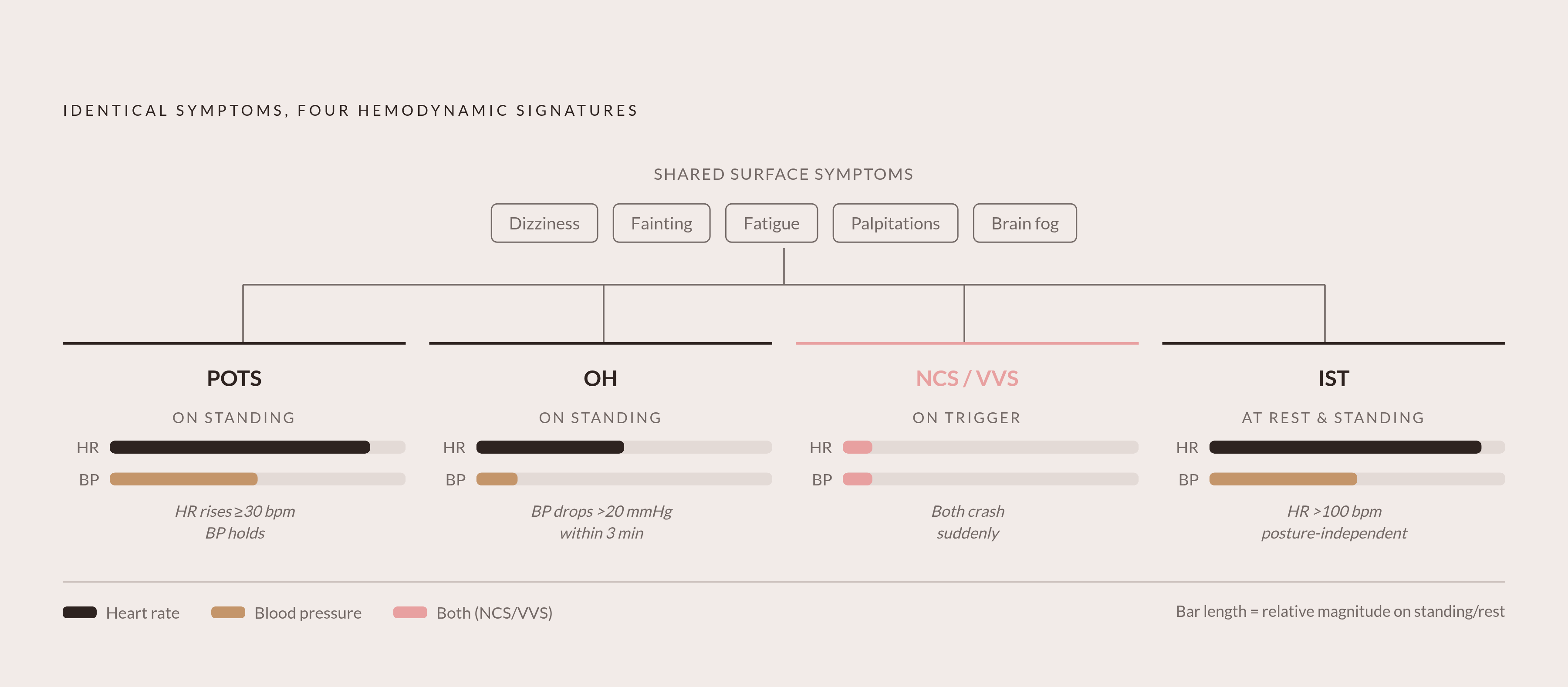
Dizziness, fainting, fatigue, palpitations, brain fog: these five show up across POTS, NCS, OH, and IST almost interchangeably. Symptom lists alone won't tell a clinician, or a patient, which one they're dealing with. Treating the symptom list as the diagnosis is the single most common mistake in this whole space, and it deserves to be named rather than softened. The 2025 Blitshteyn review made the point explicitly: POTS, NCS, and OH may go undiagnosed or be mislabeled with psychiatric diagnoses precisely because the surface symptoms look so similar to anxiety.
The actual differentiator is the hemodynamic pattern: what heart rate and blood pressure are doing while the body moves from lying to standing.
- Heart rate rises on standing, blood pressure holds: POTS.
- Blood pressure drops on standing: OH.
- Both crash suddenly with a trigger: NCS/VVS.
- Heart rate stays elevated regardless of posture: IST.
Per GlobalRPH's 2026 guidance, a careful 10-minute active stand test is a reasonable starting point, but it has to be read alongside the blood pressure pattern, the symptom timeline, current medications, and history. A fast heart rate by itself proves nothing. These categories aren't mutually exclusive, either: a patient can have POTS and NCS at once, or OH layered on top of an autoimmune process.
The clinical stakes of getting this wrong are concrete. Volume expansion helps POTS but can worsen OH in the wrong context. IST demands ruling out thyroid disease and anemia before any treatment starts. Slap the wrong label on any of these, and the management plan built on top of it is aimed at the wrong problem entirely.
How tracking patterns across time gives patients and clinicians the evidence to tell these types apart
Dysautonomia symptoms don't sit still. They shift with sleep, hydration, heat, stress, and activity level, which is exactly why a single 20-minute clinic visit so rarely catches the full picture. A patient might feel fine in the waiting room and crash an hour after driving home, and a clinician working off that one clean snapshot has almost nothing to go on.
A clinician needs more than a symptom list. What's needed is a pattern: does the racing heart happen only on standing, or all day regardless of posture? Does the dizziness come with a fainting warning, or hit without notice? How fast does a symptom build, and what, if anything, brings it down?
That kind of detail, tracked across days and weeks rather than recalled from memory in an appointment, is what turns a vague complaint into a diagnosable pattern. Get that record in front of a clinician, and a patient walks away with an actual name for what's happening in their body, instead of another "anxiety" label stapled onto a chart.