Salt and Fluid Loading in POTS Management
Sodium loading expands plasma volume and reduces heart rate spikes in POTS patients.
Postural orthostatic tachycardia syndrome happens because the autonomic nervous system can't keep blood moving back to the heart when a person stands up. The heart rate spike that defines POTS is the body's patch job for a plumbing problem. A large share of people with POTS carry chronically low plasma volume. Less blood is circulating in the system to start with, so standing up, something healthy bodies handle without a second thought, turns into a serious drain on circulation.
When a person stands, gravity pulls blood down into the legs and abdomen, setting off a mechanical sequence. In a healthy system, blood vessels tighten and the heart adjusts stroke volume to compensate. In POTS, that compensation doesn't keep up, so stroke volume drops. The heart's only remaining option is to beat faster, which produces the racing pulse that gets POTS diagnosed in the first place.
Picture a plumbing system that's only half full of water, then tipped onto its side. The upper pipes run dry fast, because there was never enough volume in the system to fill them under gravity's pull. That's the useful way to think about a body with chronically reduced plasma volume trying to push blood up and out to the brain while standing.
There's a second layer to the problem, beyond the volume deficit itself. The renin-angiotensin-aldosterone system, or RAAS, exists specifically to retain sodium and water when the body senses volume is running low. In a significant share of POTS patients, this system is dysregulated. The body isn't holding onto salt the way it's supposed to, even when it badly needs to, and that failure compounds the original deficit rather than offsetting it.
None of this is universal, and that detail matters as much as the physiology itself. Low blood volume appears often in POTS, but not in every case. The size of the deficit varies enormously from one patient to the next, and some people who meet every diagnostic criterion for POTS have no plasma volume shortfall at all. Standard blood tests won't catch this either way, because plasma and red blood cells tend to drop together, so hematocrit reads normal even when total blood volume is well below where it should be. A clean set of labs doesn't rule out hypovolemia, and that's the first honest reason a salt-loading protocol might do nothing for a given patient.
So the deficit is common, sometimes severe, and frequently invisible on routine testing, while the system meant to fix it automatically is often broken too. That leaves an obvious question: if the body's own volume-retention machinery is failing, does pouring in sodium from the outside actually help, or does it just get flushed out the same way the RAAS failure would predict?
Key Evidence on Sodium Loading, Volume Expansion, and Tachycardia
The evidence says yes, sodium loading does work, even when the RAAS is dysregulated. High dietary sodium expands plasma volume, calms down an overactive sympathetic nervous system, and measurably cuts the heart rate jump that defines POTS on standing. That said, the evidence behind this claim is thinner and less conclusive than the confidence of clinical guidelines would suggest.
The strongest data point comes from a Vanderbilt-affiliated crossover trial, led by Garland and colleagues. The same group of patients went through a low-sodium diet and a high-sodium diet, with outcomes measured in each period. This design lets researchers compare each patient against themselves rather than against a separate control group, which is part of why the result carries real weight.
The results were genuinely positive on the numbers that matter physiologically. Patients on the high-sodium diet showed measurable gains in plasma volume, lower standing norepinephrine, and a reduced heart rate jump on standing. None of that should be undersold.
What the study didn't show matters just as much for calibrating expectations. Not one participant stopped meeting the diagnostic threshold for POTS after the high-sodium period. Objective markers improved, but statistically significant improvement in subjective symptoms was not demonstrated. Patients did trend toward reporting a lower symptom burden on the high-sodium diet, but the gap between diets landed at p=0.109, short of standard statistical significance. The Fibro Guy's review states it directly: heart rates came down, but people didn't report feeling meaningfully better. That gap between what gets measured on a monitor and what a patient actually feels is a reason to describe sodium loading honestly, as one tool among several rather than something close to a cure.
IV saline offers a faster, more intense version of the same logic, and it backs up the mechanism from a different angle. A case series looked at patients with dysautonomia or POTS receiving three IV saline infusions spread across nine weeks. Heart rate dropped by roughly 11 beats per minute, and composite symptom scores improved from about 47 down to about 34, substantial numbers for a short intervention window.
IV saline still isn't something to lean on long term. Consensus guidelines don't support routine, ongoing IV saline use, and review boards such as South Carolina Blues classify long-term outpatient IV hydration as investigational, citing the absence of randomized trial data along with practical problems: access, infection risk, and veins wearing out from repeated use. Its real value here is as confirmation. The same physiological logic that makes oral sodium plausible as a treatment also produces a fast, measurable benefit when volume gets expanded directly through an IV line.
Drinking plain water without sodium doesn't fix hypovolemia, because the body excretes free water quickly once it lacks an osmotic anchor to hold it inside blood vessels. Sodium is the mechanism that keeps fluid inside the vascular compartment instead of passing straight through. RTHM's clinical explainer draws this out directly: standard hydration advice was built for people with normal autonomic function and intact RAAS signaling, and applying that advice to POTS without adjusting for sodium is a basic mismatch.
The Garland trial is the best evidence available. On the numbers that can be measured with a monitor, it points in a clearly positive direction. It's also a small, short, unblinded study whose subjective results didn't reach significance, which is exactly the kind of result that should inform a guideline without being mistaken for one.
What the guidelines recommend and how much confidence they carry
Clinical guidelines converge on a fairly specific sodium target, but that convergence rests on evidence that's thinner than the recommendations sound. The 2022 CMAJ guidelines, from Raj, Fedorowski, and Sheldon, recommend 3 to 5 grams of sodium daily, rising to 10 grams in severe cases, alongside 2 to 3 liters of fluid per day. The Heart Rhythm Society's expert consensus statement, from Sheldon, Grubb, and colleagues, goes further still, up to 10 to 12 grams of sodium chloride and 2 to 3 liters of water daily. That recommendation carries a Class IIb designation: "may be considered".
The Canadian Cardiovascular Society's 2020 position statement is unusually candid about this gap. It issues a strong recommendation while openly stating the evidence behind it is low-to-moderate quality. That's a rare moment of a clinical body admitting its own consensus has outpaced the trial data supporting it.
None of this reflects carelessness on the part of guideline authors. It reflects the honest state of the field. A proper dose-finding study, the kind of trial that tests multiple sodium levels against each other to find where benefit peaks and harm begins, has never been conducted in POTS. Clinical practice cites the six-gram figure most often, but it didn't come from testing that dose directly against alternatives. It came from a systematic review, led by Williams and Raj, that pooled data retrospectively, and the figure was originally developed for vasovagal syncope patients, a related but distinct condition, before being carried over to POTS. In 2026, a formal evidence grading, referenced in The Fibro Guy's review, rated every outcome in POTS management as low or very low certainty, and that covered medications and salt loading alike.
The open question driving the next wave of research is durability: whether plasma volume expansion from high dietary sodium holds steady over weeks and months, or whether the body eventually adapts around it and drifts back toward its original baseline. The CAlgary SAlt for POTS trial, known as CASAP, is now running to answer exactly that question, comparing a high-salt diet against a moderate-salt diet over three months in a randomized, placebo-controlled crossover design.
None of this means the guidelines are wrong to recommend sodium loading. It means patients deserve to hear the recommendation alongside its evidence tier, not instead of it. A 3-to-5-gram sodium target is a sound starting point for a conversation with a clinician, built from real clinical experience even where randomized trials are still missing. Patients who try that target and don't improve haven't failed the treatment. They've run into the current limits of an evidence base that's still being built, and that distinction matters as much emotionally as it does clinically, since plenty of patients quietly blame themselves for a gap that belongs to the research, not to them.
How POTS subtype determines the effect of salt loading
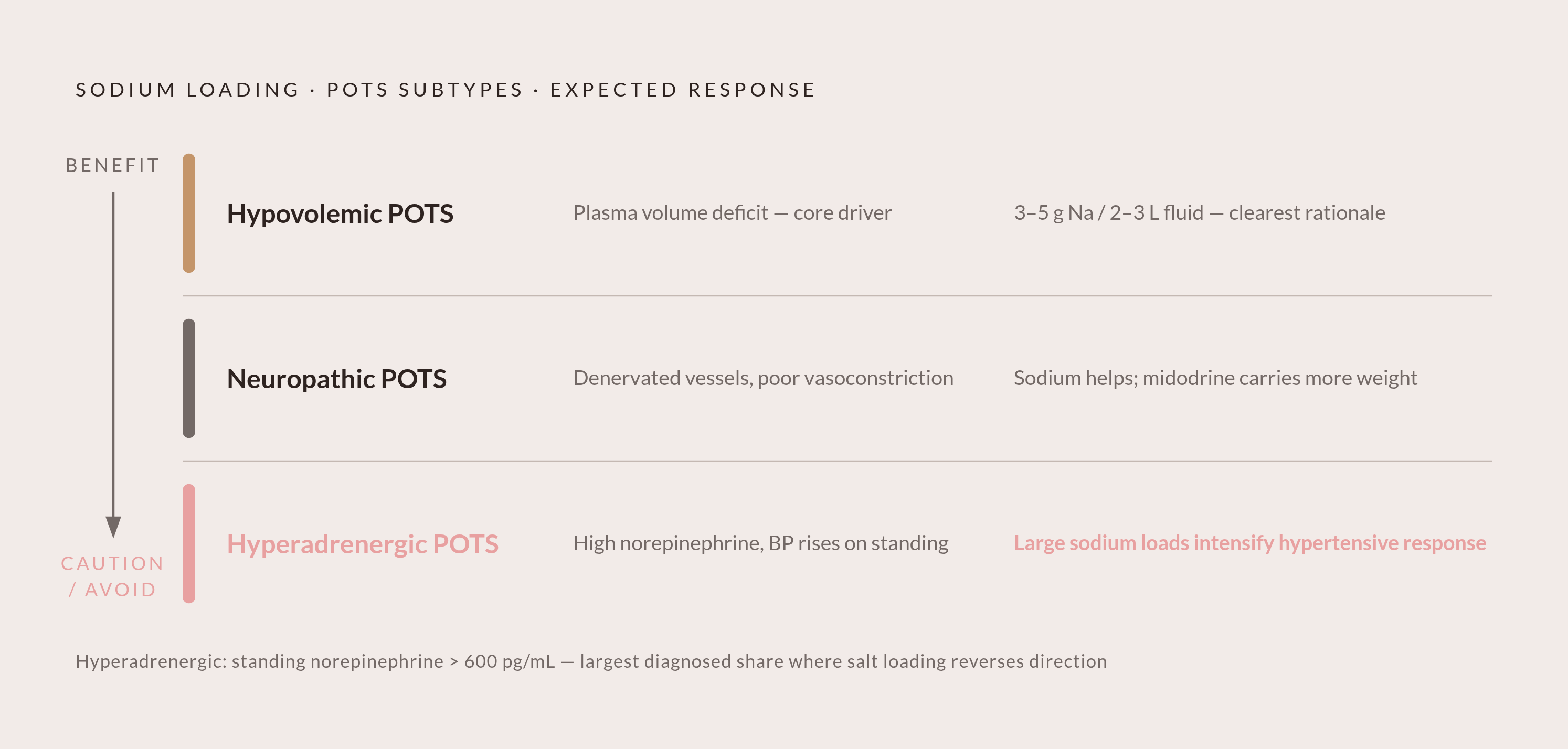
The most important thing a POTS patient can know about salt loading is that it doesn't work the same way for everyone, because POTS itself isn't one condition. Benefit, limits, and risk all trace back to which mechanism is driving an individual patient's tachycardia.
Hypovolemic POTS is the subtype where salt and fluid loading has the clearest, most direct rationale. The plasma volume deficit described earlier is the central driver of symptoms here, so adding sodium addresses the actual mechanism rather than just masking a symptom. This is the subtype the Vanderbilt/Garland trial represents most closely, and it's where the standard 3-to-5-gram sodium and 2-to-3-liter fluid targets make the most sense as a starting protocol.
Neuropathic POTS tells a different story. Salt loading still helps here, but it doesn't resolve the underlying issue. In this subtype, small nerve fibers responsible for triggering blood vessel tightening in the legs are damaged or malfunctioning, so blood pools on standing regardless of how much volume is in the system. Expanding plasma volume through sodium reduces how hard the heart has to compensate but leaves the vessels that failed to tighten in the first place unaddressed. Compression garments and medications that support vasoconstriction directly, midodrine among them, carry more of the therapeutic weight in this group. Some patients with neuropathic POTS carry autoantibodies against the ganglionic acetylcholine receptor, a detail that explains why a volume-only strategy leaves part of the problem untouched.
Hyperadrenergic POTS is where understanding subtype changes everything about the approach, because this particular mechanism runs in the opposite direction from the other two. This is the subtype where aggressive sodium loading can actively make things worse. It's defined by standing plasma norepinephrine above 600 pg/mL, often paired with systolic blood pressure that rises rather than falls on standing. The sympathetic nervous system here is overactive, which flips the entire treatment logic: the goal becomes calming an overdriven system rather than topping off a depleted one. Large sodium loads can intensify the hypertensive response these patients already have on standing, so the dial that needs turning is sympathetic activity, not blood volume.
Mast cell activation syndrome, or MCAS, is the most common companion condition in hyperadrenergic POTS, and treating it is frequently central to managing the subtype as a whole. HealthE1 Medical's clinical guide lists hyperadrenergic POTS explicitly as a case where IV saline should be limited or avoided, and that same caution carries over to aggressive oral sodium loading. A substantial share of the POTS population shows elevated standing norepinephrine. The subtype carrying the most risk from salt loading also represents a large portion of everyone diagnosed with POTS.
Most patients don't fall neatly into one bucket. Overlap between subtypes is the norm rather than the exception. A single blanket sodium protocol, handed out without any sense of which mechanism is in play, falls short as clinical advice. POTS is better understood as a clinical endpoint, a heart rate response that crosses a defined threshold on standing, rather than one single disease with one single fix. The specific mechanism driving each case of POTS shapes every decision that follows, sodium loading included.
Non-response: when salt loading fails even in the right subtype
Hypovolemic POTS patients who follow sodium and fluid targets precisely sometimes see no meaningful change, and that outcome doesn't automatically point to a diagnostic error or a failure of willpower. The RAAS dysregulation described at the outset can blunt the body's ability to hold onto added sodium at all, so a patient can increase intake correctly and still not retain enough of it to expand plasma volume the way the Garland trial's participants did.
Dosing itself remains an open question rather than a settled one. Because no dose-finding study has ever been run in POTS, the widely cited six-gram target was built by pooling retrospective data from a related condition, not by testing that specific number against alternatives in POTS patients directly. Some patients may need more, some less, and the current guidelines can't say which group a given patient falls into, because that trial hasn't been done.
Durability is a separate open question. Even where sodium loading produces a real initial gain in plasma volume, nothing in the current evidence confirms whether that gain holds steady over months or whether the body gradually adapts and drifts back toward its starting point. The CASAP trial exists to answer that question: it compares high-salt against moderate-salt intake over a three-month randomized, placebo-controlled crossover design. Until results from a trial like that are available, non-response over the long term can't be cleanly separated from an intervention that simply stopped working the way it did at first.
Subjective symptoms add one more layer of complexity. The Garland trial itself showed this pattern: heart rate numbers improved, but reported symptom burden did not improve to a statistically significant degree, landing at p=0.109. A patient whose tachycardia measurably improves on sodium loading may still report feeling just as unwell, and that's not an inconsistency to be explained away. It reflects a genuine gap between what gets captured on a monitor and what a patient experiences day to day, a gap The Fibro Guy's review states outright: better heart rate numbers didn't translate into patients saying they felt better.
None of this makes sodium and fluid loading a weak strategy. Non-response in a correctly identified hypovolemic patient points to the limits of a treatment that's still being quantified, not to a mistake the patient made. The honest clinical picture is that salt loading has strong mechanistic grounding, is supported by the best study available, and still sits inside guidelines that openly rate their own evidence as low to moderate quality. Patients deserve that full picture, dosing targets alongside the uncertainty behind them, because an informed approach to sodium and fluid loading serves people far better than a blanket instruction ever could.
Sources
- Vasovagal syncope and postural orthostatic tachycardia ...
- Salt and Fluid Loading for POTS: How to Increase Blood Volume
- POTS and Salt: What the Science Actually Says - The Fibro Guy
- The POTS Salt-and-Fluid Protocol - by Thank You, Weird Lady
- POTS and IV Saline Infusions: Evidence and Safe Use - HealthE1 Mobile Medical
- Best Electrolytes for POTS: Complete Guide to Postural Orthostatic Tac
- CAlgary SAlt for POTS
- Salt supplementation in the management of orthostatic intolerance: Vasovagal syncope and postural orthostatic tachycardia syndrome - ScienceDirect