Compression Garments for POTS Symptom Relief
Waist-high compression garments reduce heart rate and ease symptoms when worn throughout the day.
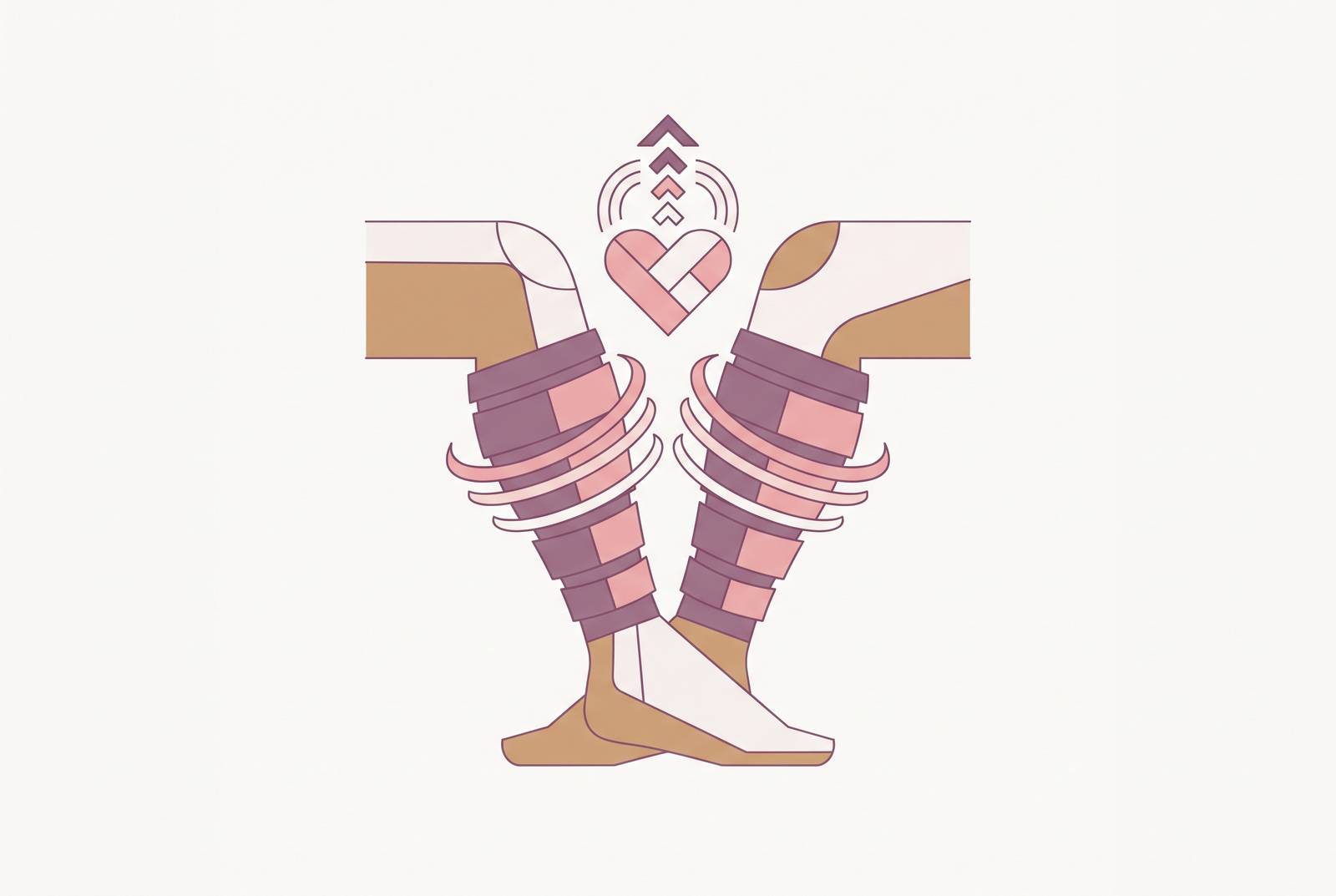
Postural orthostatic tachycardia syndrome, or POTS, breaks down at a simple moment: standing up. In a body with normal autonomic function, blood vessels tighten when a person moves from lying down to standing, pushing blood back up toward the heart. In POTS, that tightening doesn't happen the way it should. Blood drops into the legs and into the abdominal blood vessels instead of returning to the chest, so less blood comes back to the heart with each beat. The heart tries to make up for this by beating faster, sometimes 30 beats per minute faster or more within ten minutes of standing. That's the tachycardia in postural orthostatic tachycardia syndrome, and it's the body's attempt to patch over a plumbing problem by running the pump harder.
Compression garments address the pooling directly. By applying steady outside pressure to the legs, thighs, and abdomen, they narrow the space blood has to pool in. Less blood sits in the legs and belly, so more stays available to flow back to the heart. That raises preload, the amount of blood filling the heart before it contracts, and stroke volume, the amount it pumps out with each beat. With more blood moving through the heart on each cycle, the heart doesn't need to beat as fast to keep oxygen reaching the brain and the rest of the body. The racing heart rate that defines POTS eases because the garment is doing part of the job the blood vessels aren't doing on their own, not because the nervous system has been fixed.
POTS shows up in three recognized forms: hyperadrenergic, neuropathic, and hypovolemic. Despite their differences, the same starting treatments apply across all three: more fluids and salt, physical reconditioning, training the body to adjust to posture changes, and compression garments. No medication currently holds formal approval for treating POTS. Patients and doctors work instead with a mix of off-label drugs and non-drug approaches, and that gap gives compression garments so much weight as a first move rather than an afterthought. If the mechanism behind blood pooling is as direct as the evidence suggests, the real question is whether compression works in daily life, and what it takes to make that happen.
What the clinical evidence shows about compression and POTS
Compression's effect on POTS isn't just theory. Commercially available waist-high compression garments have been shown to lower heart rate and ease symptoms in POTS patients, and that finding holds up outside the lab, in the kind of ordinary daily setting patients actually live in. The benefit appears quickly after putting the garment on, and it is still present hours later, as long as the garment stays on.
The clearest test of this came from the COM-COM-POTS trial, published in JACC: Clinical Electrophysiology, which studied commercially available waist-high compression tights in a randomized crossover design, run in the community. Participants completed active stand tests in the morning and afternoon, and they compared garment-on to garment-off, both with and without heart-rate medications. Standing heart rate was lower and symptoms got better during the morning tests when the garment was on, under both protocols. When the garment came off after several hours of wear, heart rate and symptoms both got worse again, showing that the benefit depended on continuing to wear the garment. The effect held whether or not participants were on medication that controls heart rate, so compression added benefit even for patients already being treated with drugs.
Abdominal compression paired with beta-blockers also works better than either one alone, and together they produce a bigger drop in symptoms than separately. That supports using compression alongside prescribed medication.
The honest caveat: this evidence is strongest for what happens while the garment is on the body. Once it comes off, the benefit fades. Compression manages symptoms in the moment. It doesn't change the underlying autonomic dysfunction that causes POTS. Long-term data on sustained, daily compression use over months or years remains thin, and the trial's own authors have said as much. Readers deciding whether to invest in garments should understand upfront that compression is a tool for managing a standing moment, not a cure for the condition behind it.
Coverage level versus garment brand and compression grade
The single biggest factor in whether compression garments work for POTS is where they cover the body, not which brand sits on the label or how many millimeters of mercury the packaging claims. Blood pools in two main places in POTS: the legs, and the splanchnic circulation, the network of blood vessels serving the abdominal organs. Knee-high compression socks, the most common type sold at pharmacies, only reach the lower leg. They leave the thighs and the entire abdominal reservoir untouched. They miss most of where the pooling actually happens.
The COM-COM-POTS trial tested waist-high garments specifically, and found a standing heart rate of 105 beats per minute (interquartile range 99 to 116) with the garment on in the morning. The logic behind why that coverage matters traces straight back to the splanchnic pooling piece of POTS: blood sitting in the abdominal vessels can't be reached by a sock that stops below the knee, no matter how tight that sock is. Separate evidence shows that abdominal compression alone, with no leg compression at all, can still bring real symptom benefit. That matters for patients who find full-length garments too hot, too restrictive, or too hard to manage.
On compression grade, the research doesn't point you to one ideal pressure level for POTS. Medical-grade garments produced a larger percentage change in heart rate in some comparisons, but there was no statistically significant difference between medical or prescription-grade garments and sport or athletic-style garments when it came to standing heart rate, change in heart rate, or symptom response. Both categories work as treatment.
This has a direct, practical consequence for anyone who tried compression once and gave up on it. A patient who wore pharmacy knee-highs for a week and felt no different hasn't actually tested the form of compression the evidence supports. The fix is waist-high coverage that reaches the thighs and abdomen, the regions where the pooling that drives POTS symptoms actually happens, rather than a higher-pressure version of the same sock.
Wearing compression garments daily: timing, sequencing, and context
Getting the right garment is only half the job. When and how it goes on the body each day determines its ability to prevent the symptoms it's meant to prevent. The garment needs to go on before getting out of bed, while still lying flat, before blood has had any chance to shift downward. Putting it on after standing up means the pooling the garment is supposed to stop has already started.
This sequencing reflects how the COM-COM-POTS trial itself was structured: active stand tests were run in the morning and afternoon with the garment already in place, and the benefit was measured from the moment of standing onward. The trial also found that taking the garment off partway through the day caused heart rate and symptoms to climb back up, supporting continuous wear through the day's upright hours.
Exercise adds another layer. For POTS patients exercising, several things need to happen at once: staying hydrated with electrolytes before, during, and after activity; wearing compression during the activity itself to support blood returning to the heart; and elevating the legs afterward to help that return continue during recovery. None of these pieces work as well in isolation as they do together.
Daily life adds friction that trial protocols don't fully capture. Heat makes tight garments harder to tolerate. Donning a compression garment on a day when symptoms are already severe takes real physical effort. What's planned for the day, how hot it is, how bad symptoms already feel: all of it factors into whether someone puts the garment on that morning. None of that is a failure of discipline. It's a real cost-benefit calculation patients make daily, and naming it directly helps people plan around it instead of feeling like they've fallen short when a flare-up day gets skipped.
Why comfort and adherence are the real clinical bottleneck
The evidence makes a strong case that compression works. The harder question is how often and how long people actually wear the garments, and whether that is enough for the benefit to appear in their daily lives. That gap between lab result and daily habit is where compression therapy tends to break down.
Research from the University of Calgary looked at patient experience directly and found six factors that shape whether someone with POTS puts on a compression garment on any given day: how much benefit they expect for their symptoms, what activities they have planned, environmental conditions like heat, the garment's own attributes such as comfort, how easy it is to conceal under clothing, and how easy it is to put on, plus psychological and cognitive factors, and cost. Patient experiences varied widely in that research. Some participants reported real gains: lower heart rate, less fatigue, fewer presyncope episodes, less pain and swelling, even better cognitive function, described as being able to sit upright longer without losing focus. Others reported almost no benefit at all.
A separate landscape survey out of Duke University found that 65.4 percent of POTS patients reach for leg compression most often, rather than shapewear or abdominal garments, even though waist-high coverage has the stronger evidence behind it. That mismatch likely comes down to comfort and ease of use, not patients choosing to skip the better option.
The clinical takeaway: handing a patient a recommendation to wear compression without addressing comfort and the practical mechanics of donning it is a prescription that often sits unused in a drawer. Adherence needs a place inside the treatment plan itself, worked out alongside garment choice and coverage, so it isn't treated as a personal shortcoming when it doesn't happen.
Fitting compression into a pacing and energy-management approach
For many people with POTS, especially those who also live with ME/CFS, Long COVID, or post-exertional malaise, the value of compression goes beyond heart rate numbers. Standing itself costs energy in POTS, because the body has to spend extra effort compensating for blood pooling with a faster heartbeat. Compression lowers that cost. If you wear a garment before standing and moving around, less energy gets burned on compensatory tachycardia and on recovering from it afterward.
Spoon Theory offers a useful frame here. Christine Miserandino developed the concept to describe living with lupus, and it's since been widely adopted across the ME/CFS and chronic illness community. It treats daily energy as a fixed, limited supply, each task spending a portion of it. Compression fits directly into that math: it lowers what each hour of standing or walking costs, leaving more energy available for whatever else the day requires.
Post-exertional malaise is a real risk for many POTS patients. Even mild physical or mental effort can trigger a worsening of symptoms, often starting a day or two after the activity and lasting for days or weeks afterward. Compression worn before and during activity works as one piece of a broader pacing strategy, helping a person stay inside their energy limits. Pacing for POTS-related fatigue means managing energy across the whole day: heart-rate tracking, resting before exhaustion sets in rather than after, and using compression to cut down the physical load that standing and moving place on the body, all aimed at avoiding the cycle of overdoing it followed by a crash.
A 2025 systematic review of self-management approaches in POTS found real support for lifestyle advice, access to equipment, and help with sticking to a plan. The same review found no studies at all covering education, psychological well-being, communication with health professionals and social support networks, reliable sources of information, training in practical self-management, clinical action plans, or social support more broadly. That's a wide gap, and it's exactly the space where practical compression guidance, like what to wear, when to put it on, how to manage a bad day, tends to fall through.
When to seek guidance before using compression garments
Compression garments are non-drug tools, and for most POTS patients they carry no meaningful side effects. That doesn't mean they suit everyone automatically. Certain conditions make it necessary to check with a clinician before adding compression to a daily routine: peripheral artery disease, significant skin conditions, certain cardiac conditions, and other circulatory disorders. If a clinician reviews a patient's full medical picture before compression becomes a routine habit, that is a reasonable, low-friction step, not a hurdle.
For the overwhelming majority of people with POTS, the risk profile here is low, and that conversation with a clinician tends to be short. Having it early means compression gets built into a treatment plan with proper medical input from the start, rather than becoming an afterthought raised only once a problem occurs.
Tracking garment use alongside symptoms to make compression more effective over time
Compression garments manage symptoms, they don't cure the underlying condition, and their real value grows the more clearly a patient can see the pattern behind them: which days they help, how much, and under what conditions. Patients already weigh garment use daily based on activity, weather, and expected benefit. Turning that daily judgment call into something tracked, alongside symptom scores, heart rate, fatigue, and brain fog, changes an informal guess into something closer to usable data.
Keeping a record of garment use, posture, time of day, heart rate readings, and symptom scores ahead of appointments turns a vague statement like "it helps sometimes" into something a clinician can actually work with. That structure matters more in POTS care than in most conditions, since treatment often spans cardiology, neurology, and primary care at once, and each specialist benefits from seeing the same consistent record.
Long-term data on sustained compression use remains limited, and the COM-COM-POTS trial authors themselves have pointed to that gap. Until larger studies close that gap, the tracking an individual patient does on their own stands as some of the most detailed evidence available on how compression actually performs over time, for that person, in their own daily life.
Sources
- A Community-Based Trial of Commercially Available Compression Tights in Patients With Postural Orthostatic Tachycardia Syndrome
- One Size Does Not Fit All: An Exploration of Compression Garment Use in Patients With Postural Orthostatic Tachycardia Syndrome - PMC
- Current Landscape of Compression Products for Treatment of Postural Orthostatic Tachycardia Syndrome and Neurogenic Orthostatic Hypotension - PMC
- A Community-Based Trial of Commercially Available Compression Tights in Patients With Postural Orthostatic Tachycardia Syndrome - ScienceDirect
- Supportive self-management in postural orthostatic tachycardia syndrome (POTS): A systematic review - PubMed
- Pathophysiology and management of postural orthostatic tachycardia syndrome (POTS): A literature review - PubMed