Recumbent Exercise Programs for POTS Reconditioning
Lying flat removes gravity from the problem, letting three systems rebuild at once.

POTS (postural orthostatic tachycardia syndrome) sets up a loop that feeds on itself. Standing upright brings on symptoms. Symptoms push people to move less. Moving less weakens the body in ways that make standing upright even harder the next time. That loop is the subject of this piece, and so is the way out of it: a style of exercise that removes gravity from the problem before asking the heart to do any work at all.
The mechanics start at the ankles. When someone with POTS stands up, blood should get pushed back toward the heart by blood vessels tightening in the legs and lower body. In POTS, the autonomic nervous system fails to do this job well, so blood pools in the legs instead. The heart's answer is to beat faster, trying to make up in speed what it's lost in volume per beat. That's the tachycardia that gives the condition its name, and it's also the dizziness, the racing pulse, and the wave of exhaustion that so many patients feel within seconds of standing.
A body that's been deconditioned by months or years of reduced activity has a smaller heart, less blood volume, and weaker leg muscles, so each of those three failures gets worse, not better, and standing becomes harder, not easier. A Cleveland Clinic survey found that 82.39% of POTS patients felt dizzy while exercising. That number captures something important: the standard advice to "just get moving" asks patients to do the one thing their cardiovascular system is least equipped to handle. Upright exercise, the default recommendation given to almost anyone with a chronic illness, directly triggers the symptoms that caused the inactivity in the first place.
This matters because deconditioning in POTS has often been treated by clinicians as a character problem: a patient who simply stopped trying, stopped pushing, let their fitness slide. The physiology says otherwise. Deconditioning here is a downstream consequence of an autonomic nervous system that fails at a basic mechanical task, not a cause of it. A patient who avoids the treadmill because the treadmill makes them black out is responding correctly to a body that cannot yet tolerate what's being asked of it. Fixing that requires changing what's being asked, not pushing harder on the same request.
What the cardiovascular system needs to recover, and why gravity is the first obstacle to remove
Three things break down in POTS, and they break down together. And the muscles in the lower legs, which are supposed to act as a secondary pump pushing blood back up toward the heart, lose the bulk and the contractile power to do that job.
These three failures aren't separate problems sitting side by side. Each failure makes the other two worse.
The leg muscles deserve more attention than they usually get. Research published in the American Journal of Physiology, Heart and Circulatory Physiology, found that patients with a low-flow form of POTS had noticeably smaller calf circumference than healthy people, along with a severely reduced calf muscle pump ejection fraction, the measure of how effectively those muscles push blood upward with each contraction. The legs are failing as a circulatory organ in their own right, and that failure plays directly into the dizziness and tachycardia that patients feel every time they stand.
Lying flat removes gravity from the problem. Lying flat takes the pooling problem off the table entirely. Heart rate can stay in a range low enough to let the heart adapt to exercise. Lying horizontal lets three systems rebuild at once: blood volume expands, the heart adds mass and strength, and the leg muscles gain back the bulk and pump function they lost. The pressure of water against the body, called hydrostatic pressure, acts like a full-body compression garment, pushing blood back toward the heart from every direction at once. That's one reason swimming tends to be one of the gentlest and most effective ways for POTS patients to begin.
The established protocols: how the Levine and CHOP programs translate this logic into a staged progression
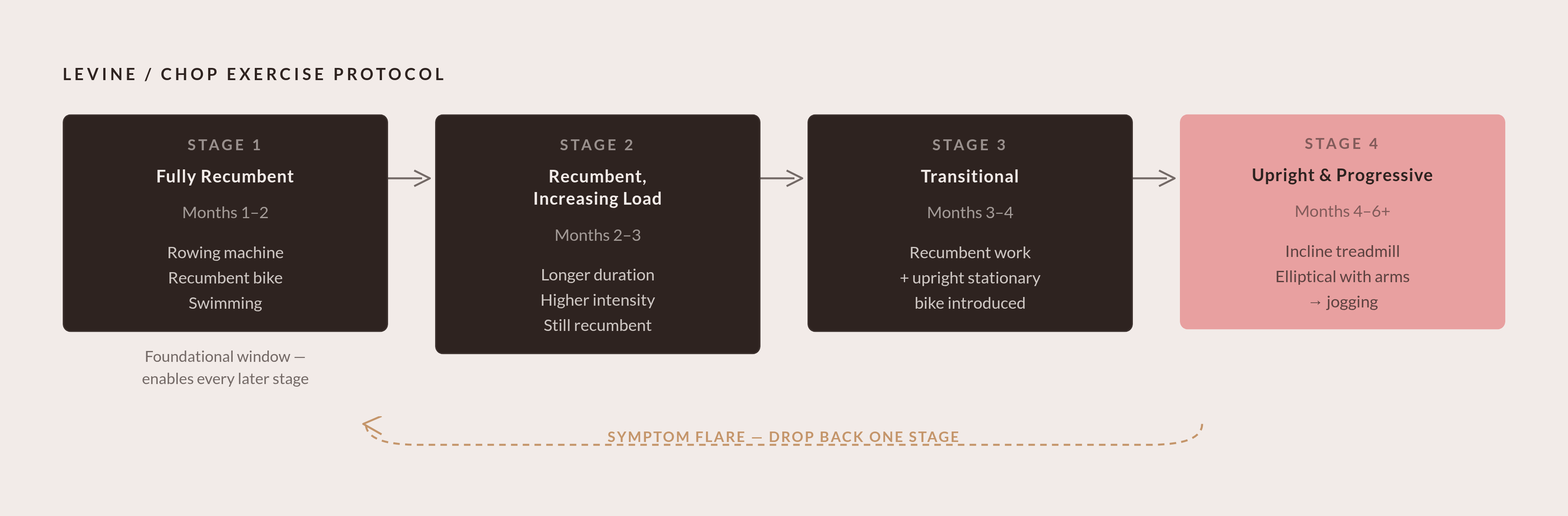
Two programs translate this physiology into something a patient can actually follow day to day: the Levine Protocol and the CHOP Modified Dallas Protocol, both built on the same Dallas Protocol research base. Despite coming from different teams, they share the same underlying architecture. Training starts entirely horizontal, builds up in how long and how hard the sessions go, and only brings in upright movement once the groundwork has been laid.
The progression runs in stages. Around months three to four, the program shifts into a transitional stage, moving from recumbent work toward an upright stationary bike, introduced only once the patient is tolerating the recumbent work well, while standing or walking exercise like a treadmill or elliptical waits until at least month five. By months four through six, patients work up to incline treadmill walking and elliptical training that uses the arms as well as the legs, progressing toward jogging if the body tolerates it.
In the Levine Protocol, heart rate zones are calculated individually for each patient.
The CHOP Modified Dallas Protocol adds a rule that makes the whole system safer to follow without a specialist standing over every session: if symptoms flare up at any stage, the instruction is to drop back to the previous, more reclined stage. Progress in this framework is a controlled back-and-forth that only moves ahead once the body shows it's ready.
A home-based version of this approach, developed by a Dysautonomia Clinic and delivered remotely through a certified physical therapist, was built for patients who can't get to a clinic or specialized facility in person. Across every version of the protocol, one rule holds steady: the first one to two months have to stay fully recumbent, with no treadmill, no stair climbing, and no brisk upright walking, because that early window is when the foundational gains in blood volume and cardiac mass get built. Skipping that foundation makes everything built on top of it less stable.
What the clinical trials demonstrate, and what they leave unresolved
The case for this approach rests on real trial data: quality of life scores, measured on the SF-36 scale, improved meaningfully, with physical functioning rising from a mean of 33 to 50, and social functioning rising from 37 to 48. Patients treated with the beta-blocker propranolol alone, by contrast, showed no significant change in quality of life. That gap between an exercise-based approach and a drug-only approach is the strongest single piece of evidence behind recumbent reconditioning, and it lines up exactly with the three deficits described earlier: more blood volume, more cardiac mass, and through the leg-strengthening work, a stronger muscle pump.
More recent research adds detail without settling every question. The PULSE feasibility trial, run across two NHS clinics in the UK, University Hospitals Coventry and Warwickshire and Imperial College Healthcare, published its results in BMJ Open on February 22, 2025. It tested supervised online exercise rehabilitation, paired with behavioral and motivational support, against standard best-practice care. It stands as the most current trial infrastructure built specifically around POTS reconditioning. An earlier pilot study of 60 patients found that structured exercise training improved aerobic fitness, orthostatic symptoms, and how much exercise patients could tolerate, but it found no overall improvement on the COMPASS-31 questionnaire, a standard measure of broader autonomic symptoms. Better cardiovascular fitness and better day-to-day symptom relief don't automatically move together.
A systematic review published in Frontiers in Neurology in 2025 reinforces that caution. It found that exercise improved the specific outcomes researchers were measuring in most of the studies reviewed, but the size of those improvements was often modest, and not always clearly better than what control groups experienced. It means the evidence base, while real, is still thinner than patients might hope. Recumbent reconditioning stands as the best-supported non-drug intervention available for POTS, and the physiological logic behind it holds up well under scrutiny. That gap matters for an audience of patients who have heard confident medical claims before that didn't hold up.
The critical exception: when POTS overlaps with ME/CFS and graded exercise becomes harmful
Everything described so far assumes a patient whose fatigue comes from cardiovascular deconditioning and orthostatic intolerance, the two problems that recumbent exercise is built to fix. That assumption breaks down for a specific group of patients, and recognizing the break matters enormously.
ME/CFS produces a different kind of fatigue, one driven by a basic problem in how cells produce energy. The hallmark of that condition is post-exertional malaise, or PEM: a delayed, measurable worsening of symptoms that follows physical or mental exertion, sometimes by a day or more. In POTS without PEM, the body adapts to graded exercise over time, building back the blood volume, cardiac mass, and muscle strength described earlier. In PEM, the body doesn't adapt to that same stress. It gets worse because of it. Graded exercise, the entire engine behind the Levine and CHOP protocols, turns from treatment into harm the moment PEM enters the picture.
This overlap isn't rare, and it isn't always obvious at diagnosis. The 2025 Frontiers in Neurology systematic review named a list of conditions that complicate exercise tolerance in POTS patients, including Ehlers-Danlos syndrome, hypermobility spectrum disorder, autoimmune disease, post-acute infection syndromes such as Long COVID, mast cell disorders, and conditions marked by orthostatic intolerance or PEM, ME/CFS among them. POTS appears regularly in people recovering from Long COVID, and Long COVID itself overlaps heavily with ME/CFS, so a patient with Long COVID-associated POTS may be carrying both conditions at once, and each one calls for a different management approach.
Where PEM is present, the right framework is pacing: staying within a known energy budget to avoid triggering a crash. A heart rate monitor still has a role here, but a different one. Instead of guiding a patient up toward a training zone, it flags an approaching limit so the patient can stop before crossing it. That's a safety tool, not a training tool, and confusing the two can cause real damage. Applying a graded reconditioning protocol to a patient with unrecognized PEM counts as harm caused by the treatment itself, and any patient who notices their symptoms getting worse after exercise, rather than gradually better, should be evaluated for ME/CFS overlap before continuing or advancing a program. None of this undermines the case for recumbent reconditioning in patients without PEM. For that group, it remains the best-supported path forward, and the exception described here exists precisely to make sure the right patients get it.
Why so many patients cannot complete these programs, and what the barriers are
A protocol can be built on solid physiology and still fail the people it's meant to help if it doesn't account for how hard it is to actually follow. Community-based studies put it close to a majority of patients who start. The benefit demonstrated in trials isn't reaching a large share of the people who need it.
A Cleveland Clinic study published in Cureus surveyed 421 POTS patients at a tertiary care center to understand exactly why. The results point to a problem that's partly physical and partly emotional. Many patients reported feeling dissatisfied with their exercise routine, feeling judged by others for how little they could do, and carrying shame or a changed sense of their own body since getting diagnosed. That's a heavy emotional weight to carry alongside the physical symptoms, and it compounds the difficulty of sticking with any program.
Most of the patients surveyed used to exercise regularly before POTS symptoms began. On top of that, access to care is uneven, and the gap is in the support structure around patients.
Practical self-management tools that help patients stay inside a program: heart rate monitoring, pacing, and symptom tracking
Closing that gap starts with giving patients a way to see what's happening in their own body in real time, rather than relying on guesswork or waiting for a flare to arrive. A heart rate monitor, worn during exercise and throughout the day, turns an invisible process into a visible number. For a patient following the Levine or CHOP progression, that number shows whether a session is staying inside the personalized training zone discussed earlier, or whether heart rate is climbing into a range that calls for backing off, exactly as the "return to the previous stage" rule in the CHOP protocol instructs.
Pacing works alongside heart rate data. For patients without PEM, pacing means matching the day's activity to what the body can currently tolerate, informed by how previous sessions went, rather than pushing to a fixed target regardless of how the body is responding that day. Pacing means something more protective for patients managing PEM, as described earlier: staying inside a known energy limit to avoid a delayed crash, using heart rate thresholds as an early warning sign.
Symptom tracking ties the two together. That record helps a patient and a clinician tell the difference between a bad day and a trend, between a session that needs to be repeated and one that needs to be scaled back. It also gives patients something that survey after survey shows they're missing: a clear, personal sense of progress, even when that progress is slower and less linear than the four-stage protocol makes it look on paper. For a population that dropped out of these programs at high rates largely because the path forward felt invisible, making that path visible may be the simplest and most practical intervention available.