Explaining POTS to Family and Friends
Learn to frame POTS's invisible mechanics in terms others can actually understand and support.
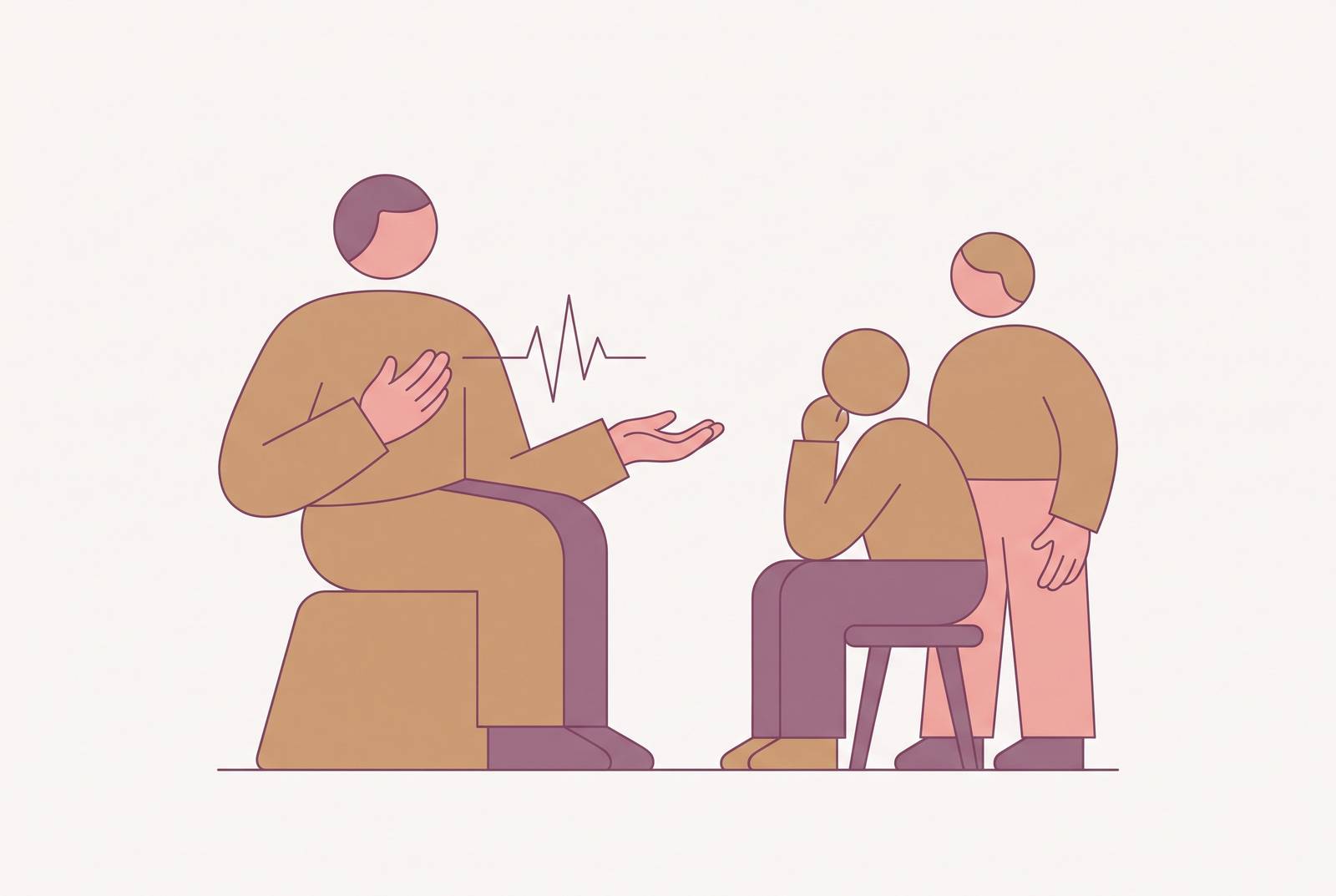
Explaining POTS to family and friends means helping them understand a physical problem they cannot see without using all your energy to defend it. The clearest approach is to explain what standing does to your body, connect that to ordinary tasks, and say what help you need. You do not need everyone to understand every symptom. You need the people closest to you to take your limits seriously.
What POTS actually does to the body when you stand up
When you stand up, gravity pulls blood down toward your legs and feet. Approximately 500 cc of blood shifts, reducing how much returns to your heart. In a healthy body, the autonomic nervous system, which handles automatic functions, corrects this in under a minute. Blood vessels constrict, the heart rate adjusts slightly, and blood flow to the brain stays stable. With POTS, that automatic compensation does not work as it should.
Instead, the heart rate surges by 30 beats per minute or more, or 40 bpm or more in adolescents, without a corresponding drop in blood pressure. The body is working hard, but its response is not correcting the problem properly. Cleveland Clinic lists symptoms including lightheadedness, palpitations, fatigue, brain fog, shakiness, shortness of breath, chest pain, headaches, feeling sick, bloating, and disrupted sleep. The full name, Postural Orthostatic Tachycardia Syndrome, gives you a starting point for explaining this range of symptoms. Postural means how the body is positioned, orthostatic means standing upright, tachycardia means a fast heart rate, and syndrome means a group of symptoms.
Why POTS is so easy to misread from the outside
Someone can see you sitting comfortably at a table and then struggle to understand why standing at the kitchen counter is difficult. The change in position causes difficulty that is invisible to the person watching. Dizziness, palpitations, fatigue, brain fog, and shakiness also resemble what many people associate with anxiety or stress. Because the trigger is such an ordinary movement, the physical effort behind it is easy to miss.
That misunderstanding also sits within a broader pattern of whose symptoms get taken seriously. POTS primarily affects adolescent girls and young to middle-aged women, a demographic whose physical complaints have historically been dismissed as emotional. The Australian POTS Patient Registry study found that 64.6% of patients had their physical symptoms blamed on anxiety before they were diagnosed. The same registry found longer diagnostic delays for women than for men. So difficulty getting people to understand is not proof that you have explained badly. The condition itself, and the assumptions people bring to it, make misinterpretation likely.
The emotional weight of explaining an illness people cannot see
Explaining POTS uses some of the limited energy you need to get through the day. Brain fog can make it harder to concentrate, remember things, and find the words while someone waits for an answer.
A 2025 qualitative study in Health Psychology found that anger and frustration, anxiety about the future, and grief were among the main feelings POTS patients described. Those feelings were tied to real changes, such as leaving work or school and changing career plans. Those feelings remain present in conversations with someone you love. That helps explain why a dismissive response can cost far more than the few minutes it takes to hear it. Lower the stakes by aiming for enough understanding to make the relationship work, rather than a complete transfer of everything you know and feel. A short, useful explanation can do its job without covering your whole medical history.
Analogies that make the mechanism click for people without medical backgrounds
For someone who thinks mechanically, picture a pump that has to push water uphill when you stand. Normally, the system adjusts automatically, but with POTS the pump races without fully restoring the flow.
Another way to picture it is a building whose plumbing cannot keep the water pressure up above the ground floor. Blood pools lower down, and the faster heartbeat cannot fully make up for that shift.
For someone who needs a familiar sensation, use the dizziness, nausea, or mental fog that can follow standing too long in the sun. POTS can bring a version of that experience when standing, even without heat or a lack of rest.
Comparing it to an invisible treadmill may work better for someone who exercises. Standing can involve hidden exertion, so a person who looks still is not necessarily resting.
Choose the image that makes sense to the listener. Each offers a partial illustration of the mechanism. In particular, the pump image needs a clear boundary. POTS is a problem with autonomic regulation.
Explaining what a bad day actually looks like in practical terms
Once the mechanism makes sense, connect it to something the other person knows you do. Explain whether a bad day means you cannot stand long enough to cook, wait in a checkout line, or finish a shower without symptoms taking over. Saying which task is hard gives someone a clearer picture than saying you feel terrible. It also shows that the limit comes from the demands of the task.
The same approach works for symptoms that affect conversation. Brain fog can mean losing a word mid-sentence, finding it hard to concentrate, or having trouble remembering things. Large meals can divert blood to digestion and trigger lightheadedness and fatigue, which helps explain eating small amounts frequently or needing to lie down afterward. Heat can worsen symptoms too, whether it comes from a shower, a warm room, or a summer day.
Be equally clear that capacity fluctuates. Being able to go out with others on Saturday does not mean being able to stand and cook on Sunday. The Australian registry study found that 26.0% of patients had social outings less than once a month.
How to explain energy limits using spoon theory — and why it works for POTS specifically
Christine Miserandino coined spoon theory to describe a limited daily supply of energy. Each spoon represents a unit that an activity uses up. Showering, making breakfast, and getting dressed all draw from the supply, and it can run out before the day is over. The framework is widely used in the POTS and dysautonomia community because it gives an invisible limit a simple form.
For POTS, the useful distinction is that the cost is postural as well as physical. Standing itself spends energy in a way most people do not have to account for. Talking, concentrating, and managing other people's reactions also use that budget, even though they may not look demanding. Once family members understand the idea, saying that only a few spoons are available can replace another symptom-by-symptom explanation.
Spoon theory gives people a shared way to discuss what fits within today's capacity. It also explains why pushing beyond that capacity is not the same as building resilience through ordinary effort. Exceeding the limit can create a debt that takes longer to repay.
What to say when someone suggests it is anxiety, or tells you to try harder
A prepared response can keep a dismissive comment from turning into an exhausting argument. Acknowledge the resemblance without accepting the explanation. Racing heart, shakiness, sweating, and unease can look like panic from the outside, but resemblance does not establish the cause. Keep the response focused on blood regulation and the physical demands of standing.
The notes for that response can be simple enough to say aloud. The racing heart comes from a physical problem with blood regulation. Standing is physiologically taxing, so willpower does not remove the limit. What looks like avoidance can be pacing that helps preserve function. Use the answer that fits what the person said.
From there, redirect toward what would help. You do not need to offer test results or recount your diagnostic history to every person who questions you. A calm factual statement can be a complete answer, even if the other person remains unconvinced. The aim is to hold your ground while prioritizing the relationship and your energy over winning a debate.
Practical asks: how to tell the people who want to help what actually helps
When someone wants to help, give that willingness a specific job. Ask for time to sit while shopping instead of walking through the whole store without a break. For dinner, explain whether an earlier time would avoid standing at the stove when symptoms are worst. Before going out, ask them to check whether it will be hot or you will be on your feet for a long time.
Flexibility is another useful form of care. Explain that rest breaks and changes in timing make plans more manageable. Ask people not to take a last-minute cancellation as a measure of how much you want to see them. The request is not for less connection, but for a way of staying connected that respects fluctuating capacity. Believing a stated limit is often the most important help someone can offer.
Cleveland Clinic identifies salt and hydration as tools for managing POTS, rather than incidental habits for relatives to question. Explaining what compression garments do can also help keep people from making the same comments again. Lurie Children's Hospital recommends low-impact exercise, including swimming, recumbent biking, and gentle yoga. Support means understanding why an exercise routine has changed.
When to go deeper: preparing a clear account of your condition for doctors and serious conversations
Some conversations need more than an analogy and a practical request. Clinicians need a clear account of symptoms, triggers, and changes over time, but a single appointment may not show the pattern. The Australian registry study found that patients had seen a mean of more than five physicians before diagnosis and were consulting a mean of more than seven specialists afterward. That repeated explaining makes preparation especially useful.
A symptom diary can record when symptoms occur, what triggered them, your position, what you had eaten, and what helped. Keeping track of sleep, activity, meals, and symptoms together can show patterns that are hard to remember when asked. Heart rate readings taken while lying, sitting, and standing can also give the conversation concrete numbers. These records make changes visible rather than leaving you to reconstruct them through brain fog.
The Dysautonomia Project advises asking prospective clinicians directly about their experience with dysautonomia. Its suggested questions cover whether they have patients with the condition, their experience diagnosing it, their awareness of current research, and whether they take orthostatic vitals. Asking about those points helps you understand their experience before investing more time. Preparation helps you bring a clear pattern into the room.
You do not have to explain yourself to everyone — choosing your conversations wisely
The depth of the explanation can match the role someone plays in your life. A close family member who helps make daily decisions needs more detail than an acquaintance. Someone you work with may mostly need to know why you sit to do things that others do standing. Having a short version, a medium version, and a fuller account ready lets you tell each person as much as they need without starting from scratch.
A written paragraph can carry some of that work when a long conversation is impractical or unwelcome. You can prepare it once and share it with people who genuinely want to understand. That gives you less to remember on the spot and less pressure to explain everything perfectly while you have symptoms. Choosing the format and depth is part of pacing.
Connection with other people who have POTS can also reduce the burden on these conversations. Online communities and peer groups give people a place to feel understood without having to explain as much of the basics. Family and friends still matter, but no single conversation has to carry the whole weight of being understood.
Sources
- Postural Orthostatic Tachycardia Syndrome (POTS)
- Symptom burden, quality of life, and diagnostic journey of people with postural orthostatic tachycardia syndrome, Australia, 2021–24: a descriptive patient registry data study
- Postural Orthostatic Tachycardia Syndrome and Its Unusual Presenting Complaints in Women: A Literature Minireview
- Living with Postural Orthostatic Tachycardia Syndrome (POTS)