Wearables for POTS Heart Rate Monitoring
Chest straps capture the diagnostic standing rise better than smartwatches for POTS management.
For POTS heart rate monitoring, a wearable’s value comes down to whether it captures the rise on standing. A chest strap works well for planned measurements, while a smartwatch tracks heart rate through the day. Pairing those readings with posture, symptoms, activity, and medication timing makes them useful for pacing and symptom pattern recognition across comorbid conditions.
Why the standing heart rate rise is the one measurement that defines POTS management
POTS is defined by a sustained heart rate rise of at least 30 bpm within 5–30 minutes of standing upright, without a corresponding drop in blood pressure. That posture-triggered rise is the diagnostic signature a useful record needs to capture. It reflects sympathetic nervous system overactivation, which often comes with low blood volume. Blood pressure must also be monitored to distinguish POTS from orthostatic hypotension, a gap consumer wearables cannot currently fill reliably.
A clinical tilt-table or active stand test measures the response to being upright. Outside the clinic, patients need to track that response during ordinary moments, including getting out of bed, walking to the kitchen, and showering. This differs from fitness tracking, where totals for the day and trends through the night may be enough. A device that samples only at fixed intervals or overnight can miss the standing window. Before buying a device, first check whether it can capture that event when it happens.
Why so many POTS patients arrive at device choices without reliable guidance
Many POTS patients go years without a diagnosis and start gathering evidence before anyone tells them what to measure. The Australian POTS Patient Registry (MJA, 2025) found that patients had seen a mean of 5.2 physicians before diagnosis and were consulting a mean of 7.5 specialists at the time of the study. The Australian POTS Patient Registry also found that 64.6% of patients had their physical symptoms attributed to anxiety before receiving a POTS diagnosis. Diagnostic delay was longer for women than for men. In that setting, self-monitoring becomes a practical response to a care gap.
The pressure is to arrive with numbers that make the pattern clear, but that does not mean patients know which numbers matter. A wearable can collect months of readings without capturing the standing rise in a useful form. The cost of a poor fit is therefore more than wasted money, because the resulting record may do little to advance diagnosis or care. A dedicated tracking option such as Juno can bring vitals, symptoms, and daily context together and generate appointment summaries, reducing the work of assembling a coherent account by hand.
The two-tier device hierarchy POTS patients should understand before buying anything
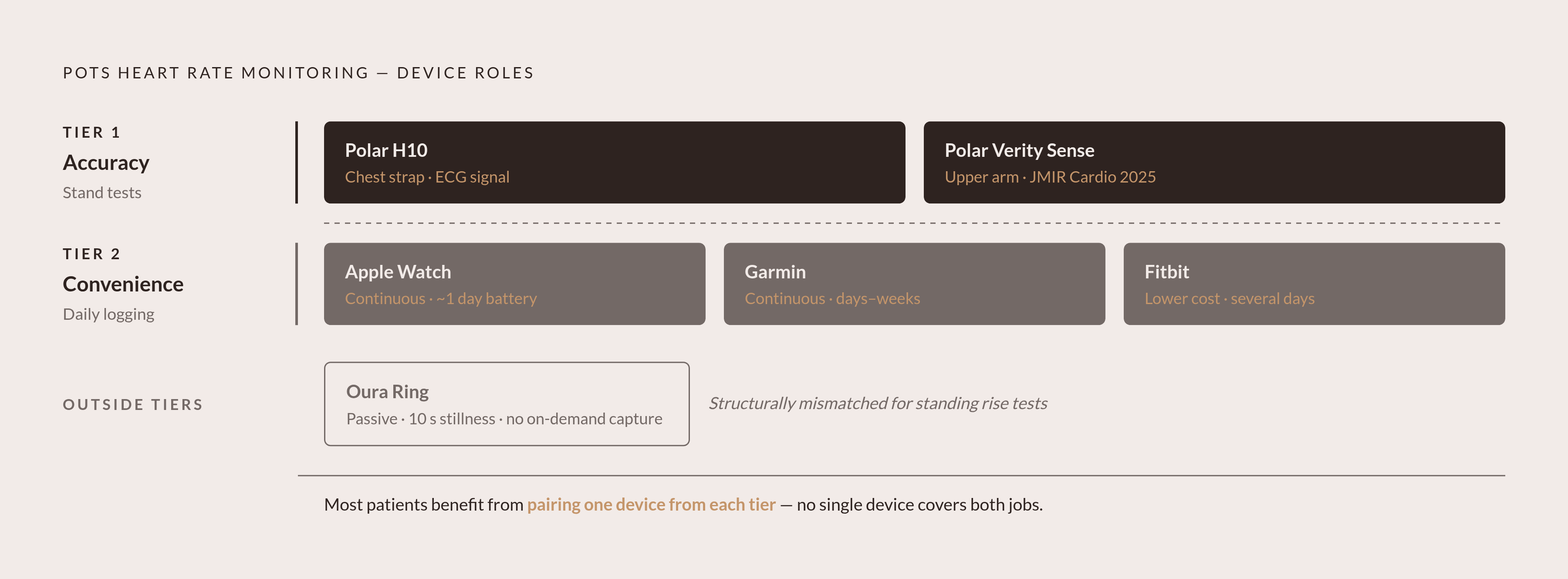
The simplest framework separates accuracy from convenience. Chest-strap ECG devices measure heart rate from the heart’s electrical signal, the same signal that a clinical monitor reads. Optical devices, also called PPG devices, use light to detect changes in blood flow and estimate heart rate from them. A wrist or arm sensor is convenient for ongoing tracking, but its accuracy varies with movement, wearing position, and skin tone.
For deliberate stand tests, the accuracy tier is a chest strap or a well-performing upper-arm optical sensor. For everyday activity, a smartwatch that keeps a running heart rate log is the easy-to-wear tier. Upper-arm optical devices offer a middle path because wearing position can substantially improve optical accuracy compared with the wrist. Sensor placement belongs in the decision, together with the method used to measure heart rate.
Most POTS patients benefit from using the tiers for different jobs. A chest strap is worn only for a session, so combining it with daily watch tracking is less burdensome than it sounds. The practical approach is to reserve the more precise device for measurements that need to be defensible. The watch then supplies the wider picture of ordinary activity. This is not a case for buying the most expensive wearable, but for matching each tool to the evidence needed.
How the main devices compare on the one measurement that matters for POTS
The Polar H10 is the strongest choice here for a rigorous stand-test record. Its chest strap reads the heart’s electrical signal, producing numbers close to what a clinical monitor reads. It has no screen and does not provide all-day passive tracking, so it is used deliberately with a heart-rate app. No subscription is required.
The Polar Verity Sense uses upper-arm optical sensing and is more comfortable to wear than a chest strap. A 2025 JMIR Cardio validation study found it highly accurate and reliable across activities. The same study found only moderate accuracy for the wrist-worn Polar Vantage V2, with considerable variation by activity type. For planned tests, the Verity Sense is a sound choice between the electrical readings of a chest strap and the ease of wearing a watch.
The Apple Watch tracks heart rate continuously and gives a live reading through the Heart Rate app, so a lying-to-standing check is easy to run at home. The Health app keeps a timestamped timeline that can be shared at appointments. Wrist-based readings are useful for documenting the rise in daily life, but do not reach chest-strap precision. Its regulator-cleared ECG feature checks for atrial fibrillation, and no smartwatch ECG detects POTS. Battery life is approximately one day, and no subscription is required.
Garmin watches suit patients who want dependable continuous heart rate logs with fewer charging gaps. Their battery life lasts days to weeks depending on the model, and no subscription is required. The workflow for a deliberate standing test is less polished than Apple’s, but the raw continuous log is dependable. Fitbit is a lower-cost way to start tracking heart rate throughout the day. It is less suited than Apple or Garmin to deliberate standing-test workflows, while offering core features without a subscription and battery life of several days depending on the model.
The Oura Ring serves a different purpose, with passive overnight measurements of sleep stages, resting heart rate, and HRV trends. Oura’s official support page says Live Heart Rate needs 10 seconds of relative stillness and is unavailable if it detects too much movement. That makes it unreliable for an on-demand reading at the moment of standing, a structural mismatch for this task. It can add sleep and resting-heart-rate context, but should not be the primary tool for documenting the standing rise. It requires a membership subscription, and its battery lasts approximately one week.
Across optical devices, movement and skin tone remain important accuracy caveats. Limitations for darker skin tones are a documented equity concern across brands. A convenient reading is not automatically a precise one simply because it appears as an exact number. The useful comparison is therefore between each device’s performance and the job being asked of it. Overnight context, daily logging, and deliberate stand tests are related tasks, but they are not substitutes for one another.
Why reading wearable heart rate data correctly matters as much as choosing the right device
Even an accurate heart rate reading can mislead if it is interpreted as exercise when it reflects posture. A person with POTS may have a low resting heart rate, then spike simply by standing to walk to the bathroom. A fitness pacing algorithm may classify that rise as moderate exercise. Applying a standard exercise ceiling without accounting for these orthostatic spikes could, in effect, prohibit standing at all and contribute to severe deconditioning.
Positional pacing helps by separating rises triggered by posture from those caused by effort. If standing is the trigger, changing position may make a task more manageable than treating it as an exercise problem. Examples include using a shower chair, preparing meals seated, or performing tasks horizontally. With tools such as Juno, patients can log standing together with time of day, activity, hydration, the previous night’s sleep, and medication timing, so the reading becomes part of a structured account.
A 2025 study of people with POTS who completed an active stand and a tilt-table test on the same day found that a meaningful proportion met the heart rate criterion on the tilt table but not during the active stand at the standard threshold. The gap narrowed when the threshold was slightly lowered. That finding limits what a negative home standing test can mean: a result without a 30 bpm rise does not rule POTS out and is a reason to discuss the result with a clinician.
Using wearable heart rate data for pacing, not just recording
Spoon theory gives many people with chronic illness a way to think about limited daily energy. Wearable heart rate data can make that spoon counting more objective by showing how the body responds during ordinary tasks. Continuous tracking lets patients notice when an activity is pushing heart rate toward a pacing threshold and adjust before symptoms escalate. The earlier distinction between posture and effort still applies, so changing position may allow activity to continue. Non-pharmacological pacing is a recognized strategy for reducing symptom fluctuations in POTS, and monitoring makes it more practical.
A 2025 study in Stud Health Technol Inform found that people testing a wearable app to help manage POTS valued its real-time heart rate monitoring and symptom tracking. They said it took less mental effort to manage their condition and they felt more confident doing so. They also identified navigation and alert management as areas needing improvement. For a condition that can involve significant brain fog, the mental work required to use a tool matters. A tracker that demands constant interpretation can add to the burden it is meant to reduce.
Alert customization is therefore part of useful pacing. A standard high-heart-rate alert calibrated for a healthy adult may repeatedly flag ordinary standing in someone with POTS. Repeated alerts without positional context offer little help in deciding what to change. Useful monitoring connects the warning to the activity, posture, and symptoms around it.
How do you build a wearable record that actually helps at appointments?
A timestamped record showing a 45 bpm standing rise at 8:14 am gives a clinician something specific to assess. The most useful POTS record pairs heart rate at rest and on standing with the time, activity, and symptoms experienced. Rises that happen again and again in the morning or after sitting tell more than a single high reading.
Annotated screenshots from Apple Health or Garmin Connect can serve this purpose. Standalone chest-strap sessions recorded in a log can be cleaner because they contain less unrelated activity noise. For patients tracking several chronic conditions, the same record also needs room for symptoms, medication routines, and energy limits rather than separating every diagnosis into its own account. That supports symptom pattern recognition across comorbid conditions without treating a heart rate spike as proof of which condition caused it.
Juno connects wearable and health data, including inputs from Apple Health, Oura, and Garmin, with symptom tracking by text or voice, medication routines, and spoon-based energy pacing. It generates a doctor-ready summary before appointments, offering an integration option beyond annotated screenshots or a standalone session log. Its role is to organize the standing-rise pattern and its relationship to daily functioning. The Vanderbilt study found that patients used smartwatches to speak up for their own needs before they had a diagnosis. Choosing the right device, reading its data correctly, pacing with it, and presenting an organized record are all parts of that advocacy, turning a wearable from a number display into a tool for a more specific clinical conversation.
Sources
- JMIR Cardio - Wrist-Worn and Arm-Worn Wearables for Monitoring Heart Rate During Sedentary and Light-to-Vigorous Physical Activities: Device Validation Study
- Feasibility Assessment of a Wearable App to Manage Symptoms of Postural Orthostatic Tachycardia Syndrome Using Real-Time Heart Rate Monitoring - PubMed
- A Wearable Solution for Managing POTS: Patient Perspectives on Real-Time Heart Rate Monitoring and Activity Pacing - PubMed
- Juno: Chronic Illness Support App | Pacing & Symptoms